
Housing pipelines treat household_id as a required key. How should nullability be enforced?
Select an answer to reveal the explanation.
Short Explanation
household_id is the house number on the form—if too many are blank, fail the batch instead of building metrics on ghosts.
Full Explanation
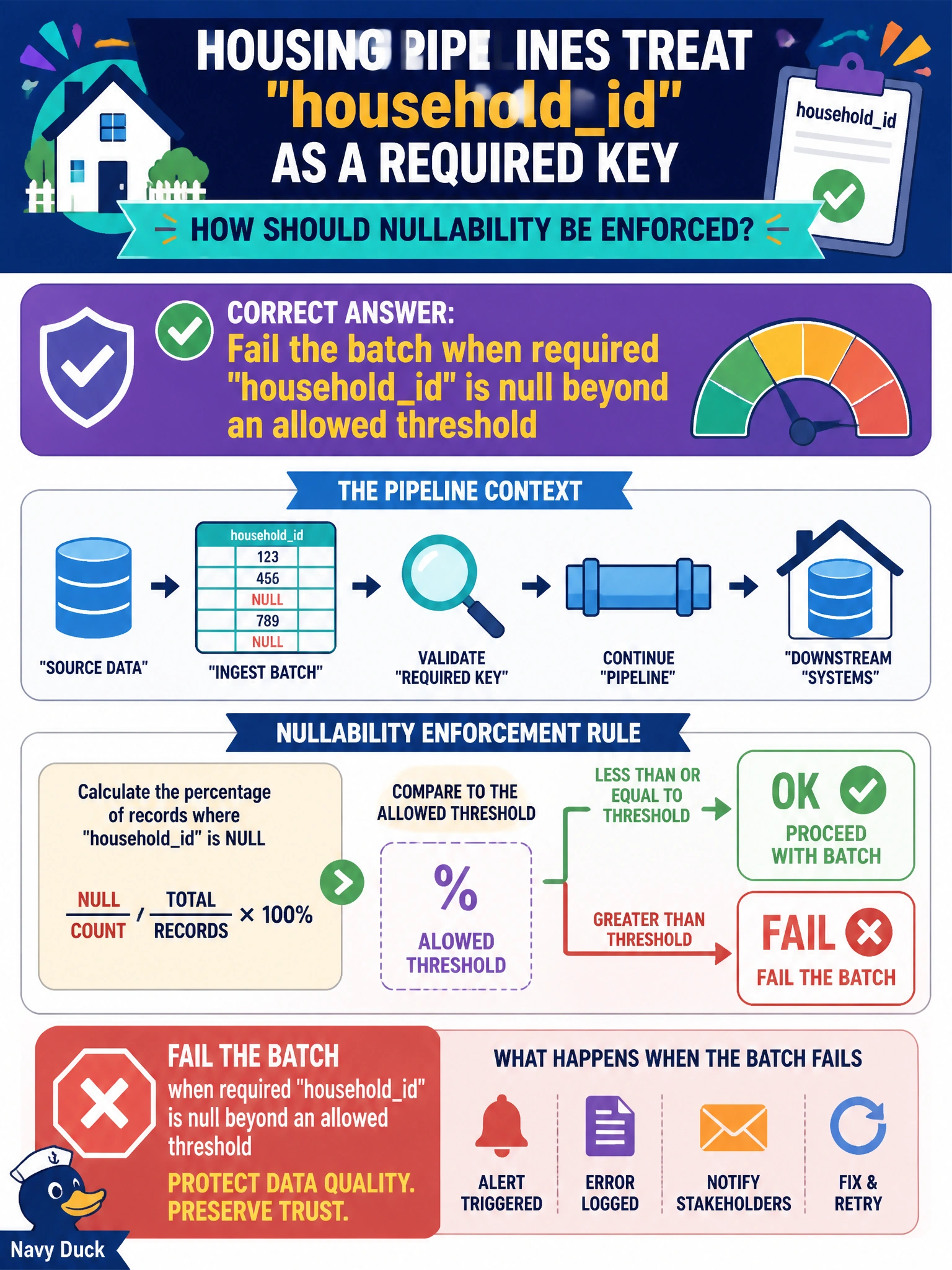
Housing pipelines that treat household_id as a required key must enforce nullability with a threshold: fail (or hard-quarantine) the batch when null household_id rates exceed the allowed limit. Required keys underpin grain, joins, and gold household metrics; unlimited nulls produce ghost households and broken linkage to members and addresses. Failing closed on required-key nulls protects civic housing analytics from silently corrupt identity.
Allowing unlimited null household_id values in gold household metrics fails by concept: metrics aggregate incomplete identities. Replacing null household_id with the string "unknown" and skipping validation hides the defect and collapses many households into one fake key. Disabling all null checks because extracts are "always perfect" removes the safety net municipal feeds routinely need.
Exam caveat: Nullability rules differ for required keys versus optional attributes. Threshold-based fail is common when a small null rate is tolerable for quarantine but large rates indicate broken extracts. "Unknown" substitution without controls is not validation.
Operational check: Submit a housing batch with null household_id above the threshold and confirm the job fails or quarantines per policy. Submit a clean batch and confirm gold metrics build. Prove "unknown" substitution is not used as a bypass, and alert owners when null rates trend upward.
Prefer to study offline? Printable PDF study book + test engine ($7.50, unofficial). These questions stay free here.