
Courts must publish a public calendar without sealed case IDs. Which set approach is correct?
Select an answer to reveal the explanation.
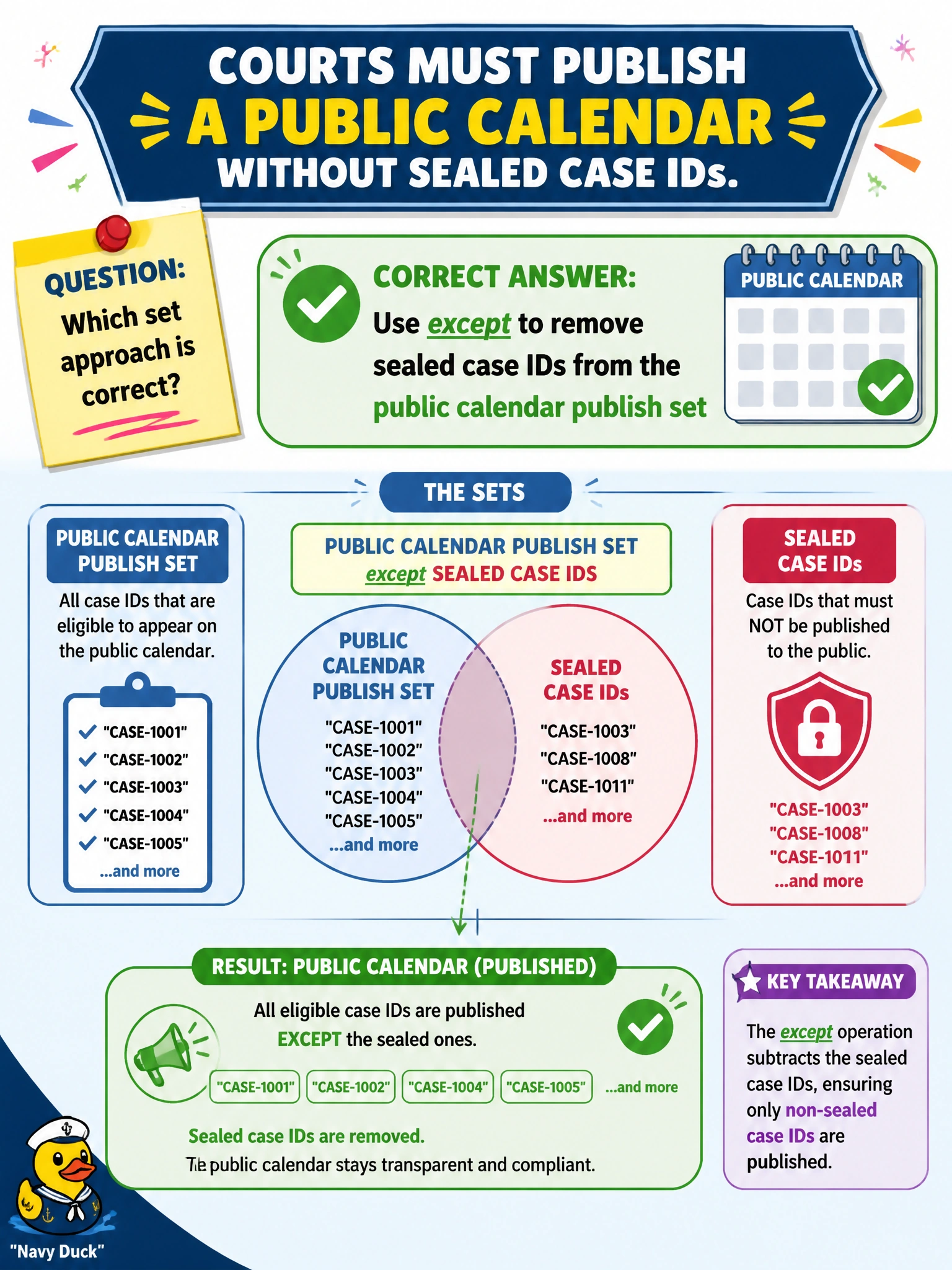
Short Explanation
Except is the blackout marker here—you subtract the sealed case IDs from the calendar feed so residents never see what's supposed to stay sealed. If you try union to merge sealed IDs in, union by name to combine daily IDs, or intersect to retain sealed IDs, you'll still leak sealed IDs because those operations add or overlap and can't subtract.
Full Explanation
Courts publishing a public calendar must remove sealed case IDs from the publish set. EXCEPT (or an anti-join) subtracts sealed matters from the allowable calendar rows so residents see only what policy permits. That set difference is the correct privacy control when the public extract is "all calendared cases minus sealed."
Using union by name to combine daily case IDs into the public calendar publish set fails by concept: it still combines sets without subtracting sealed cases, so BY NAME only matches columns and protected IDs can still leak into the public calendar. Using intersect to retain sealed case IDs for the public calendar publish set inverts the requirement: it keeps only overlap between the publish set and sealed matters, publishing exactly the protected cases that must be withheld instead of subtracting sealed matters from the public extract. Using union to merge sealed case IDs into the public calendar publish set widens the set at the expense of confidentiality—it adds sealed records to the public extract instead of sealing out protected cases from the public calendar.
Exam caveat: EXCEPT/anti-join implements exclusion lists for open-data and public court calendars. INTERSECT is for overlap; UNION widens the set. Privacy-by-set-operation questions hinge on subtracting the restricted cohort.
Operational check: Maintain a sealed_case_id list, EXCEPT it from the calendar publish query, and verify sealed IDs never appear in the portal file. Spot-check that ordinary public cases still publish. Attempt an intersect-to-retain-sealed path in a dry run and confirm it is rejected by release checklist.
Prefer to study offline? Printable PDF study book + test engine ($7.50, unofficial). These questions stay free here.