
City hydrant inspections need an ongoing production ingest, not a one-time backfill. Which tool choice fits best?
Select an answer to reveal the explanation.
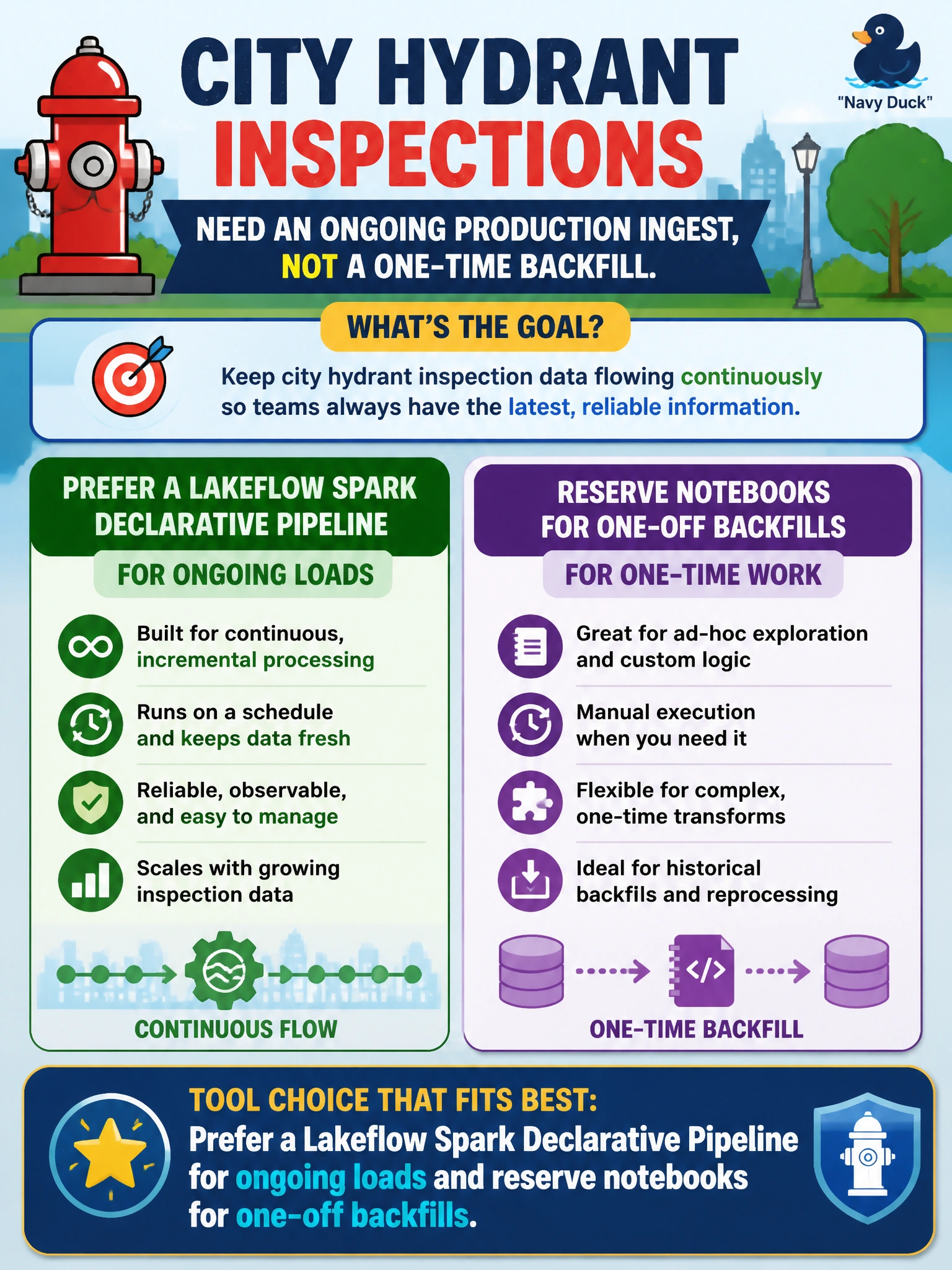
Short Explanation
One-off notebooks are great for a hydrant backfill Saturday, but ongoing inspection loads want a real declarative pipeline, not an interactive notebook cluster running Auto Loader for file arrival detection. A nightly workflow reusing backfill notebook logic or a Lakehouse Federation query won't give you the scheduled, governed, recoverable ingest the city needs.
Full Explanation
City hydrant inspections that require ongoing production ingest belong in a Lakeflow Spark Declarative Pipeline (or equivalent sustained pipeline), not on an interactive notebook cluster using Auto Loader for file arrival detection. Declarative pipelines give scheduled, recoverable, monitored loads with defined expectations and tables—the right operational posture for continuous municipal inspection data. Notebooks remain appropriate for one-off historical backfills, exploration, and remediation, then hand off to the production pipeline for daily or continuous runs. Hosting ongoing hydrant ingest on an interactive notebook cluster using Auto Loader is not a production ingest pattern; it ties continuous municipal data to an interactive session, lacks durable scheduling and ownership, and breaks when the cluster or user is unavailable. Orchestrating hydrant loads with a scheduled Databricks Workflow reusing backfill notebook logic on a nightly schedule treats continuous ingest as a batch afterthought and lacks the declarative, monitored pipeline the question requires. Serving hydrant inspections through Lakehouse Federation queries against the operational store does not ingest or persist inspection data; it leaves the ongoing hydrant feed without a governed lakehouse destination and cannot provide recoverable production ingest.
Exam caveat: DP-750-style items often contrast exploratory notebooks with production Lakeflow / declarative pipelines. Notebooks are not wrong—they are the wrong primary tool for continuous civic loads. Prefer pipelines for recurring ingest and notebooks for finite backfill or debug work.
Operational check: Confirm the hydrant inspection source is wired to a declarative pipeline with a schedule and destination silver/gold tables. Run a controlled one-off notebook backfill for a historical year, then prove subsequent days flow only through the pipeline. Verify pipeline run history, failure alerts, and row counts match inspection system extracts.
Prefer to study offline? Printable PDF study book + test engine ($7.50, unofficial). These questions stay free here.