
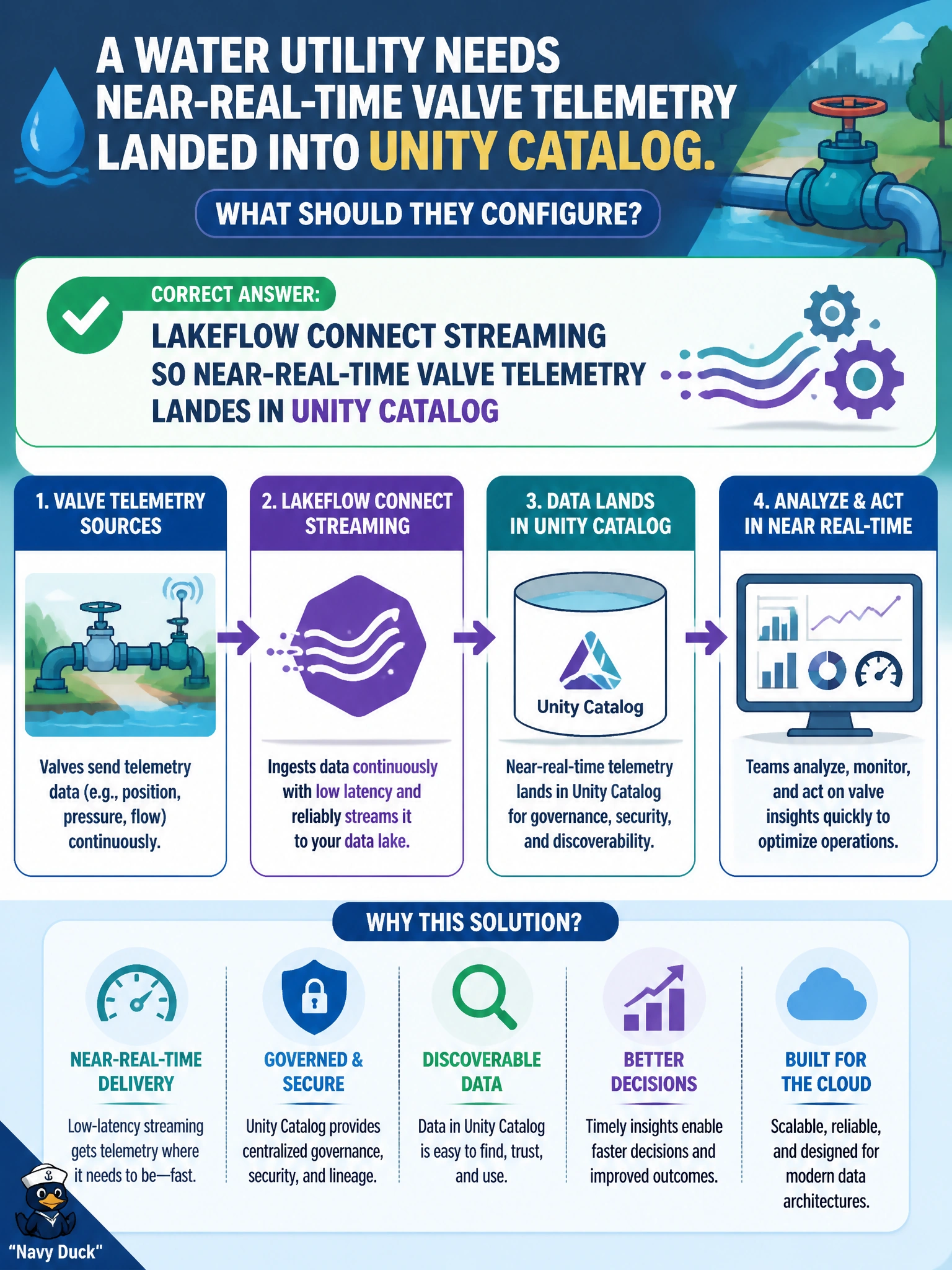
A water utility needs near-real-time valve telemetry landed into Unity Catalog. What should they configure?
Select an answer to reveal the explanation.
Short Explanation
Streaming Lakeflow Connect is the live valve gauge feed into Unity Catalog—you'll get near-real-time readings as they land under governance. Lakehouse Federation only queries data where it sits, Auto Loader handles files and can't consume Kafka, and Delta Sharing shares data out, so none of them land your telemetry.
Full Explanation
A water utility that needs near-real-time valve telemetry in Unity Catalog should configure Lakeflow Connect in streaming mode so readings land continuously under UC governance. Streaming Connect matches operational telemetry freshness for valve state, pressure, or similar SCADA-adjacent feeds that cannot wait for annual dumps. Near-real-time civic water operations depend on that continuous path into governed tables that ops and analytics can share.
Lakehouse Federation streaming does not land data into Unity Catalog tables because Lakehouse Federation is for querying external sources in place, not for continuous ingestion, so there would be no governed landing path for valve telemetry. Auto Loader streaming from Kafka misapplies Auto Loader, which is built for incremental ingestion of files from cloud storage, not for consuming Kafka topics, so it would not connect to the live telemetry feed. Delta Sharing streaming is for securely sharing existing Delta data with external recipients, not for ingesting operational feeds into Unity Catalog, so valve readings would never land for ops and analytics to use.
Exam caveat: streaming Lakeflow Connect is for continuous connector-style feeds into UC—still apply retention, quality checks, unit validation, and access controls appropriate to utility telemetry and critical infrastructure data. Operational check: enable Lakeflow Connect streaming for the valve telemetry source into Unity Catalog, confirm rows arrive with acceptable latency, validate schema and engineering units, set retention and quality expectations, and point ops dashboards at the UC tables rather than weekly spreadsheets.
Prefer to study offline? Printable PDF study book + test engine ($7.50, unofficial). These questions stay free here.