
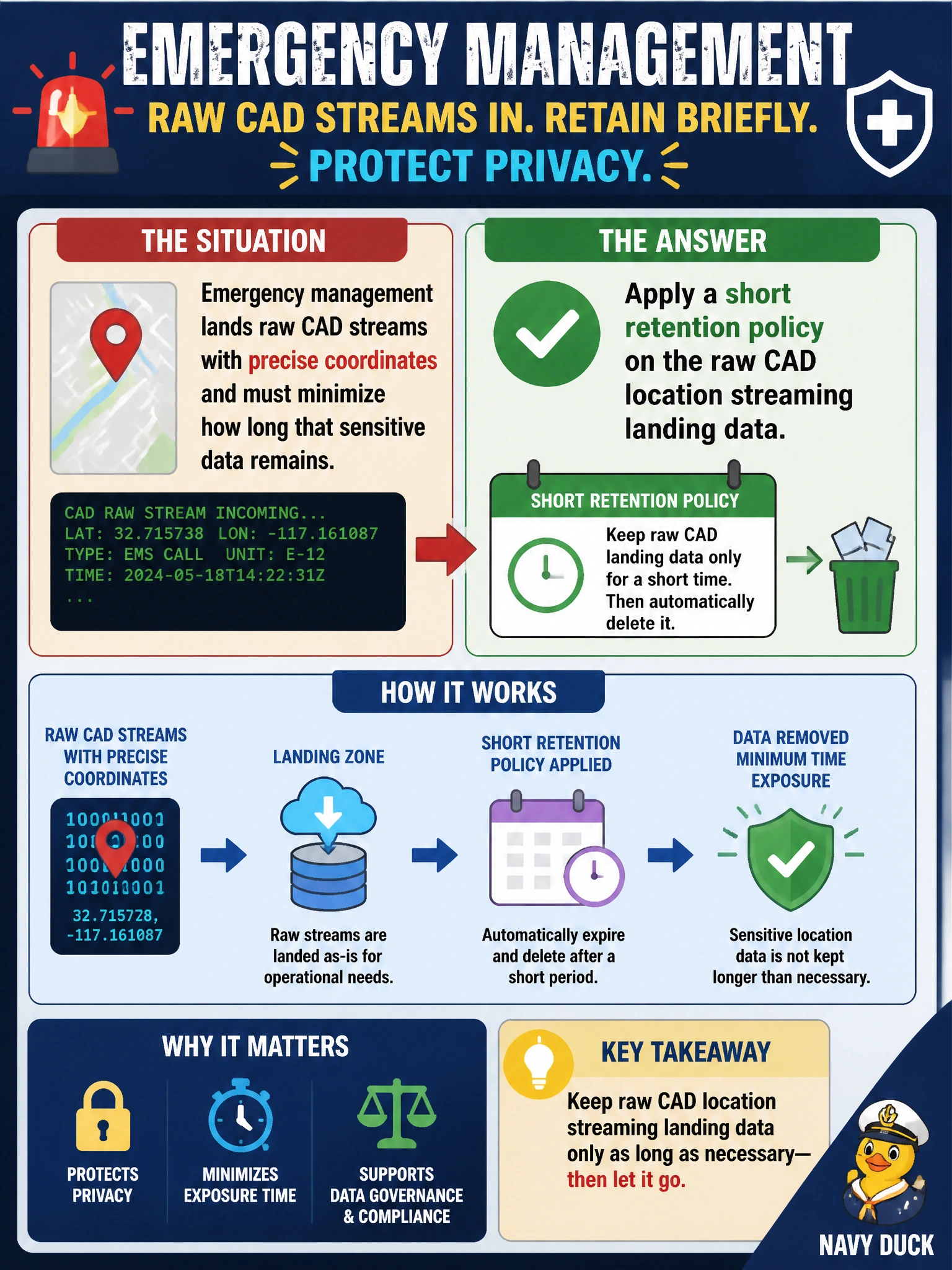
Emergency management lands raw CAD streams with precise coordinates and must minimize how long that sensitive data remains. What should they apply?
Select an answer to reveal the explanation.
Short Explanation
Short retention on raw CAD coordinates is like auto-shredding the sticky note with the exact pin drop once ops don't need it anymore. You still keep the history you need in aggregated or snapped locations—you just don't let the raw precise points pile up.
Full Explanation
A short retention policy on the raw CAD location streaming landing data is the correct control when emergency management must minimize how long precise coordinates remain. Raw computer-aided dispatch locations are highly sensitive civic telemetry; short retention limits the window of exposure after operational value for immediate response has passed, while derived, minimized products can live longer if needed.
A short retention policy on the curated CAD location streaming refined data applies to the downstream refined product, not the raw landing, so the precise coordinates in the landing stream are still retained and the minimization requirement for raw data is not met. A short refresh schedule on the raw CAD location streaming landing data only ingests new precise points more often but does not delete aged points, so it does not shorten how long the raw coordinates themselves are stored and does not satisfy the minimization requirement. A short retention policy on the raw CAD location streaming landing metadata only shortens how long descriptive metadata is kept while leaving the actual precise coordinate values stored, so it does not minimize how long the sensitive raw data itself remains.
Exam caveat: Short retention on raw landings pairs with longer retention on aggregated or snapped location products when after-action reporting needs history without raw precision. Retention is not access control—while raw CAD exists, privileges, masks, and audit still apply. Legal or investigative holds may require suspending deletion for specific incidents.
Operational check: Apply a short retention window to the raw CAD coordinate landing stream, verify aged precise points are removed automatically, confirm downstream minimized datasets used for after-action reports are designed deliberately rather than by keeping raw forever, and do not treat short retention on landing metadata as sufficient because it removes descriptions while leaving the precise points themselves stored.
Prefer to study offline? Printable PDF study book + test engine ($7.50, unofficial). These questions stay free here.