
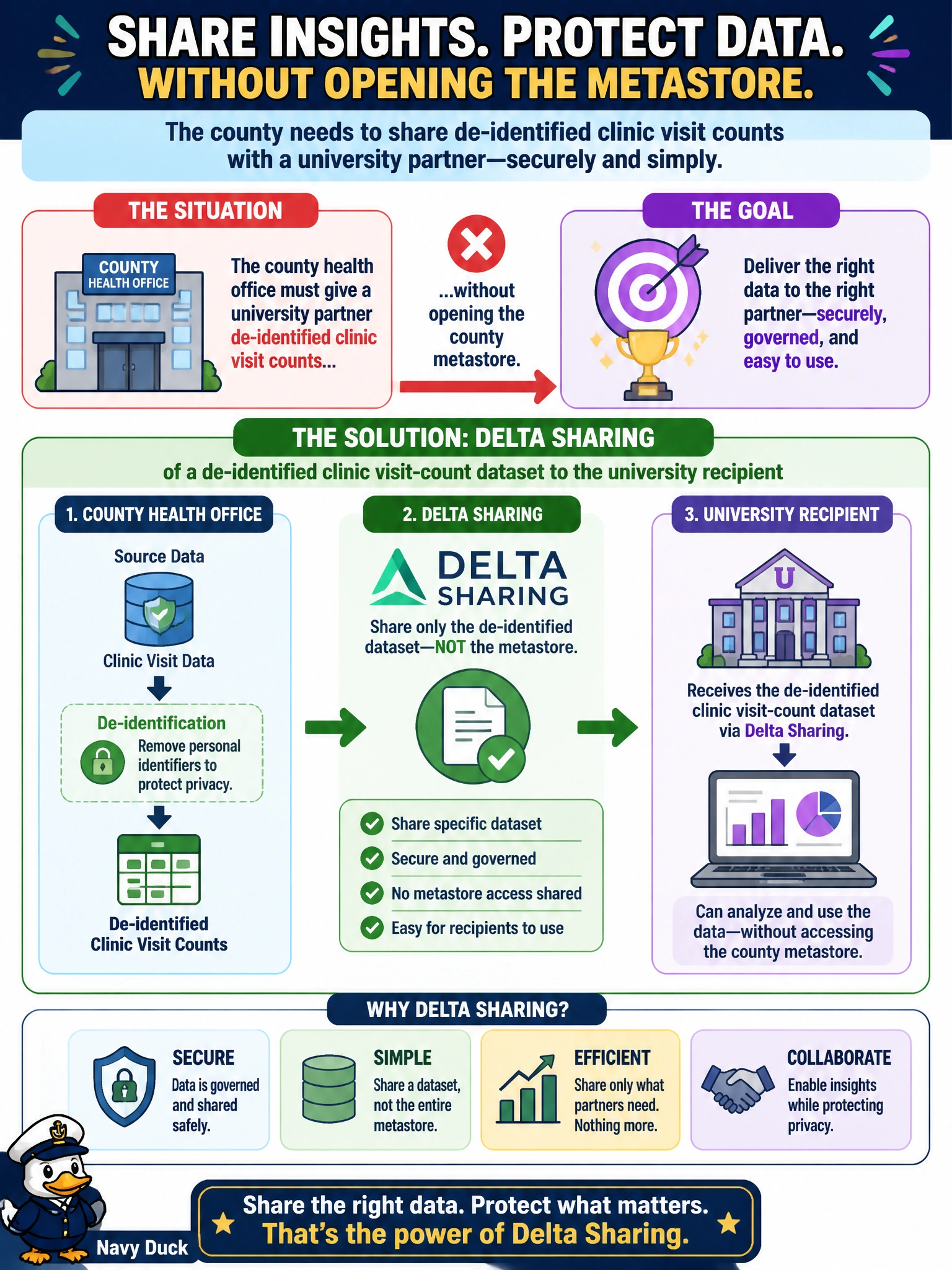
A county health office must give a university partner de-identified clinic visit counts without opening the county metastore. What should they implement?
Select an answer to reveal the explanation.
Short Explanation
You're sharing only de-identified visit counts as a consumable dataset through Delta Sharing, since a notebook alone doesn't deliver the counts. A Clean Rooms collaboration adds joint governance you don't need for a simple one-way delivery, and Lakehouse Federation leaves live access to your metastore open so it's not a bounded share. Revoke access when the agreement ends so the share stays explicit and revocable.
Full Explanation
Delta Sharing of a de-identified clinic visit-count dataset to the university recipient is the correct implementation when a county health office must give a partner de-identified counts without opening the county metastore. The share delivers a minimized civic data product to a named recipient while production PHI tables and metastore administration remain inside the county boundary. Delta Sharing of a de-identified clinic visit-count notebook to the university recipient fails by concept because it shares analysis code rather than a consumable counts dataset, so the partner does not receive queryable visit counts without separate data access. Clean Rooms collaboration on a de-identified clinic visit-count dataset with university team fails by concept because it establishes joint governed co-analysis rather than a simple one-way delivery of minimized counts, adding unnecessary complexity when no collaborative computation on sensitive data is required. Lakehouse Federation of de-identified clinic visit-count dataset to the university workspace fails by concept because it enables live federated queries against the county metastore rather than a bounded share, violating the requirement to keep the metastore closed to the partner. Exam caveat: De-identified aggregates via Delta Sharing are not the same as Delta Sharing of a de-identified clinic visit-count notebook to the university recipient, which delivers code rather than a consumable bounded dataset. Recipients should be explicit and revocable; a Clean Rooms collaboration on a de-identified clinic visit-count dataset with university team requires joint clean-room governance when a simple revocable one-way share to the university meets the requirement. De-identification quality still matters—counts with extreme sparsity may need additional suppression even when shared through Delta Sharing. Operational check: Publish only the de-identified visit-count dataset to a Delta Share, add the university as recipient, verify university users can consume the share without metastore admin, confirm identifiable charts are absent from the share, and revoke access when the research agreement ends.
Prefer to study offline? Printable PDF study book + test engine ($7.50, unofficial). These questions stay free here.