
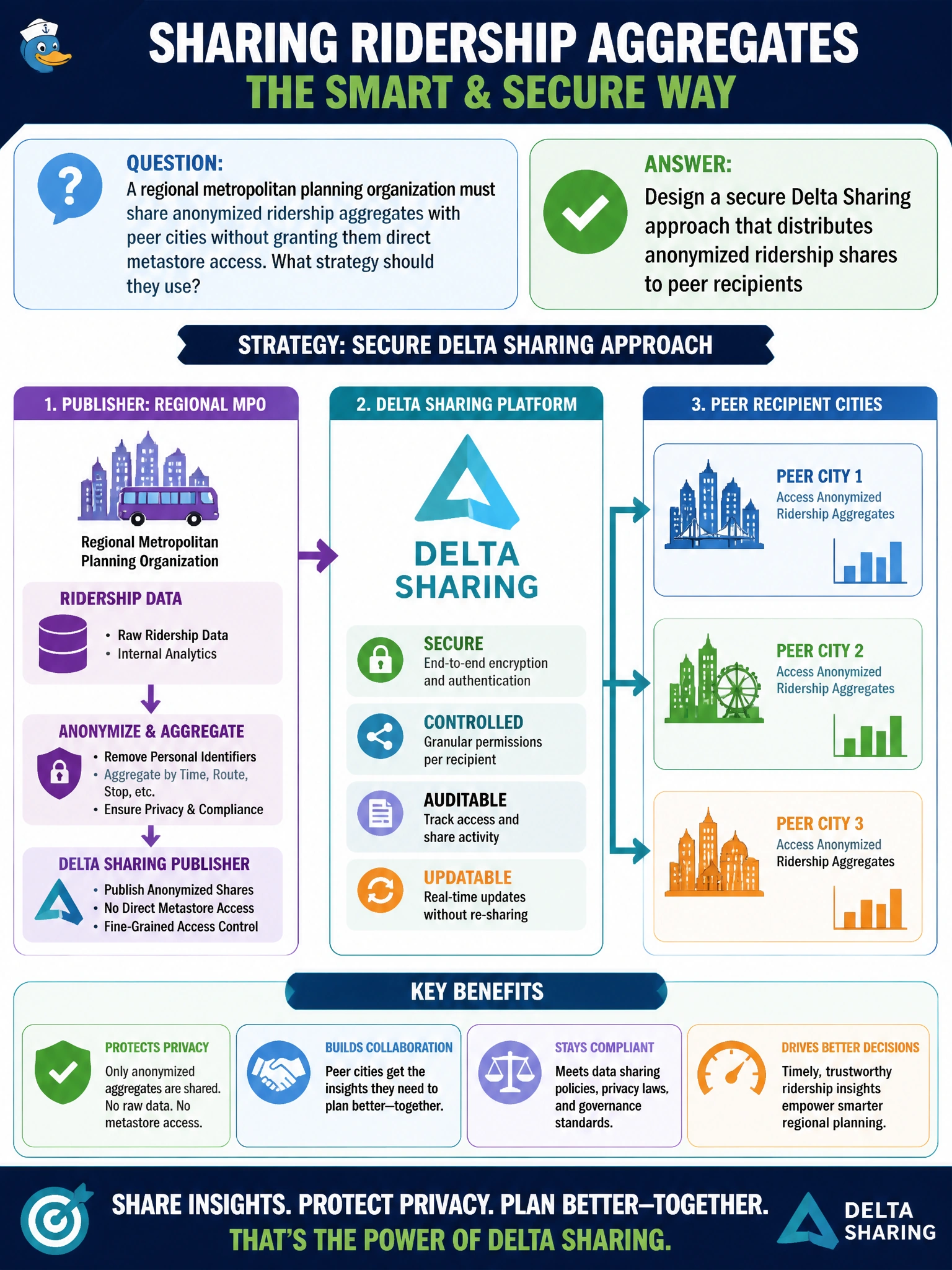
A regional metropolitan planning organization must share anonymized ridership aggregates with peer cities without granting them direct metastore access. What strategy should they use?
Select an answer to reveal the explanation.
Short Explanation
Delta Sharing is like a sealed inter-city courier pouch—peers get the anonymized ridership package without keys to your whole metastore building.
Full Explanation
Designing a secure Delta Sharing approach that distributes anonymized ridership aggregates to peer recipients is the correct strategy for a regional metropolitan planning organization that must share with peer cities without granting direct metastore access. Delta Sharing exposes selected data products to named recipients while the producer retains Unity Catalog governance; anonymized aggregates minimize re-identification risk compared with raw rider trails. Configuring a secure Unity Catalog foreign catalog that maps anonymized ridership aggregates for peer recipients fails because it federates external sources into the producer metastore and still requires direct metastore access to query instead of a controlled, recipient-limited share. Building secure Delta Live Tables pipelines that replicate anonymized ridership aggregates to peer recipients fails because it creates internal ETL copies that push unmanaged data into peer environments and sidesteps the governed share model. Establishing secure Databricks SQL warehouses serving anonymized ridership aggregates to peer recipients fails because it requires peers to log into the producer environment with direct access rather than using a revocable Delta Sharing share with named recipients. Exam caveat: Delta Sharing is not the same as granting USE/SELECT inside your metastore or adding external users as metastore admins. Shares should be least-privilege datasets—preferably anonymized aggregates—with explicit recipients and revocable access. Unsecured or recipient-less shares are a common wrong pattern when the stem emphasizes controlled peer exchange. Operational check: Create a share containing only anonymized ridership aggregates, add peer-city recipients, verify peers can read the share without metastore admin or workspace login to your environment, confirm raw GPS breadcrumbs are not included, and test revocation when a peer engagement ends.
Prefer to study offline? Printable PDF study book + test engine ($7.50, unofficial). These questions stay free here.