
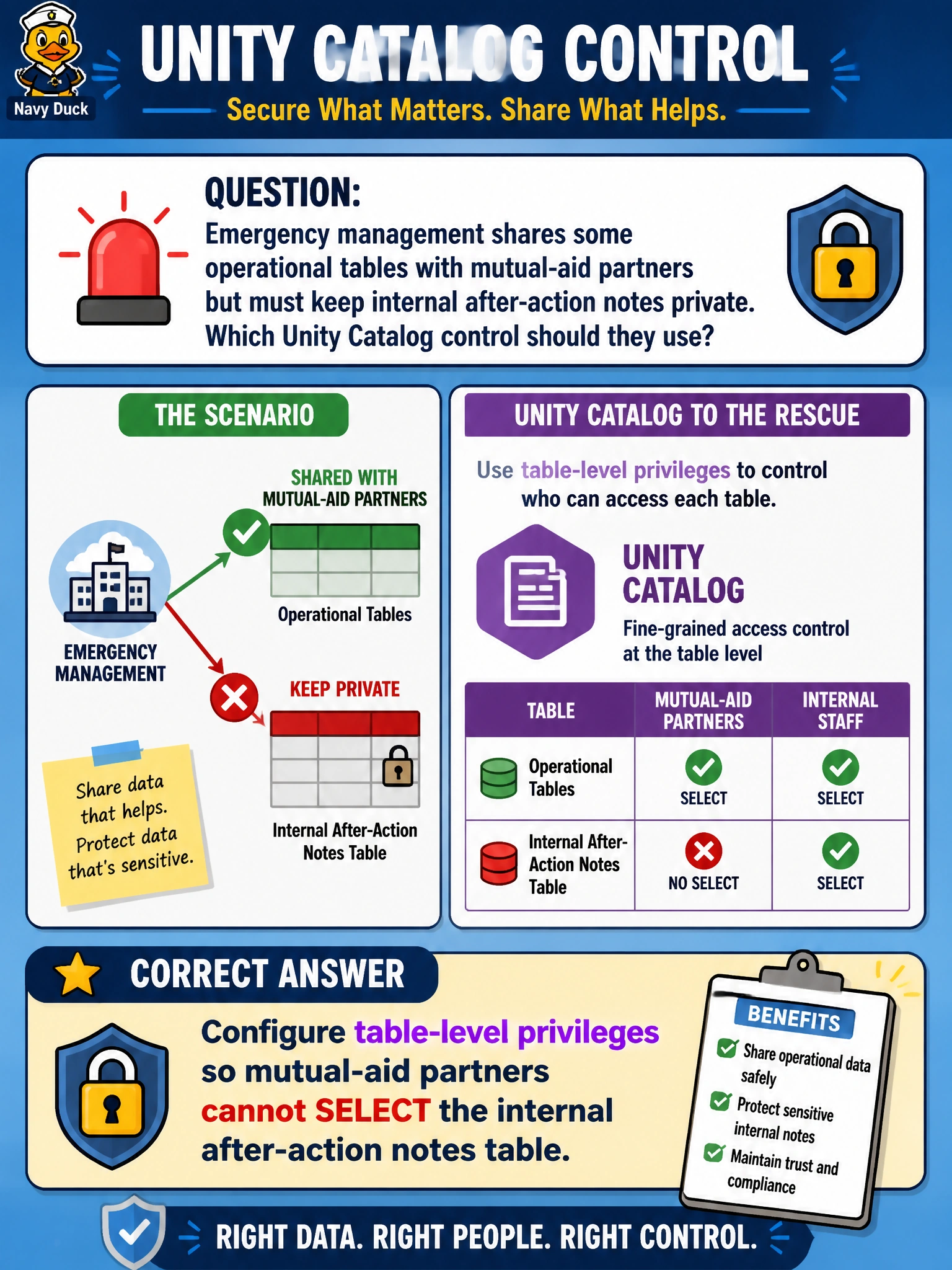
Emergency management shares some operational tables with mutual-aid partners but must keep internal after-action notes private. Which Unity Catalog control should they use?
Select an answer to reveal the explanation.
Short Explanation
Table-level access is the sealed envelope in the EOC filing cabinet—partners can get the shared ops tables, not the after-action notes. Defaulting every partner to SELECT on everything defeats the seal.
Full Explanation
Table-level privileges are the right control when emergency management shares some operational tables with mutual-aid partners but must keep internal after-action notes private. Grant partners SELECT only on the shared ops tables and omit (or explicitly deny via lack of grant) SELECT on the after-action notes table. That sealed-envelope model keeps partner tenants out of sensitive internal retrospectives while still enabling mutual-aid operational coordination.
Publishing after-action notes to a public external location with anonymous read discloses protected internal content. Granting SELECT on all emergency-management tables to every partner by default defeats selective sharing. Storing after-action notes in Slack instead of Unity Catalog removes centralized governance, retention control, and fine-grained table ACLs.
Exam caveat: table-level control is coarser than column/row policies—if one table mixes shareable and sensitive columns, split tables or add column masks. Partner identities should be groups/SPs with reviewed membership, not personal forwards. Operational check: list partner grants, ensure after-action notes has no partner SELECT, query as a partner SP to confirm ops tables work and notes fail, and include this check in the EOC sharing runbook.
Prefer to study offline? Printable PDF study book + test engine ($7.50, unofficial). These questions stay free here.