
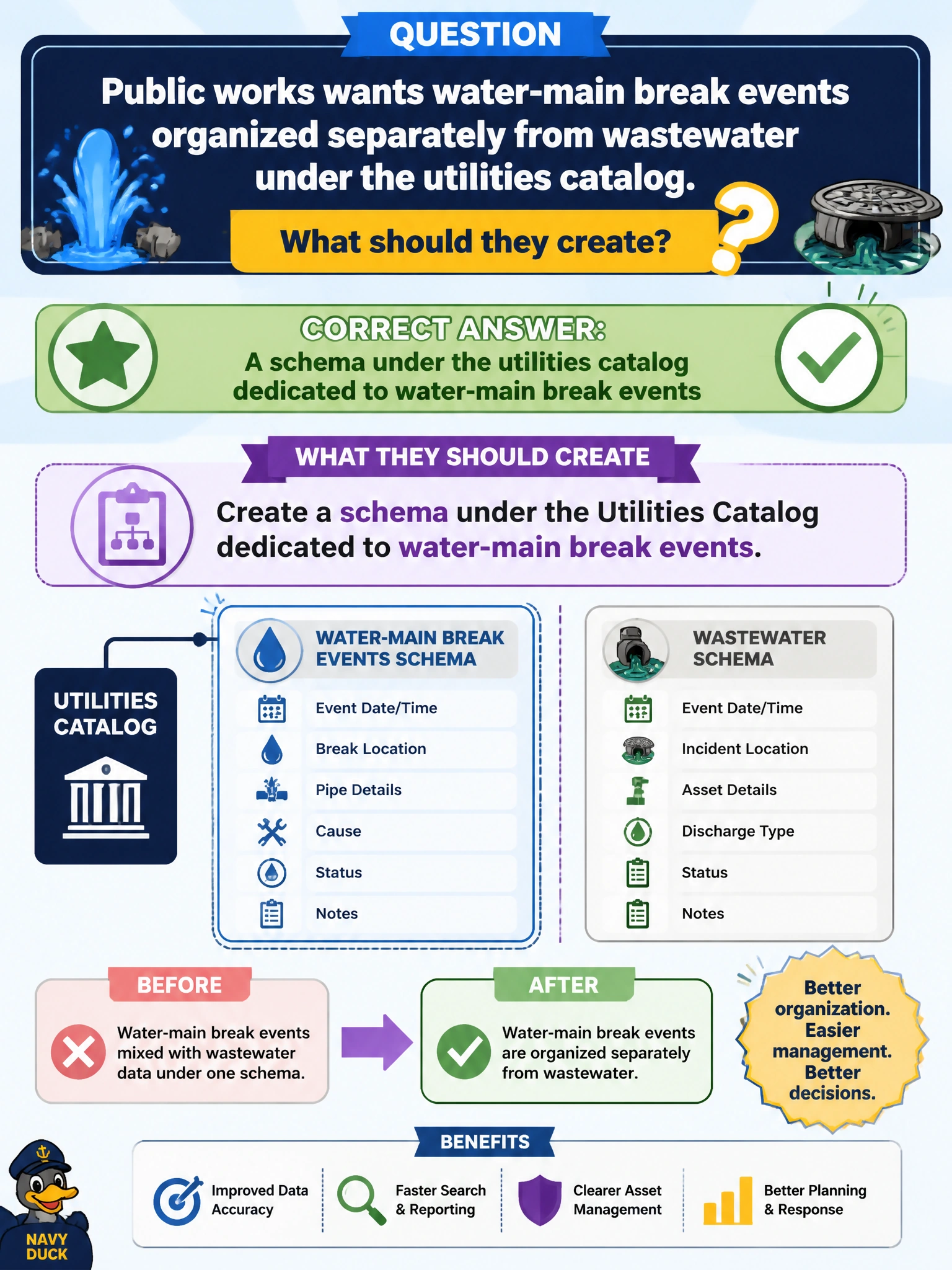
Public works wants water-main break events organized separately from wastewater under the utilities catalog. What should they create?
Select an answer to reveal the explanation.
Short Explanation
Schemas are the drawers inside the utilities catalog—one drawer for water-main breaks, another for wastewater—so the domains stay organized. A managed table isn't a drawer, it's just one table inside it, so you can't use it to separate whole domains. A volume won't help you either since it's for files, not tables.
Full Explanation
Public works wanting water-main break events organized separately from wastewater under the utilities catalog should create a schema under that catalog dedicated to water-main break events. Schemas partition domains within a catalog so related tables/views (breaks, valves, crews) stay grouped while wastewater objects live in a sibling schema—standard UC organization for municipal utilities data products.
A managed table under the utilities catalog dedicated to water-main break events is a single data object for storing rows, not a namespace container—it cannot partition water-main break events from wastewater or hold the related breaks, valves, and crews tables that require a dedicated sibling schema. Creating a Delta Sharing share under the utilities catalog for water-main break events confuses an external-sharing mechanism with an internal namespace container—shares expose data to external consumers, they do not organize tables for public works' own internal utilities catalog. A volume under the utilities catalog dedicated to water-main break events is not how Unity Catalog organizes domains—volumes store non-tabular files, not tables/views, and it does not create the sibling schema needed to separate break events from wastewater.
Exam caveat: catalog vs schema vs table vs volume—when the stem says “under the utilities catalog,” the next container is a schema. Do not create a managed table under utilities for departmental separation. Delta Sharing shares are for cross-org data share, not local organization.
Operational check: create utilities.water_main_breaks (naming per standards), place break-event tables there, keep wastewater in utilities.wastewater, and grant public-works roles at schema scope where appropriate.
Prefer to study offline? Printable PDF study book + test engine ($7.50, unofficial). These questions stay free here.