
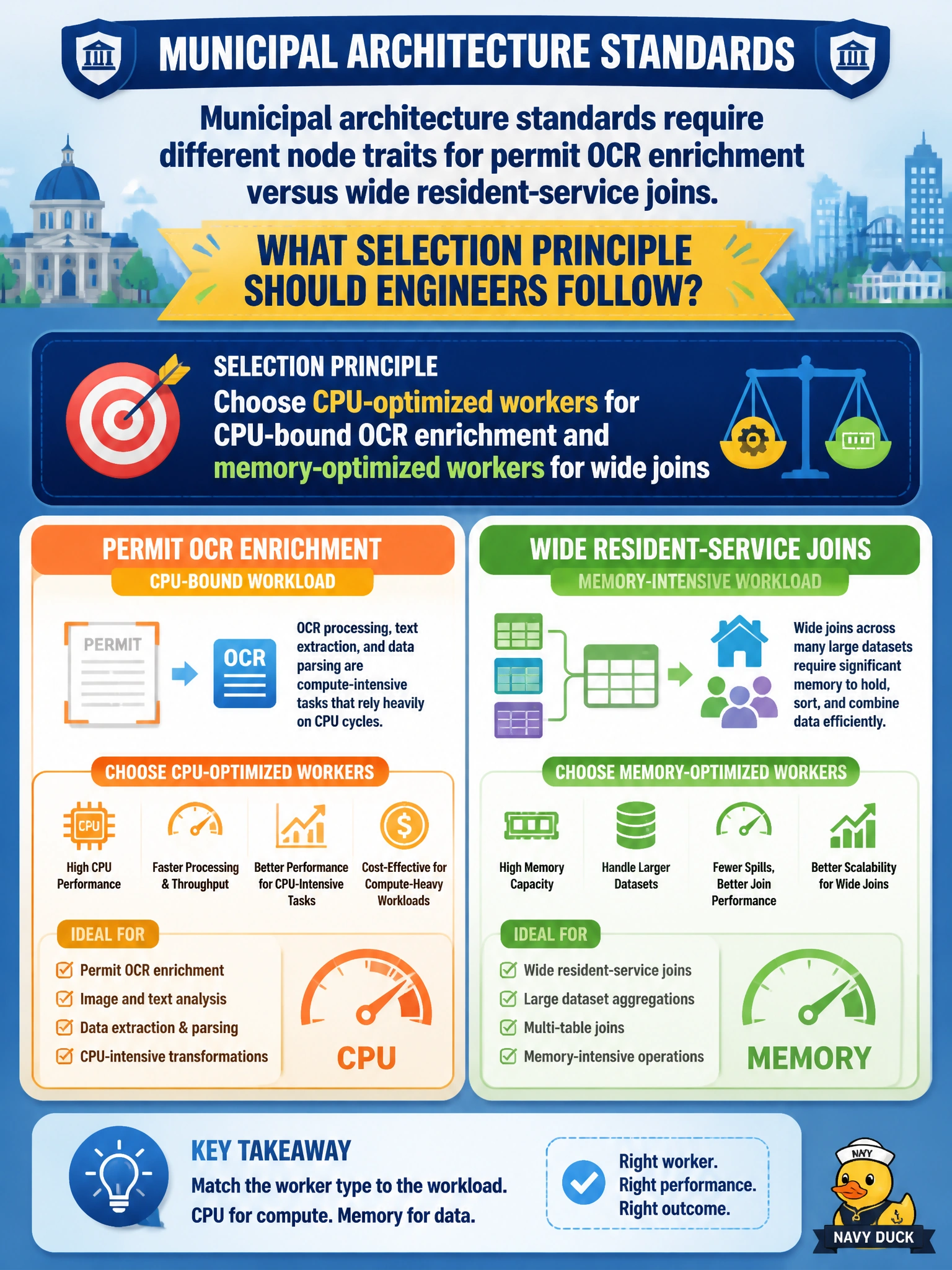
Municipal architecture standards require different node traits for permit OCR enrichment versus wide resident-service joins. What selection principle should engineers follow?
Select an answer to reveal the explanation.
Short Explanation
Match the truck to the job: CPU-heavy OCR enrichment wants CPU-optimized workers; fat wide joins want memory-optimized ones. Cheapest-everything or GPU-for-CSV is how civic jobs get slow and spendy for the wrong reasons.
Full Explanation
Municipal architecture standards that require different node traits for permit OCR enrichment versus wide resident-service joins should follow the principle of choosing CPU-optimized workers for CPU-bound OCR enrichment and memory-optimized workers for wide joins. OCR/PDF/image-style enrichment is typically CPU-intensive per task, while wide joins spill and shuffle memory-heavy intermediates—so node family selection should track the bottleneck, not a one-size municipal default.
Always picking the cheapest burstable node regardless of OCR or join profile optimizes sticker price over performance and often increases runtime cost through spills and timeouts. Using GPU ML nodes for every CSV parse including tiny lookup tables misapplies accelerators and inflates spend for workloads that do not need GPUs. Forcing single-executor clusters for both OCR and wide joins “to simplify billing” destroys parallelism required for civic batch scale and does not address CPU vs memory trait differences.
Exam caveat: map workload profile → node type (CPU vs memory vs GPU) before picking SKUs. GPUs appear often as distractors for non-ML SQL/ETL. Spot/cheap nodes can be valid for fault-tolerant batch, but not when the stem asks for trait-matching principles across OCR vs wide joins.
Operational check: profile permit OCR CPU utilization versus resident-service join spill metrics, assign separate job-cluster policies (CPU-optimized vs memory-optimized), and validate runtime and cost against mixed “cheapest node” baselines before standardizing architecture.
Prefer to study offline? Printable PDF study book + test engine ($7.50, unofficial). These questions stay free here.