
Housing authority data engineers need a workspace cluster that several developers can attach to while collaboratively building lease-enrichment notebooks. Which compute pattern should they choose?
Select an answer to reveal the explanation.
Short Explanation
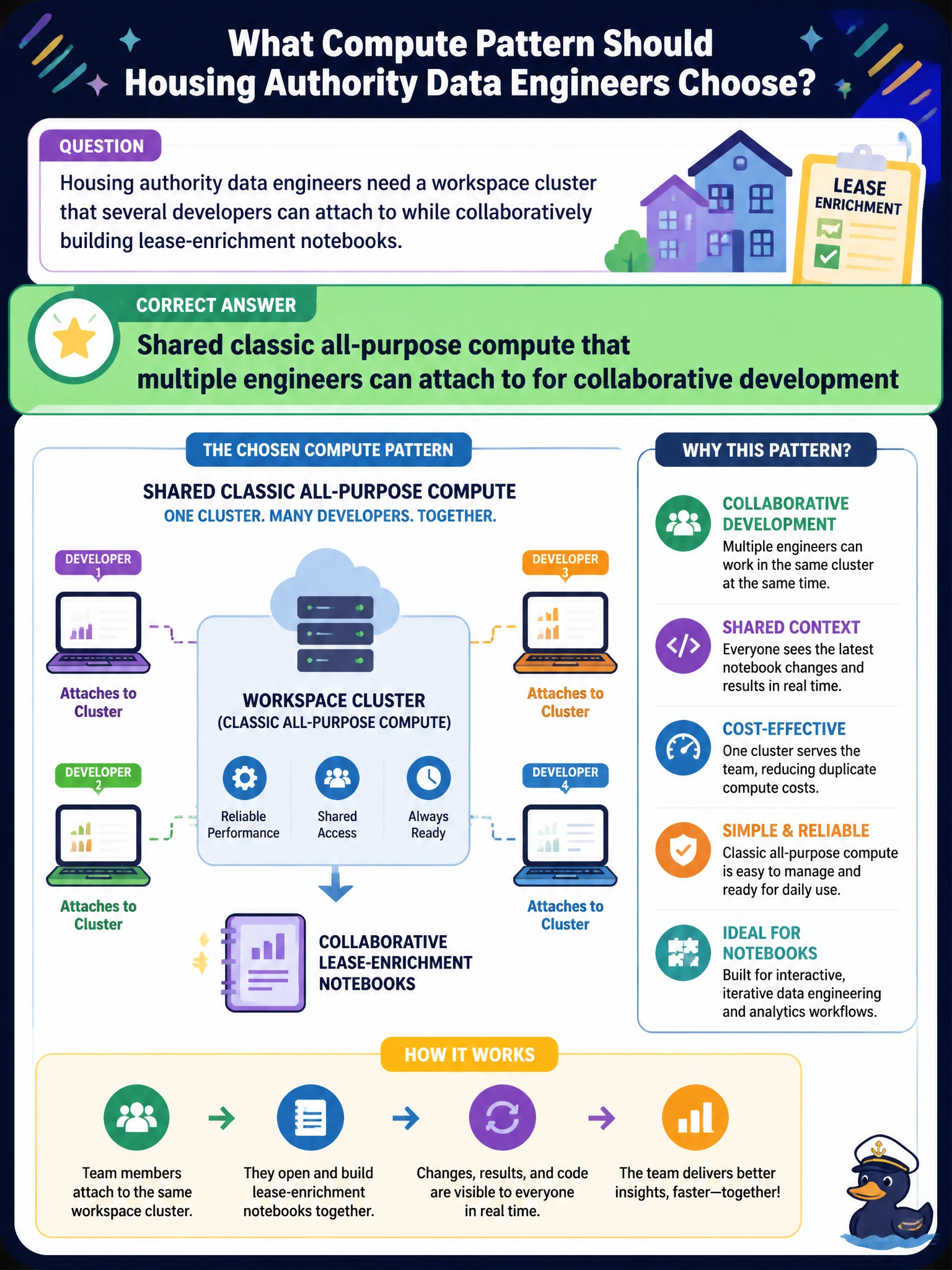
Shared classic compute is the team workshop bench—several housing engineers can clip onto the same cluster while they iterate on lease-enrichment notebooks. Job compute is the overnight factory line; warehouses are the SQL reading room. Collaboration needs that shared all-purpose pattern.
Full Explanation
Housing authority engineers collaboratively building lease-enrichment notebooks need a shared classic all-purpose compute cluster that multiple developers can attach to. All-purpose compute is the interactive development surface in Azure Databricks: several engineers can attach notebooks to the same cluster, iterate on transformations, and share libraries/runtime context while designing enrichment logic before promoting it to jobs. That matches civic team development—pair programming on lease joins, shared debugging, common package versions—without forcing every experiment through a non-interactive job run.
Job compute that rejects interactive notebook attachment is for scheduled production execution, not multi-developer collaborative authoring; using it as the only pattern blocks the interactive loop the stem describes. A SQL warehouse limited to SELECT statements supports BI SQL, not collaborative Python/Spark notebook enrichment of lease data. Serverless SQL only with Python enrichment libraries blocked workspace-wide removes the notebook/ML/Spark libraries housing engineers need for enrichment and again confuses SQL endpoints with development clusters.
Exam caveat: shared all-purpose clusters are correct for collaborative development, but production lease pipelines should still be promoted to job compute for isolation, rightsizing, and terminate-on-completion. Do not treat “shared cluster” as a license to run unrestricted production ETL on developer compute. Also distinguish personal compute (single-user) from shared all-purpose when the stem stresses several developers attaching together.
Operational check: create a policy-compliant shared all-purpose cluster for the housing enrichment team, set auto-termination for idle evenings, pin a Databricks runtime, install required libraries once at cluster scope, and schedule a separate job-compute pipeline once notebooks stabilize.
Prefer to study offline? Printable PDF study book + test engine ($7.50, unofficial). These questions stay free here.