
A digitisation team writes millions of rows of scanned-document metadata into a Fabric Lakehouse table using Spark, and the table is later queried heavily through both Power BI reports and the SQL analytics endpoint. Which optimization, applied automatically when the Spark job writes the table, is specifically intended to speed up exactly this kind of downstream read?
Select an answer to reveal the explanation.
Short Explanation
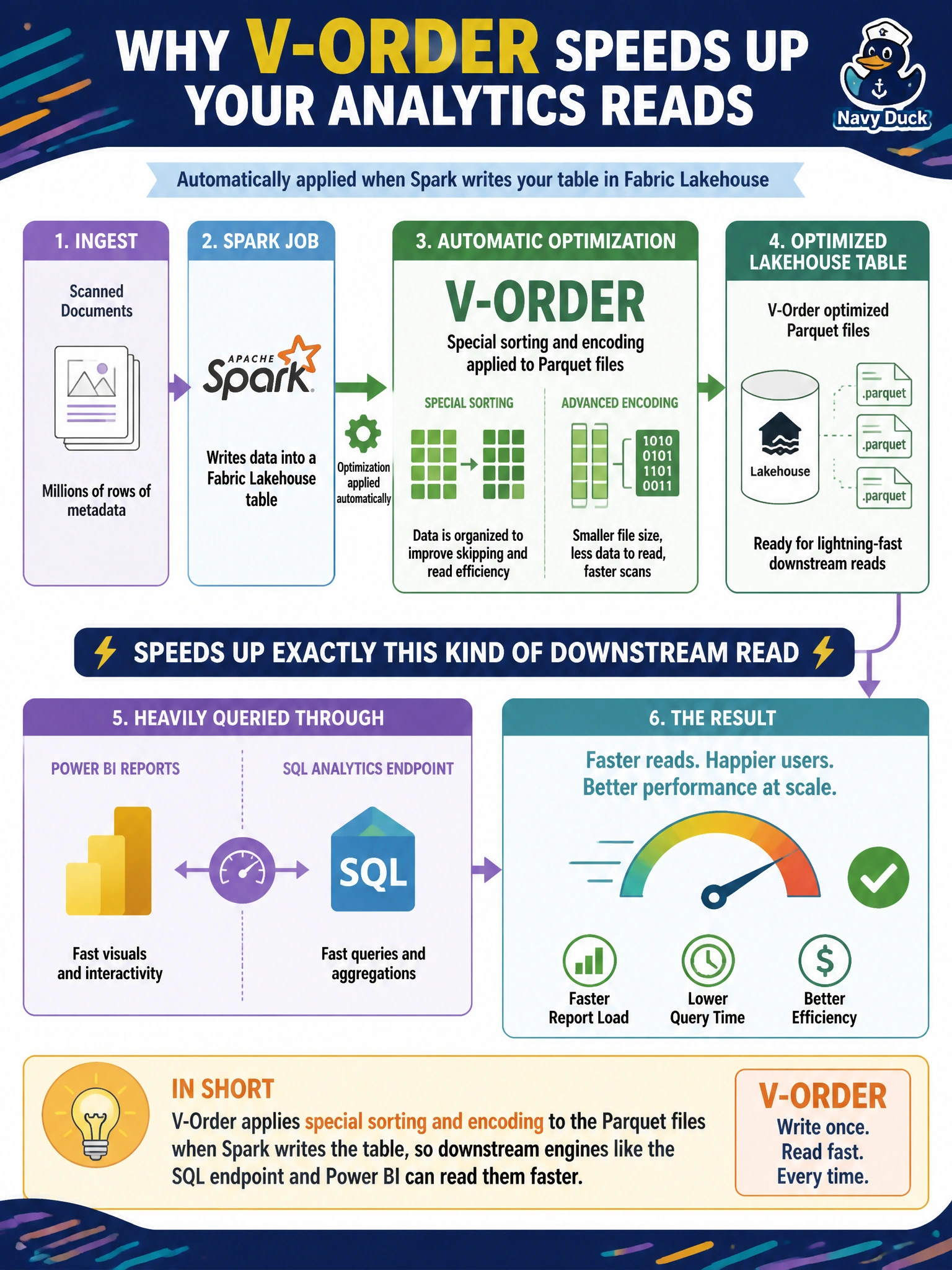
Picture V-Order as pre-sorting a card catalog before anyone even asks a question — the files are written in an order and encoding that later readers can skim through instead of scanning cover to cover. It's applied as data lands in the Lakehouse, and it specifically pays off for read-heavy engines like the SQL analytics endpoint and Power BI. You get faster downstream reads without touching your query code at all.
Full Explanation
V-Order is a write-time optimization applied to Parquet files in a Fabric Lakehouse: it sorts and specially encodes the data so that engines built for fast analytical reads — the SQL analytics endpoint, Power BI's Direct Lake mode, and Spark itself — can skip more work when scanning, filtering, and aggregating. Because it's applied when Spark writes the table, the benefit shows up automatically on every subsequent read, which is exactly the scenario described: heavy downstream querying from multiple engines. Dynamic data masking is a security control that obscures column values for unauthorized users; it changes what's visible, not how fast files are physically scanned, and masked queries aren't inherently cheaper to execute. A deployment pipeline is a lifecycle-management feature for promoting Fabric items between workspaces — it has nothing to do with file layout or read performance. Endorsement is a governance signal that tells report authors a table is trustworthy; it doesn't touch the underlying storage format at all. One caveat worth knowing: V-Order adds some overhead to the write itself, so extremely write-heavy, rarely-read tables may not see a net benefit. A concrete check: compare SQL analytics endpoint query duration on a table with V-Order enabled against one where it's been turned off for the same query pattern.