
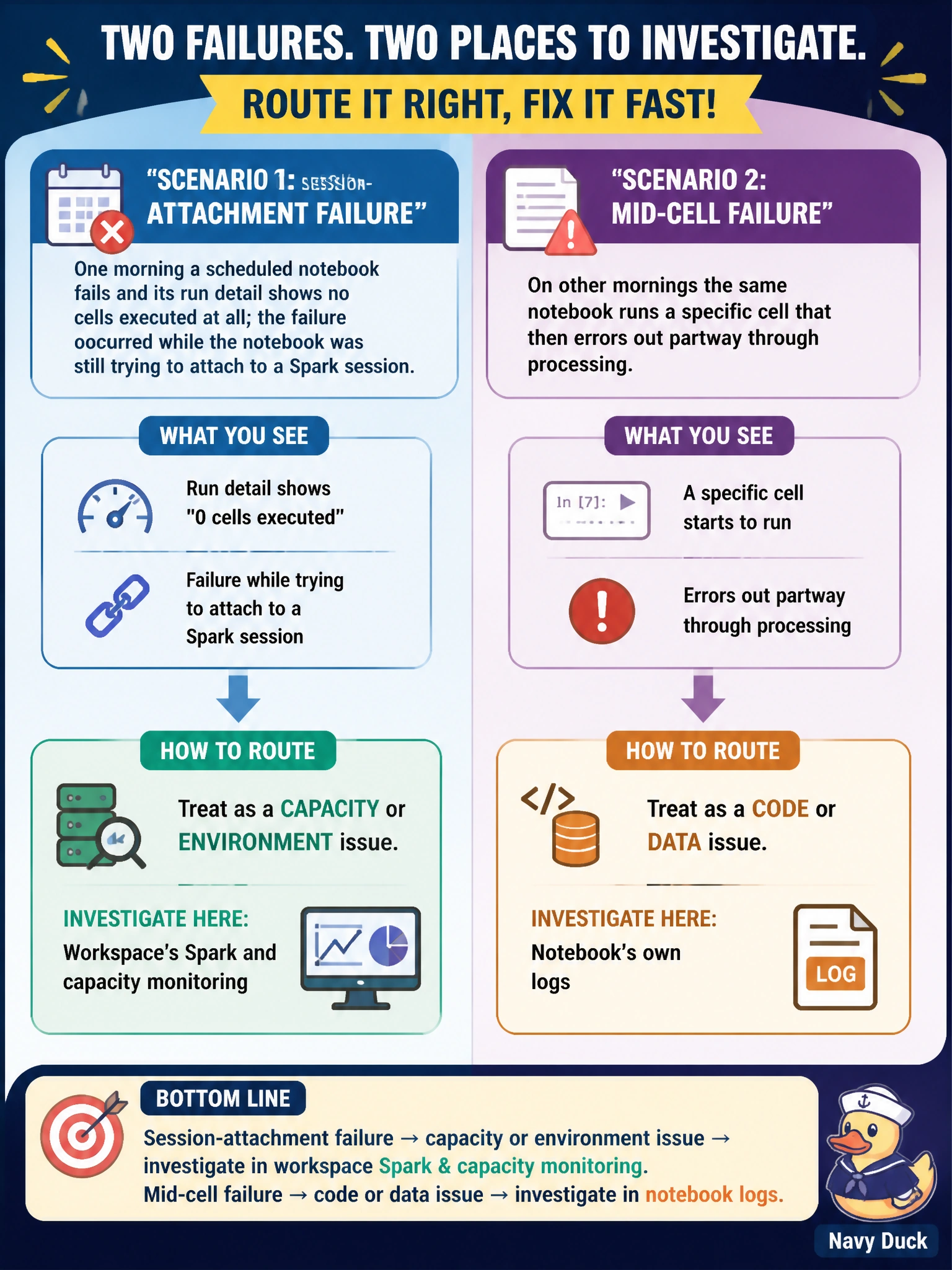
One morning a scheduled notebook fails and its run detail shows no cells executed at all; the failure occurred while the notebook was still trying to attach to a Spark session. On other mornings the same notebook runs a specific cell that then errors out partway through processing. How should an engineer route these two different failures?
Select an answer to reveal the explanation.
Short Explanation
Where a failure happens tells you almost as much as what the failure says. A notebook that can't even get a Spark session yet hasn't touched your code — that's an environment problem. A notebook that gets three cells deep before erroring is a completely different animal: your logic or your data is the suspect there.
Full Explanation
A failure to attach to a Spark session happens before any user code runs, so it points at environment-level causes such as capacity throttling, an unavailable or misconfigured Spark pool, or a temporary resource shortage in the workspace, and the right place to investigate is the workspace's Spark application and capacity monitoring rather than the notebook's own cell output, since there is no cell output yet to inspect. A failure that occurs partway through a specific cell, by contrast, means a session was successfully established and code began executing against real data, so the notebook's own run logs and stack trace for that cell are the right place to look for a logic error or a data condition the code did not anticipate. Treating every notebook failure identically discards this useful signal and leads engineers to search code for a problem that is actually about resource availability, or to chase capacity metrics for a problem that is actually a bug. Assuming a session-attachment failure implicates the code is backwards, since the code never ran. Assuming a mid-cell failure is a capacity problem ignores that the session clearly did become available, or the cell could not have started running at all. As a concrete first step, always note whether the run detail shows any cell output before deciding which category of investigation to pursue.