
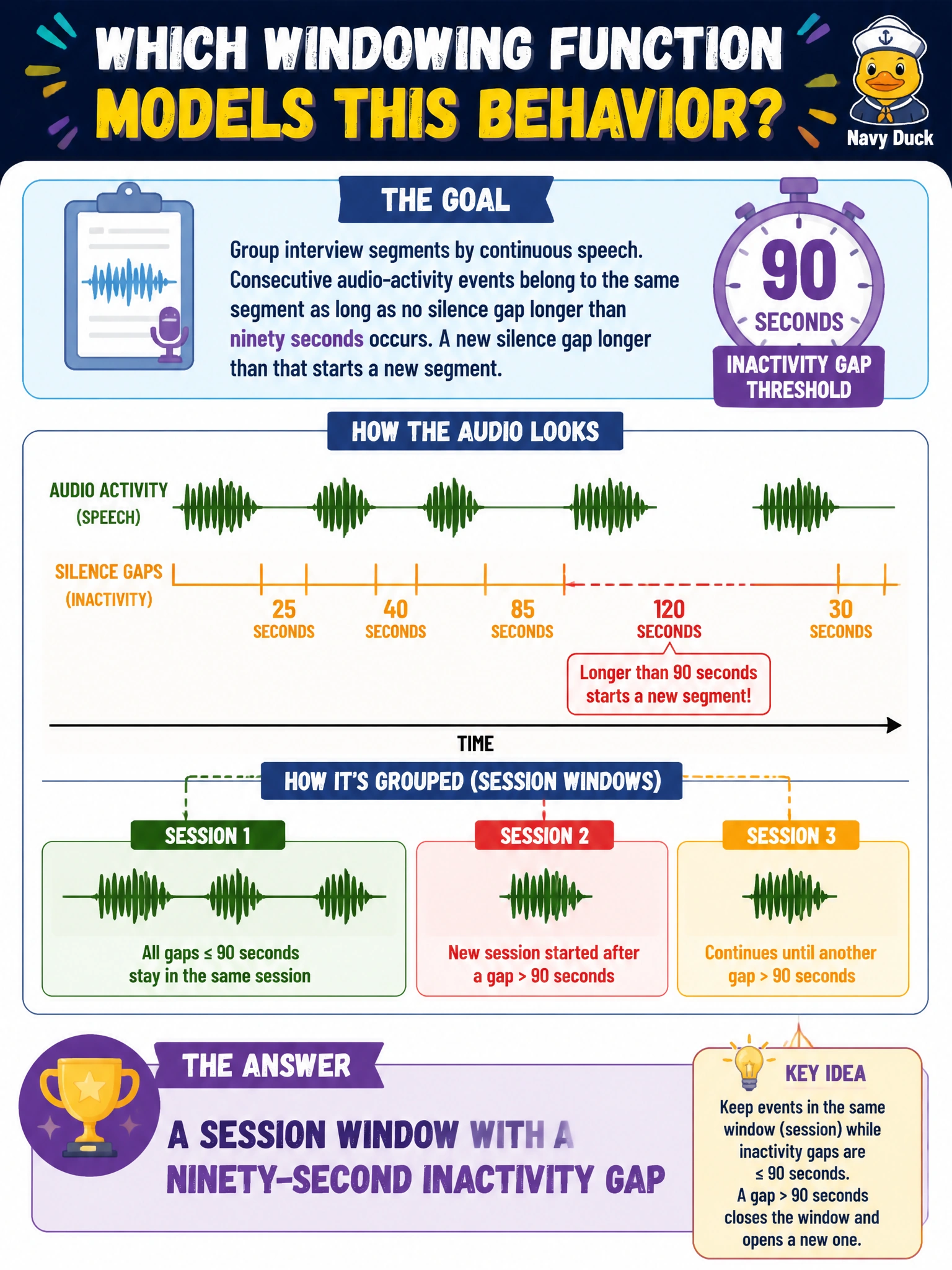
An archivist reviewing oral-history recording sessions wants each interview segment automatically grouped by continuous speech, where consecutive audio-activity events belong to the same segment as long as no silence gap longer than ninety seconds occurs, and a new silence gap longer than that starts a new segment. Which windowing function models this behavior?
Select an answer to reveal the explanation.
Short Explanation
A recording segment isn't tied to a clock — it's tied to whether the speaker keeps talking. As long as gaps between activity events stay under ninety seconds it's the same segment; cross that gap and a session window starts a fresh one, which is exactly how this grouping works.
Full Explanation
A session window groups events based on activity rather than a fixed schedule: it remains open across consecutive events as long as the gap between them stays within the configured inactivity threshold, and it closes — finalizing the current group and starting a new one on the next event — the moment that gap is exceeded. A ninety-second gap threshold applied to audio-activity events produces exactly one group per continuous stretch of speech, matching 'group by continuous speech, break on a silence gap over ninety seconds' precisely.
A tumbling window with a ninety-second duration would instead slice a single continuous stretch of speech into arbitrary fixed segments regardless of whether the speaker paused at all, which does not track actual continuity of speech. A hopping window compounds the mismatch by additionally overlapping those fixed segments, offering no improvement for this need. A snapshot window groups only events sharing an identical timestamp, an unrelated concept that has nothing to do with gaps of silence over a span of time.
A caveat: choosing the gap threshold too short risks splitting one natural pause-and-continue moment in an interview into two separate segments, while too long a threshold risks merging genuinely separate recording sessions together, so the ninety-second value should be validated against real interview pacing. Operationally, trace one known interview recording's raw activity timestamps and confirm they collapse into the expected number of continuous-speech segments.