
Facilities wants a congestion indicator for the main atrium that updates every two minutes but reflects the average visitor-flow rate over the trailing ten minutes, so a short burst at the entrance doesn't cause the indicator to spike and immediately drop back down. Which windowing function delivers this trailing, overlapping average?
Select an answer to reveal the explanation.
Short Explanation
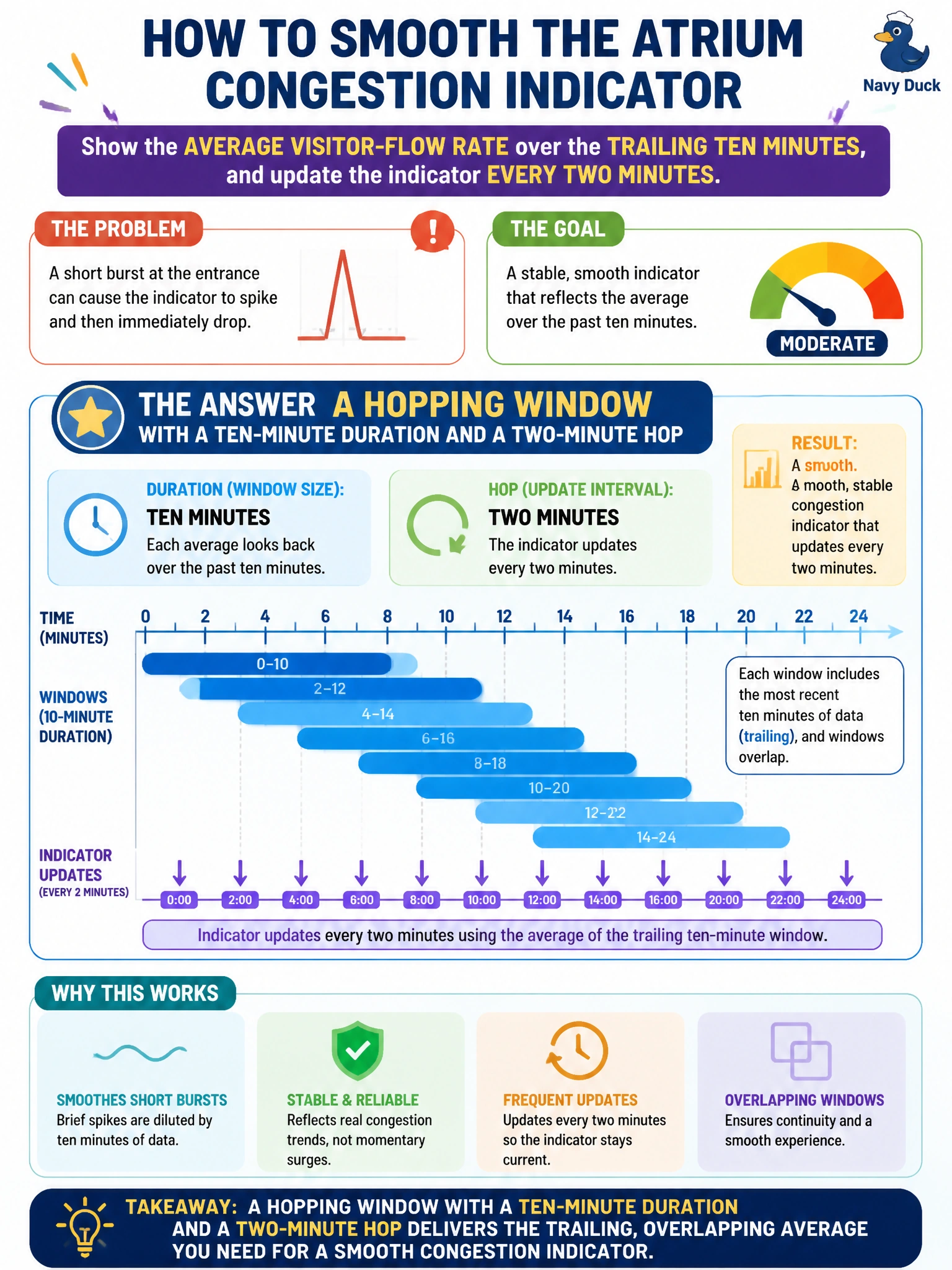
Ten minutes of context, refreshed every two minutes — that overlap is what smooths out a brief entrance burst before it can make the indicator spike and crash. A hopping window with those settings is built for exactly this kind of rolling, less-jumpy average.
Full Explanation
A hopping window keeps a fixed window duration but advances by a hop interval smaller than that duration, so consecutive windows overlap and share most of the same underlying events. A ten-minute duration with a two-minute hop recomputes the atrium's average visitor-flow rate every two minutes using the trailing ten minutes of data, which smooths a short entrance burst across several overlapping windows instead of letting it dominate a single narrow calculation.
A tumbling window with a ten-minute duration would only refresh once every ten minutes with no overlap, which is both less frequent than the required two-minute cadence and more susceptible to a burst dominating a single, non-overlapping segment. A snapshot window groups only events sharing an identical timestamp, an unrelated concept with no averaging span at all. A session window closes on a gap of inactivity rather than a fixed refresh cadence, and a busy atrium with continuous foot traffic would rarely, if ever, produce the kind of gap a session window needs to close and emit a result.
A caveat: because hopping windows overlap, any given visitor-flow event can be counted in multiple windows (here, up to five, since ten minutes divided by a two-minute hop is five), so this pattern is appropriate for an average or rate but would badly overstate a running total. Operationally, confirm the smoothing is working by comparing the hopping-window series against a raw one-minute count series and checking that short spikes are visibly dampened rather than passed through unchanged.