
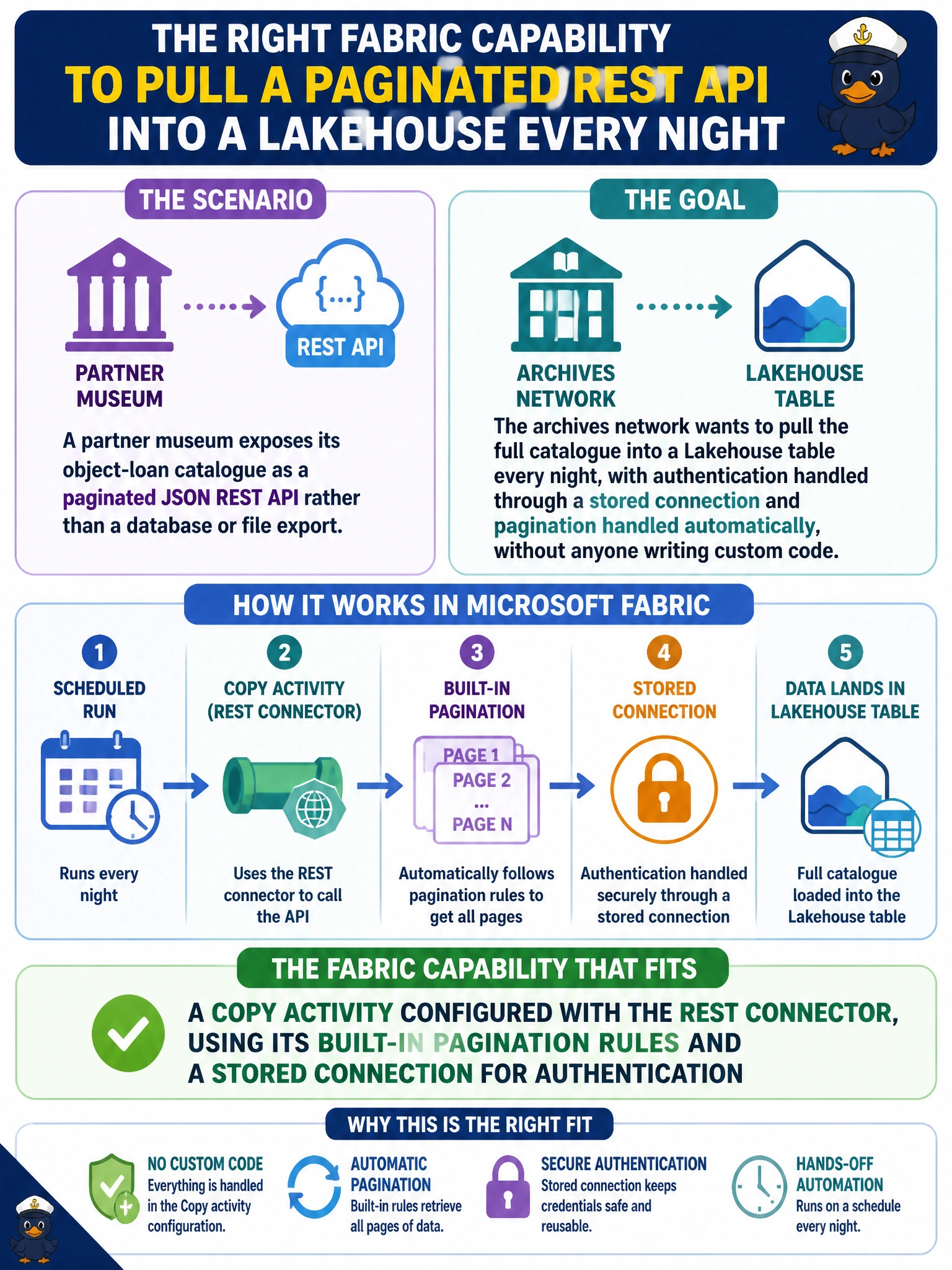
A partner museum exposes its object-loan catalogue as a paginated JSON REST API rather than a database or file export, and the archives network wants to pull the full catalogue into a Lakehouse table every night, with authentication handled through a stored connection and pagination handled automatically, without anyone writing custom code. Which Fabric capability directly fits this need?
Select an answer to reveal the explanation.
Short Explanation
Think of the REST connector like a mail carrier who already knows how to ask for "page 2, then page 3" on your behalf and knock with the right credentials each time. A Copy activity configured that way just walks the whole catalogue home into the Lakehouse, no code required.
Full Explanation
A Copy activity's REST connector is built specifically for this pattern: point it at the endpoint, store the authentication details in a connection once, and configure the connector's pagination rules (such as following a next-page token or incrementing an offset) so it keeps requesting pages until the source signals there are no more, landing every row into the target Lakehouse table without anyone writing a loop by hand. That built-in pagination handling is exactly what turns a paginated API into a routine nightly copy. A PySpark notebook calling requests in a loop can technically pull the same data, but it is custom code the team explicitly wanted to avoid, and it also means someone has to maintain retry logic, rate-limit handling, and credential storage that the Copy activity already provides out of the box. A shortcut only works against a storage-style source that exposes files or tables directly, such as ADLS Gen2 or S3; a REST API returning JSON payloads over HTTP is not the kind of target a shortcut can reference, since there is no underlying file system to link into OneLake. A KQL update policy only runs inside an Eventhouse to reshape rows already ingested there; it has no way to reach out and call an external HTTP API in the first place, so it never gets involved in getting the data in. A caveat: some REST APIs use pagination styles the built-in rules don't model cleanly, such as cursors returned only in a response header, and those cases may still require a small amount of custom logic layered on top. Operationally, check the Copy activity's run history after the first execution to confirm the row count matches the partner catalogue's known total, rather than assuming the last page was reached correctly.