
A conservation dashboard needs to show a smoothed, frequently-updating view of a gallery's average lux exposure, refreshing every minute over a rolling five-minute span so curators can spot a creeping light-exposure trend without the choppiness of a strict five-minute tumbling average. Which windowing function fits this need?
Select an answer to reveal the explanation.
Short Explanation
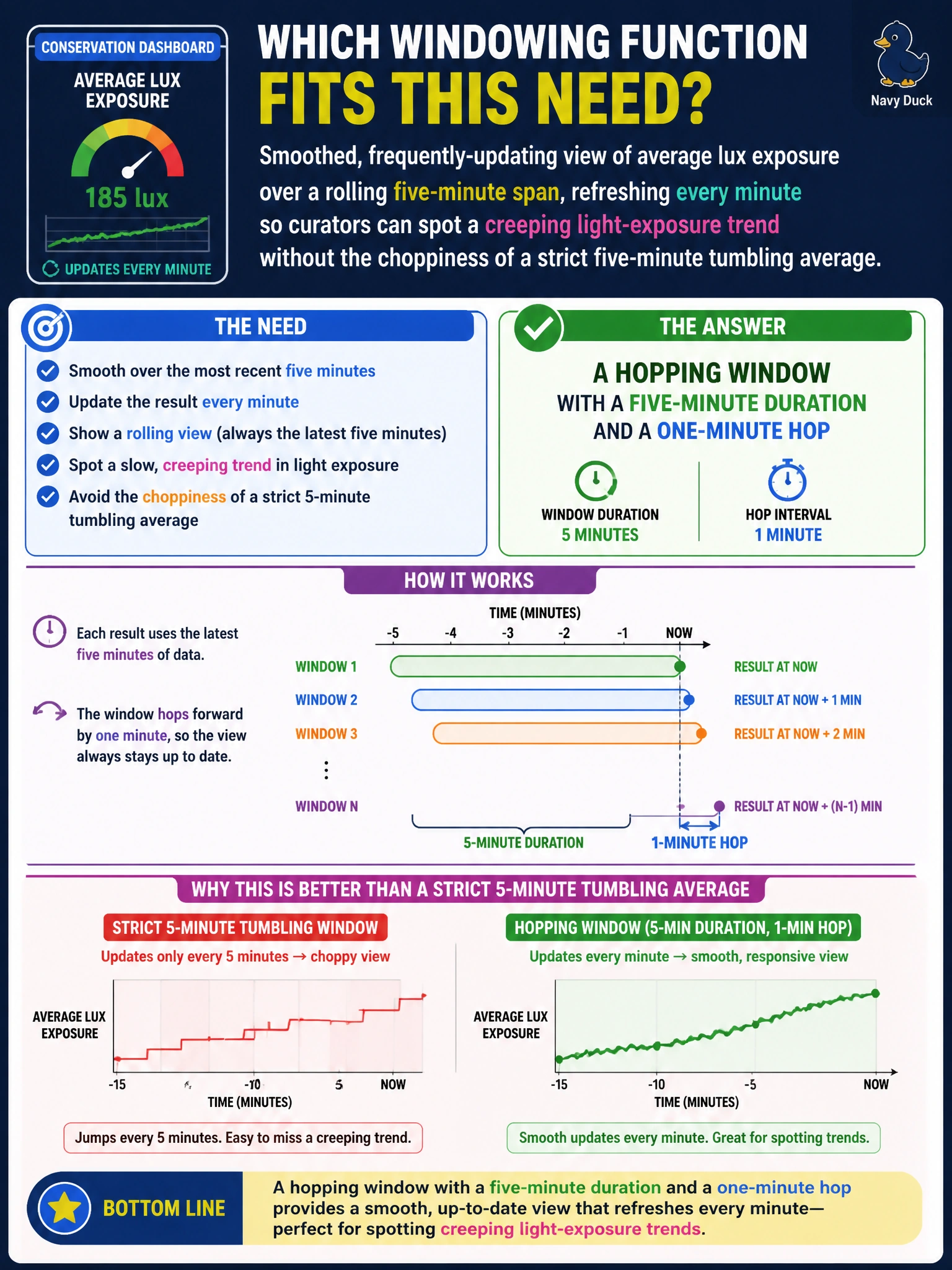
Picture a five-minute window that scoots forward one minute at a time instead of jumping in five-minute leaps — that overlap is what smooths out the choppiness curators don't want. A hopping window with a five-minute span and a one-minute hop gives a fresh, smoothed average every minute.
Full Explanation
A hopping window is a fixed-size window, like a tumbling window, but it advances by a hop interval smaller than the window's duration, so consecutive windows overlap and share most of their data. A five-minute window hopping every minute recomputes the average lux exposure once per minute using the trailing five minutes of readings, which produces the frequent, smoothed update curators want while still averaging over a meaningful span.
A snapshot window groups only the events that share an identical timestamp, which is a much narrower and different concept — it does not span five minutes of readings at all, so it cannot produce a rolling average. A tumbling window with a five-minute duration only emits a new value once every five minutes with no overlap, which is exactly the choppier behavior the scenario says to avoid. A session window closes after a period of inactivity rather than on a fixed cadence; lux readings arriving steadily every few seconds would likely never trigger a session boundary at all, so it cannot deliver a once-per-minute refresh.
A caveat: because hopping windows overlap, a single lux reading can be counted in up to five separate windows (five minutes / one-minute hop), so any downstream total (as opposed to average) would double-count unless that overlap is accounted for. Operationally, check that the dashboard's minute-by-minute average changes gradually rather than in sharp five-minute jumps, confirming the overlap is actually smoothing the series.