
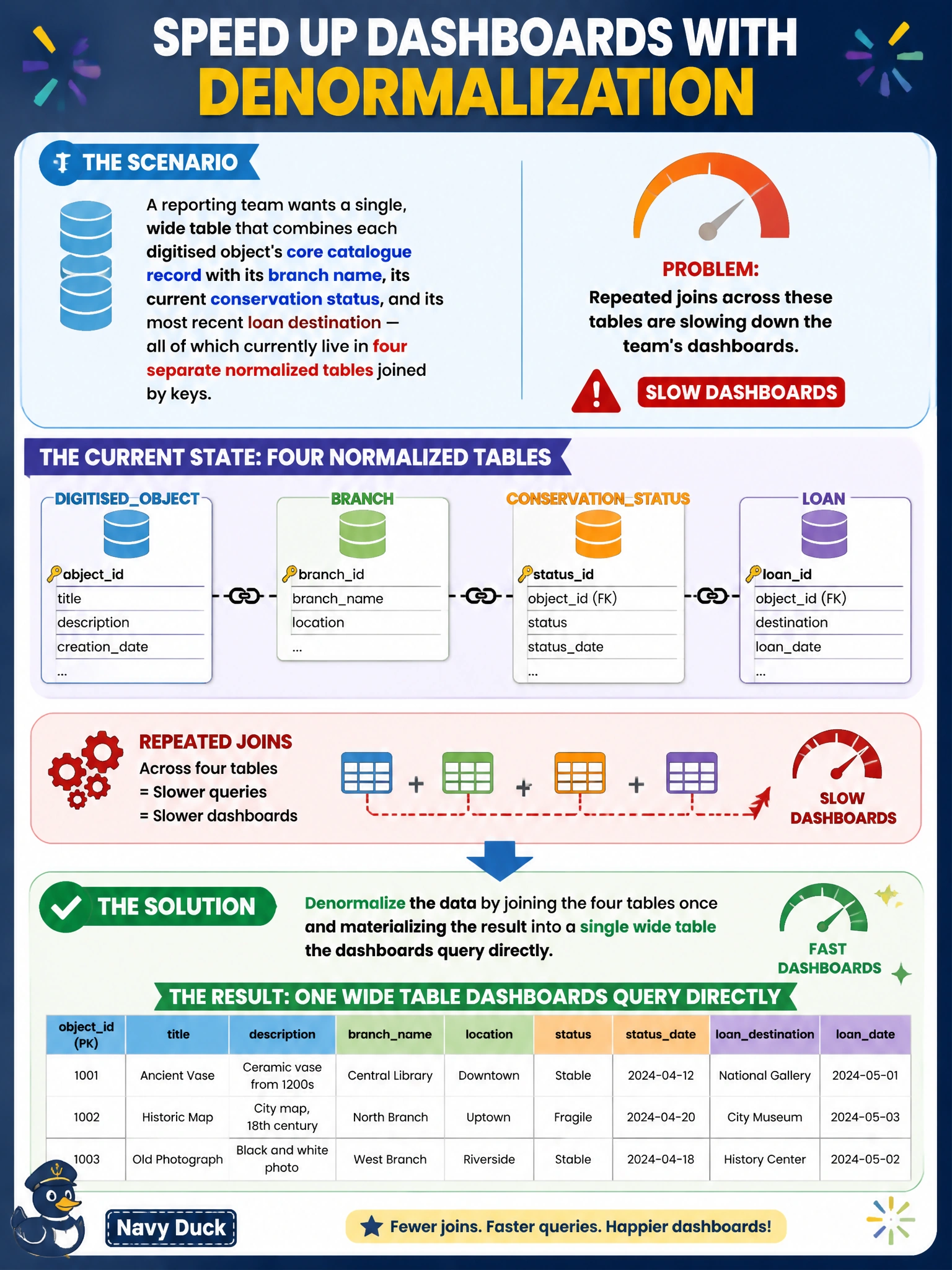
A reporting team wants a single, wide table that combines each digitised object's core catalogue record with its branch name, its current conservation status, and its most recent loan destination — all of which currently live in four separate normalized tables joined by keys. Repeated joins across these tables are slowing down the team's dashboards. What transformation should a data engineer apply to address this?
Select an answer to reveal the explanation.
Short Explanation
Think of denormalization like photocopying a finished, assembled report instead of asking every visitor to flip between four separate binders to piece it together themselves. Doing the joins once and saving the combined result means the dashboard never has to repeat that work.
Full Explanation
Denormalizing means performing the joins across the catalogue, branch, conservation-status, and loan tables once, up front, and writing the combined result into a single wide table that downstream dashboards can query directly with no further joins — trading some storage redundancy for consistently faster read performance, which is the right trade when the same joins are being repeated on every dashboard refresh. Adding primary keys can help join performance somewhat, but it doesn't eliminate the repeated join work itself; the dashboards would still be joining four tables every time, just marginally faster. Converting the tables to Eventhouse tables changes the query language to KQL, but Eventhouse is built for time-series telemetry, not for improving relational join performance over catalogue and status data, and it doesn't address the underlying repeated-join pattern either. Sharding the tables across separate Lakehouses would make the joins harder, not easier, since cross-Lakehouse joins add coordination overhead rather than removing it. Before rolling the denormalized table into production dashboards, set a refresh cadence that keeps it acceptably current, since the wide table is now a derived copy that can drift from the four source tables between refreshes.