
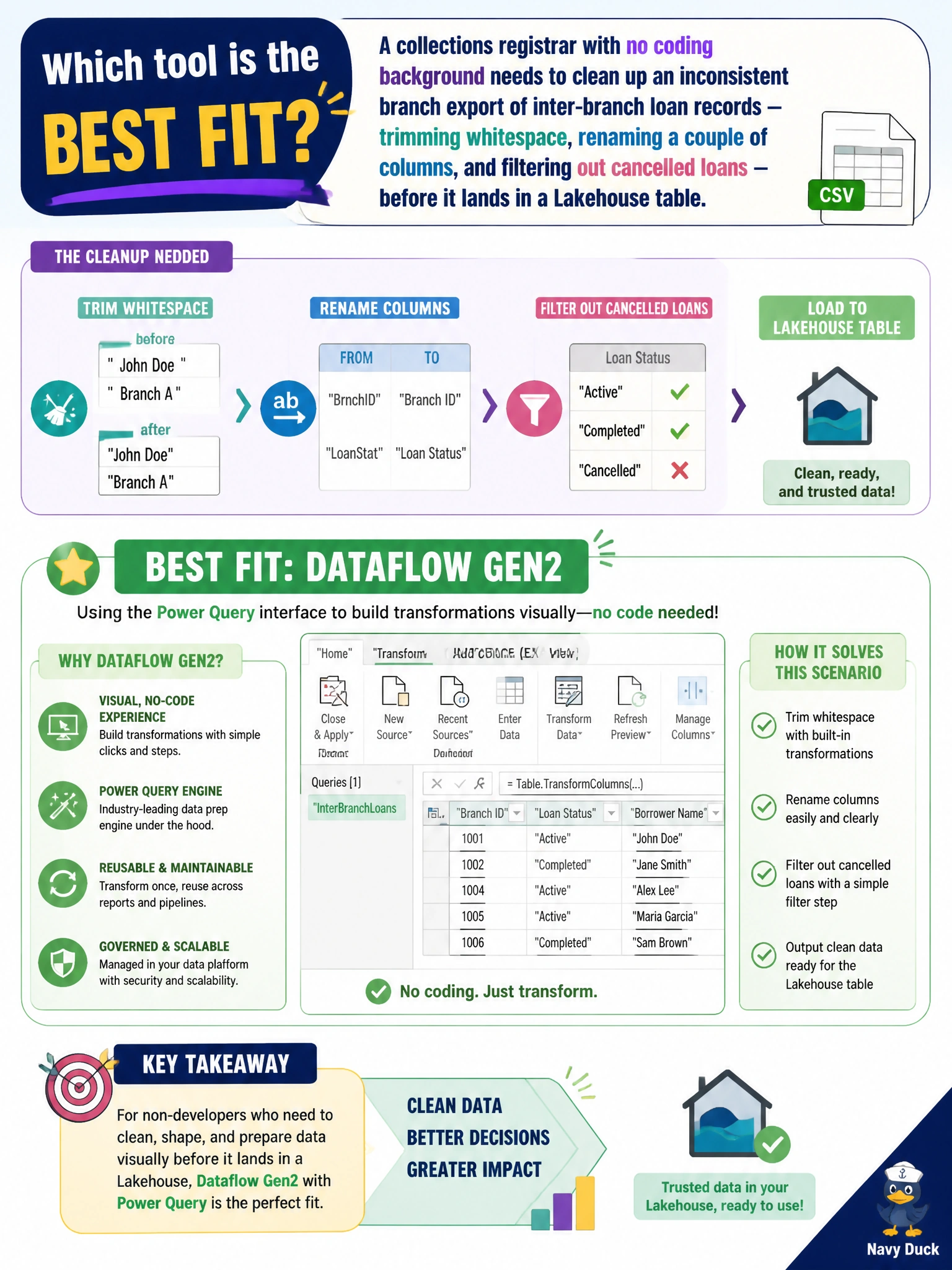
A collections registrar with no coding background needs to clean up an inconsistent branch export of inter-branch loan records — trimming whitespace, renaming a couple of columns, and filtering out cancelled loans — before it lands in a Lakehouse table. Which tool is the best fit for this task?
Select an answer to reveal the explanation.
Short Explanation
Think of Dataflow Gen2 like a mixing board with labeled knobs instead of a raw audio-editing script: the registrar can point-and-click their way through trimming, renaming, and filtering without writing a line of code. That low-code Power Query experience is exactly what a non-developer needs for light, one-off cleanup.
Full Explanation
Dataflow Gen2 wraps the Power Query engine in a visual, low-code interface, letting someone without programming experience apply column renames, trims, and row filters through a guided UI rather than writing code, which matches a registrar's skill set and the light-touch nature of the cleanup. A Spark notebook would technically accomplish the same cleanup, but it requires PySpark fluency the registrar doesn't have, and it's overkill for a handful of straightforward, one-time transformations rather than a complex, code-driven pipeline. KQL is built for querying an Eventhouse's time-series telemetry, not for cleaning up a batch export of loan records sitting outside that store; reaching for it here means fighting the tool's intended workload. A T-SQL stored procedure demands both SQL authoring skill and a target Warehouse, neither of which matches a non-developer doing ad-hoc cleanup ahead of a Lakehouse load. Before publishing the Dataflow, check its output against the Lakehouse table's expected schema, since Power Query's flexible typing can silently produce a column type the downstream table doesn't expect.