
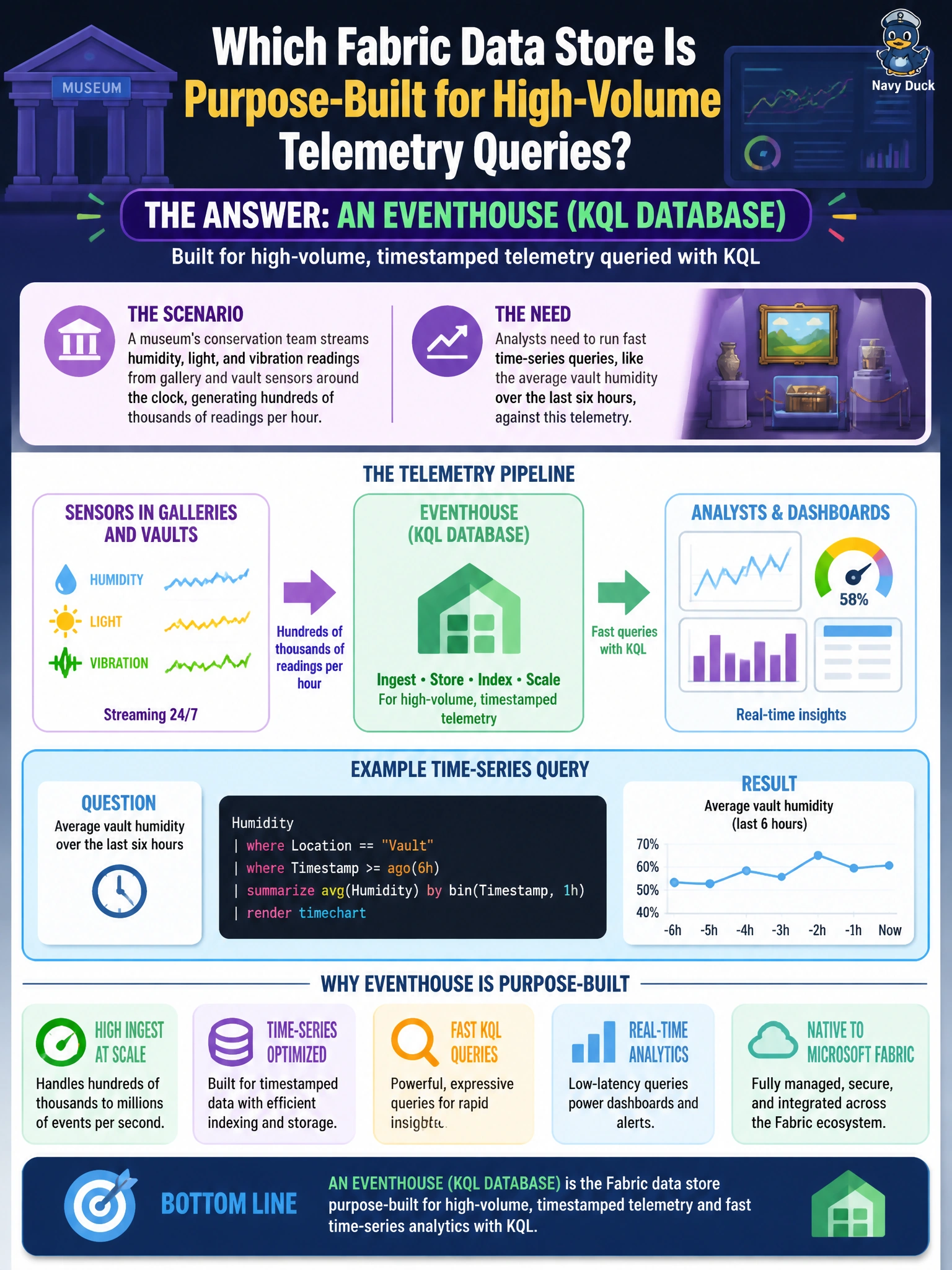
A museum's conservation team streams humidity, light, and vibration readings from gallery and vault sensors around the clock, generating hundreds of thousands of readings per hour. Analysts need to run fast time-series queries, like the average vault humidity over the last six hours, against this telemetry. Which Fabric data store is purpose-built for this workload?
Select an answer to reveal the explanation.
Short Explanation
Picture a security desk with a bank of live monitors instead of a filing cabinet: readings pour in nonstop and someone needs the last few hours at a glance, not a full archival search. An Eventhouse is that live-monitor desk — built to ingest and query time-stamped streams fast.
Full Explanation
An Eventhouse is Fabric's Real-Time Intelligence data store, purpose-built to ingest high-volume, timestamped telemetry and answer time-windowed questions through KQL, which has native operators for bucketing time ranges and computing rolling aggregates efficiently. That combination of ingestion rate and query pattern is exactly what continuous sensor readings need. A Warehouse is optimized for relational, T-SQL-driven reporting over structured business data like ticketing or finance; it can technically hold timestamped rows, but it lacks KQL's time-series operators and isn't tuned for the ingestion rate sensor telemetry produces. A Lakehouse restricted to its SQL endpoint gives up Spark's flexibility without gaining anything the Eventhouse doesn't already do better for this specific pattern, and its SQL endpoint isn't built around time-series functions either. A OneLake shortcut just points at data that lives somewhere else; it has no compute engine of its own, so it can't be the answer to “where do the readings live and get queried.” Before finalizing, confirm whether the sensor data volume also requires setting appropriate retention policies on the Eventhouse to control storage growth.