
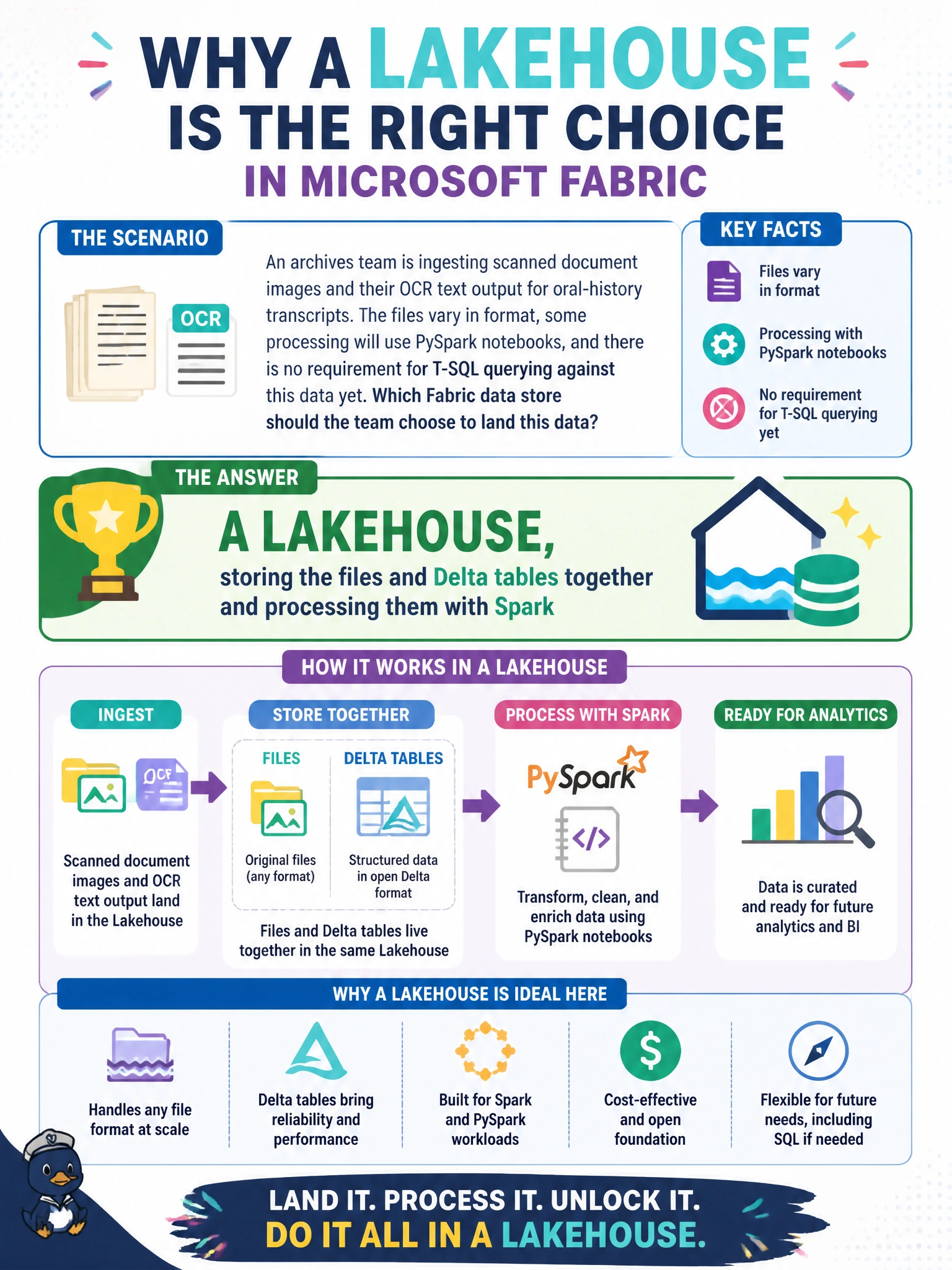
An archives team is ingesting scanned document images and their OCR text output for oral-history transcripts. The files vary in format, some processing will use PySpark notebooks, and there is no requirement for T-SQL querying against this data yet. Which Fabric data store should the team choose to land this data?
Select an answer to reveal the explanation.
Short Explanation
Think of a Lakehouse as one shelf that holds both the raw scanned pages and the tidy indexed records side by side. It stores files and Delta tables together and is built for Spark-first processing, which fits scanned images and OCR output that a PySpark notebook will crunch.
Full Explanation
A Lakehouse is the right choice when the workload mixes unstructured or semi-structured files, here scanned document images and OCR text, with structured Delta tables, and when the primary processing engine is Spark through notebooks. It exposes both a file-based view and a tabular view over the same OneLake storage, so raw scans and derived, structured transcript records can coexist without duplicating the data into a separate store. A Warehouse is optimized for T-SQL-based relational analytics over structured data and does not natively hold arbitrary files as first-class citizens the way a Lakehouse does; the scenario explicitly says there is no T-SQL requirement yet, so defaulting to a Warehouse adds structure the workload does not need. An Eventhouse is purpose-built for high-volume, time-series and log-style telemetry queried with KQL, such as sensor streams, not for scanned documents and OCR text that have no time-series shape. A Power BI semantic model is a reporting and analysis layer built on top of already-modeled data; it is never the landing zone for raw files and cannot store arbitrary binary content. Before committing to a Lakehouse, confirm the notebook's output tables use the Delta format so downstream consumers, including any future Warehouse or SQL analytics endpoint, can read them consistently.