
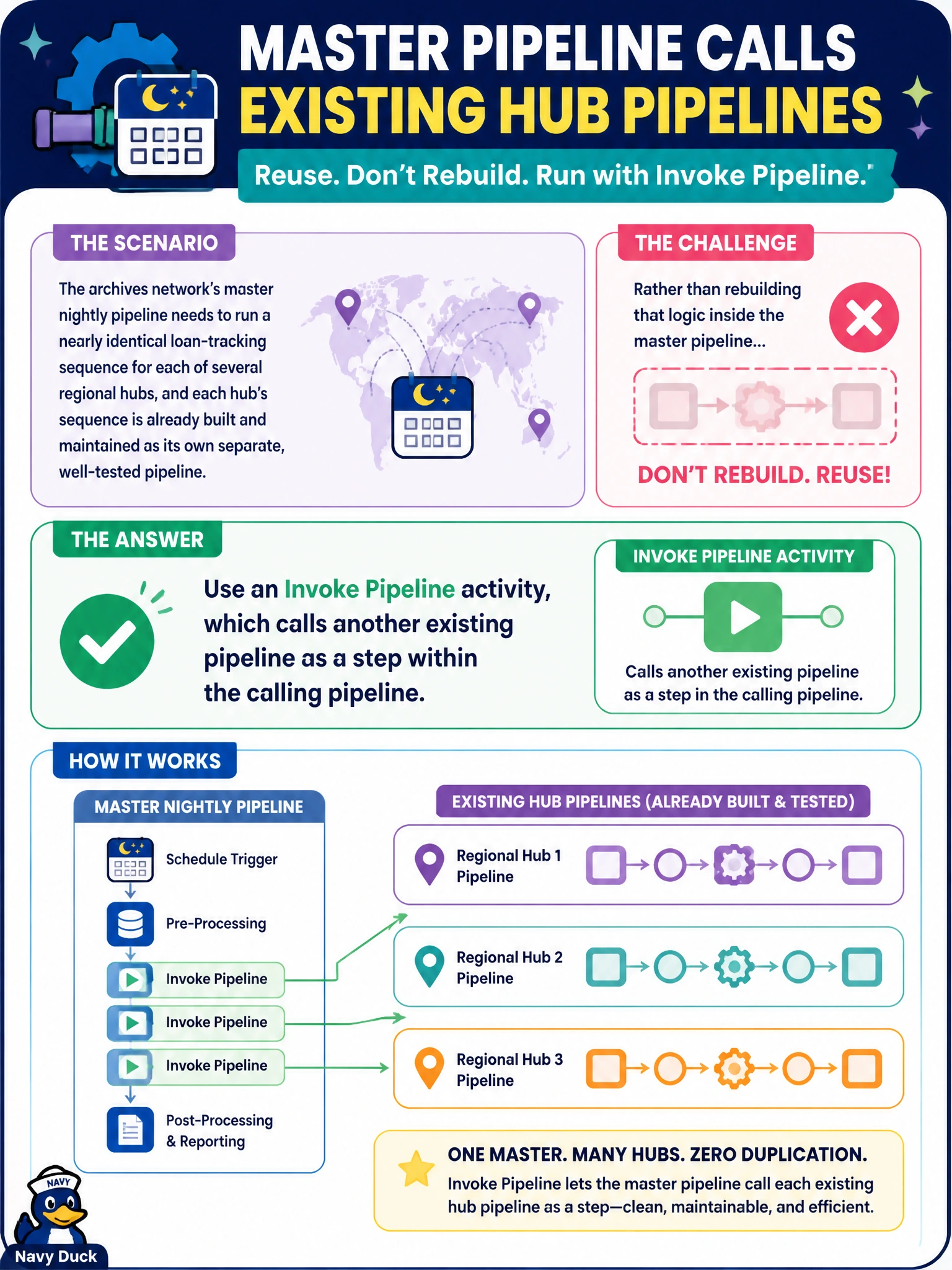
The archives network's master nightly pipeline needs to run a nearly identical loan-tracking sequence for each of several regional hubs, and each hub's sequence is already built and maintained as its own separate, well-tested pipeline. Rather than rebuilding that logic inside the master pipeline, what activity lets the master pipeline call each existing hub pipeline as a step?
Select an answer to reveal the explanation.
Short Explanation
Why rebuild a pipeline that already works and is already trusted? An Invoke Pipeline activity lets the master pipeline reach out and call each hub's existing pipeline directly as one step, keeping every hub's tested logic exactly where it lives.
Full Explanation
An Invoke Pipeline activity is built specifically to call another existing pipeline from within a calling pipeline, treating the called pipeline's entire run as a single step in the parent's activity sequence, which is exactly the modular composition needed here — reuse each hub's already-built, already-tested pipeline rather than duplicating its logic inside a master pipeline. This keeps ownership and testing scoped to each hub pipeline while still letting the master pipeline orchestrate the overall nightly sequence across all of them. A Web activity calling a REST API endpoint could theoretically trigger something externally, but it's the wrong tool for calling another Fabric pipeline as a native orchestration step, and it sidesteps the pipeline-to-pipeline dependency and monitoring relationship an Invoke Pipeline activity provides directly. A Copy activity moves data between stores; it has no concept of invoking another pipeline's execution and would do nothing to actually run the hub logic. A Dataflow Gen2 referencing another pipeline's output table might read data that pipeline eventually produces, but it doesn't invoke or orchestrate that pipeline's run at all, and there's no guarantee of timing or sequencing between the two. The caveat: an Invoke Pipeline activity can optionally wait for the called pipeline to finish before continuing, which matters if the master pipeline's own downstream steps depend on that hub's completion. A concrete check: run the master pipeline and confirm the Monitoring hub shows each hub pipeline's run nested under the master pipeline's own run.