
Cascade Regional Airlines needs a subnet for the maintenance depot with room for at least 100 usable host addresses, sized as efficiently as possible once Azure's reserved addresses are taken into account. Which CIDR prefix should they use?
Select an answer to reveal the explanation.
Short Explanation
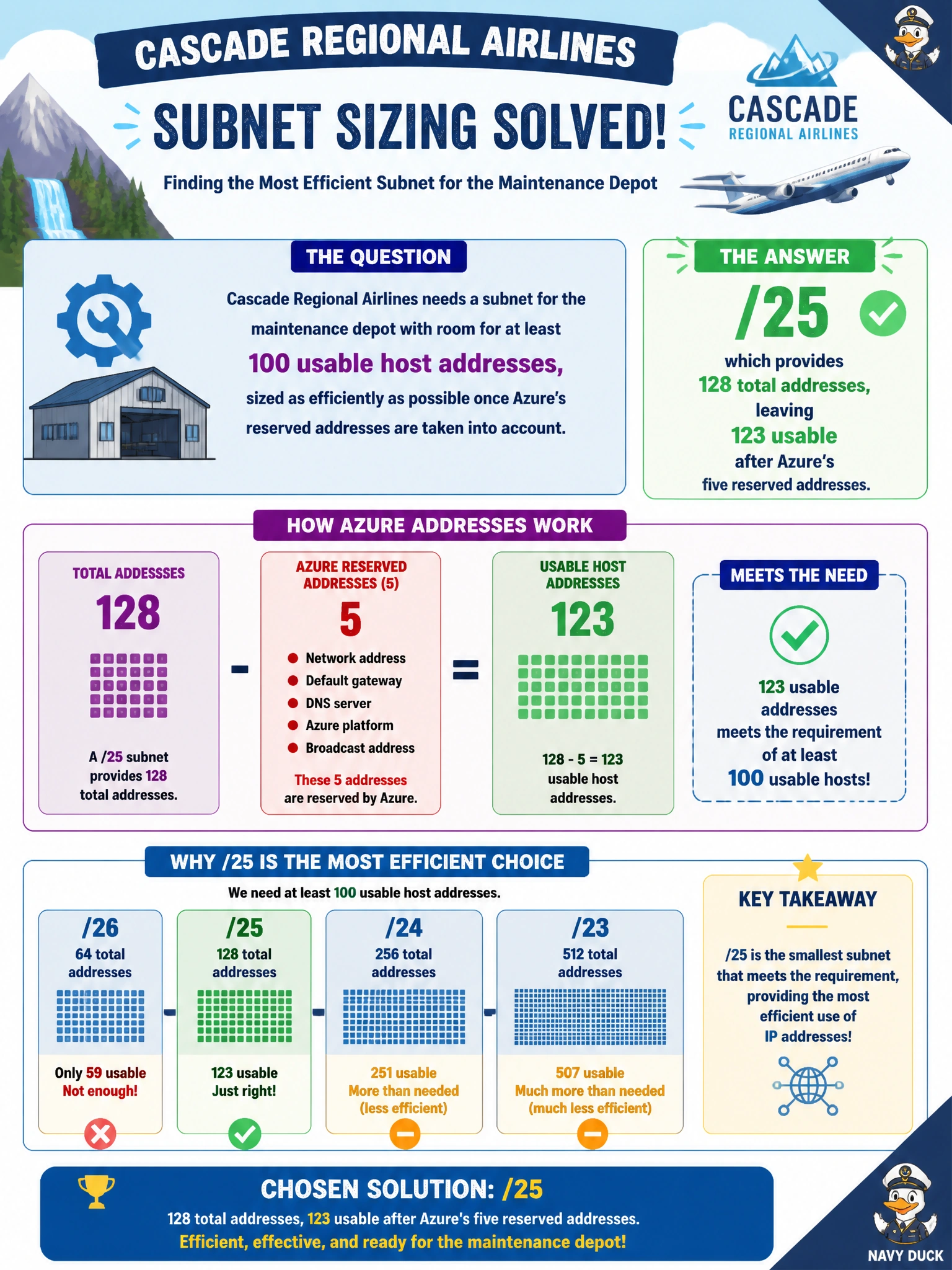
Every Azure subnet loses 5 addresses to reservations no matter its size, so needing 100 hosts really means needing at least 105 total. A /26 only holds 64, nowhere close — a /25 holds 128, which comfortably clears the bar with 123 left over.
Full Explanation
Because Azure reserves five addresses in every subnet regardless of its size, meeting a requirement of at least 100 usable hosts really means the subnet must contain at least 105 total addresses (100 + 5). A /26 provides 64 total addresses, which after the five reservations leaves only 59 usable — well short of the requirement. A /27 provides just 32 total addresses (27 usable after reservations), and a /28 provides only 16 (11 usable), both far too small. A /25 provides 128 total addresses (2^7), and after subtracting the five reserved addresses leaves 123 usable, which comfortably meets the 100-host requirement while being the smallest standard prefix that does so; a /26 fails and the next size up, /25, succeeds, which is what ‘as efficiently as possible’ means in this context. This kind of sizing mistake is common because engineers often subtract only two addresses (network and broadcast) out of on-premises habit, which would make a /26's 62 ‘usable’ addresses look sufficient when it is not once Azure's actual five-address reservation is applied. Before finalizing the subnet, Cascade's team should also confirm the /25 block does not overlap any address range already allocated elsewhere in the VNet.