
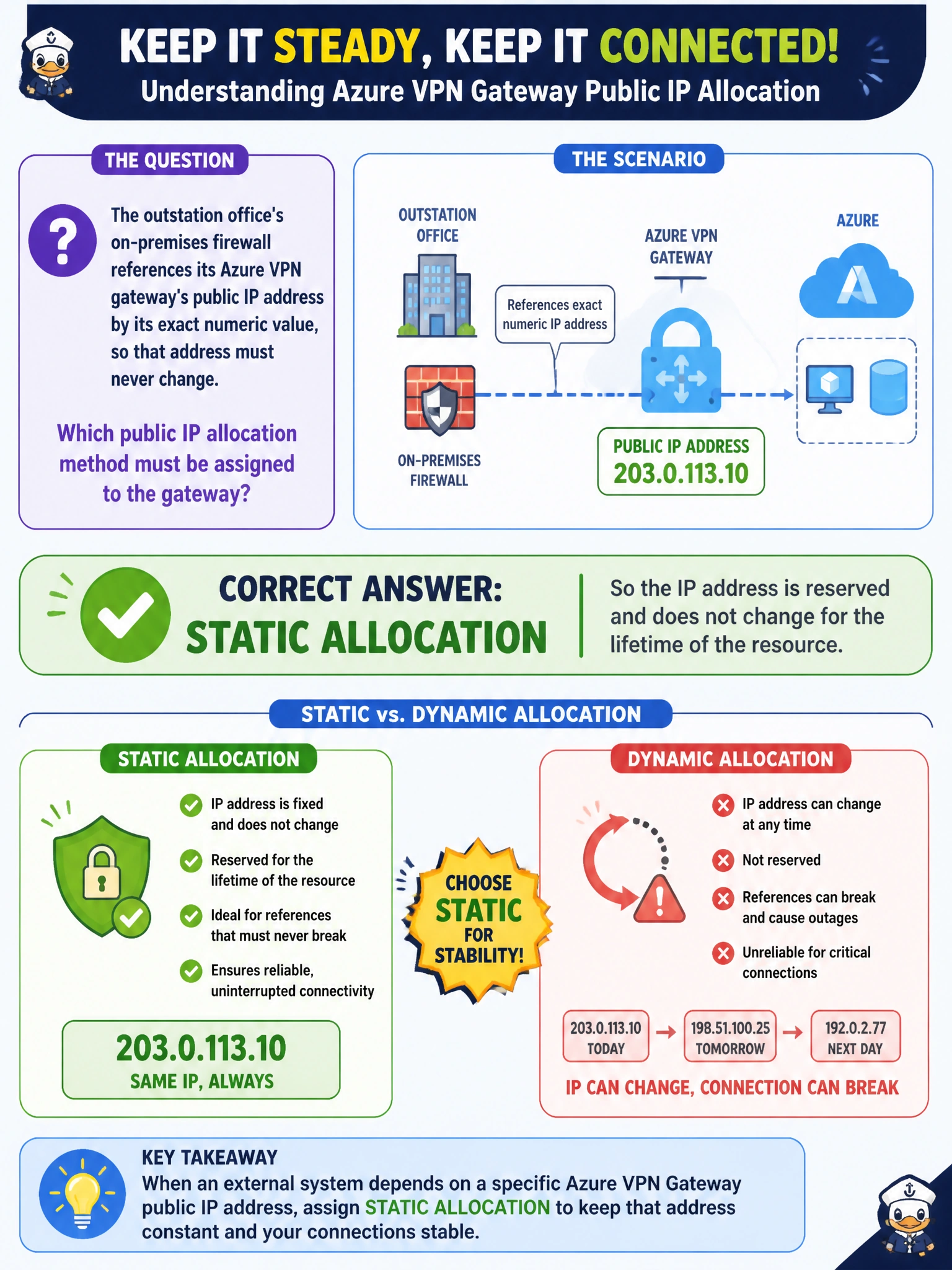
The outstation office's on-premises firewall references its Azure VPN gateway's public IP address by its exact numeric value, so that address must never change. Which public IP allocation method must be assigned to the gateway?
Select an answer to reveal the explanation.
Short Explanation
If a firewall rule on the other end hardcodes an exact IP, that address can't be allowed to drift — ever. Static allocation is Azure's promise that the address is reserved and stays put for as long as the resource exists. Dynamic addresses carry no such promise.
Full Explanation
A static public IP address is reserved to a resource and guaranteed not to change for the lifetime of that resource, which is exactly what is needed when an on-premises firewall rule references the address by its literal value rather than a DNS name. A dynamic public IP address, by contrast, is only assigned when the resource is created or started and is not guaranteed to be the same address if the resource is stopped and later restarted, making it unsuitable whenever an external system depends on the address staying fixed. The claim that dynamic allocation reliably reuses the same address is incorrect; reuse is not guaranteed, only likely under some circumstances, which is not a basis for a production firewall rule. VPN gateways do support static public IP allocation and, in fact, generally should use static IPs precisely because on-premises VPN device configurations typically hardcode the peer's address the same way Cascade's outstation office does here. The claim that static allocation is unavailable for gateways and must be replaced with a DNS label is simply false; static allocation is a directly configurable property of the public IP resource itself. Cascade's team should confirm the allocation method on the public IP resource's properties page before finalizing the on-premises firewall configuration.