
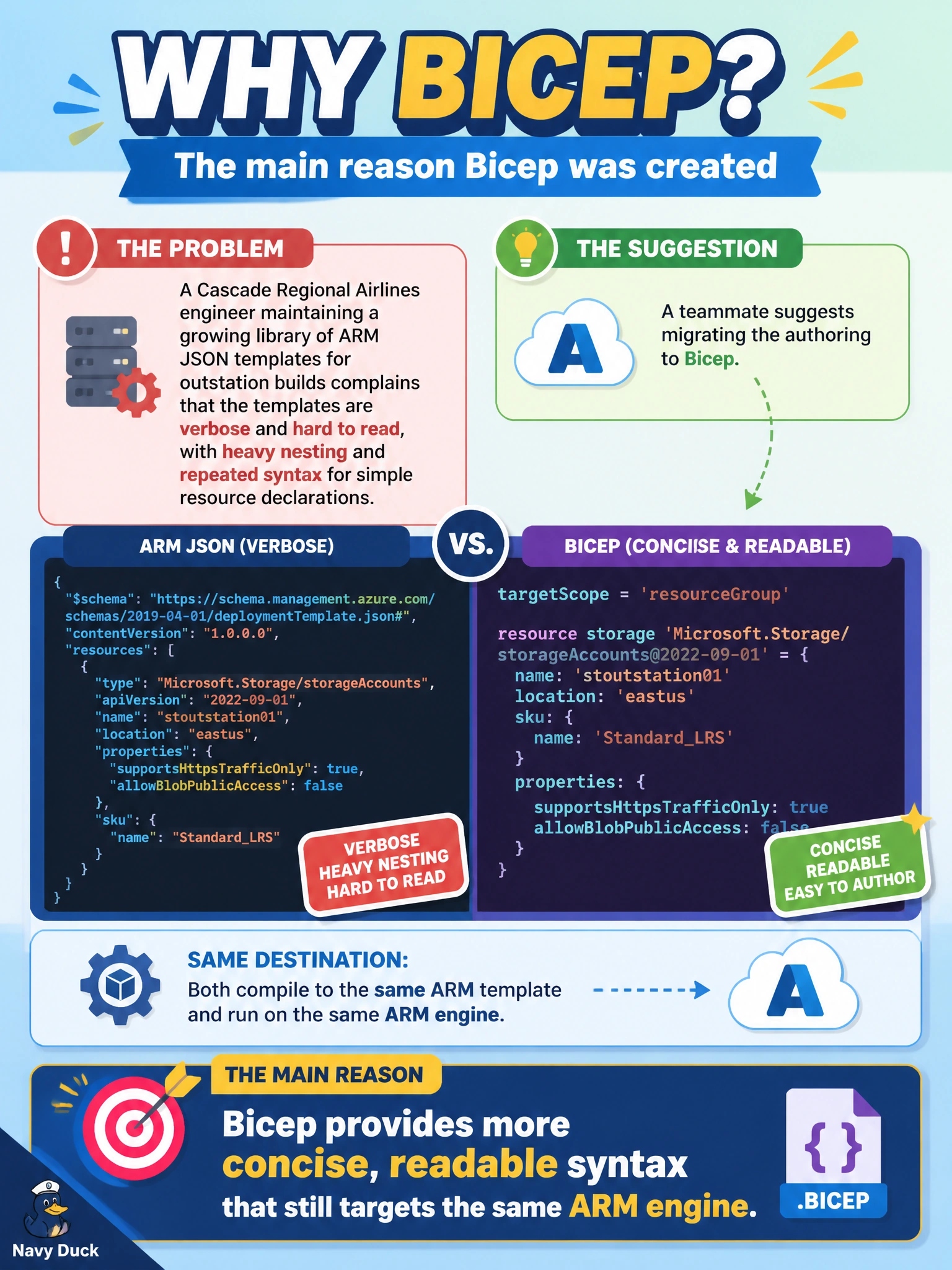
A Cascade Regional Airlines engineer maintaining a growing library of ARM JSON templates for outstation builds complains that the templates are verbose and hard to read, with heavy nesting and repeated syntax for simple resource declarations. A teammate suggests migrating the authoring to Bicep. What is the main reason Bicep was created to address this complaint?
Select an answer to reveal the explanation.
Short Explanation
Bicep exists to fix exactly this pain point: the same resources, the same deployment engine underneath, but a much cleaner and less repetitive way to write it all down.
Full Explanation
Bicep was designed as a more concise, readable authoring language for the same declarative infrastructure model ARM JSON already provides. It reduces boilerplate like nested bracket structures and repeated function calls for resource references, while still expressing parameters, variables, resources, and outputs conceptually the same way. It does not replace Azure Resource Manager or introduce a separate deployment engine; the earlier point about transpilation to ARM JSON is the mechanism that makes this possible. Bicep still supports parameters and variables, and in fact uses them constantly, so claiming it removes the need for them is incorrect and would make templates less reusable, not more. Deployment mode, Incremental or Complete, is a setting chosen at deployment time and is unrelated to which authoring language produced the template; Bicep does not default to or enforce Complete mode. A good check when evaluating whether to migrate a template is comparing line count and nesting depth between the existing ARM JSON and its Bicep equivalent for the same resource set.