
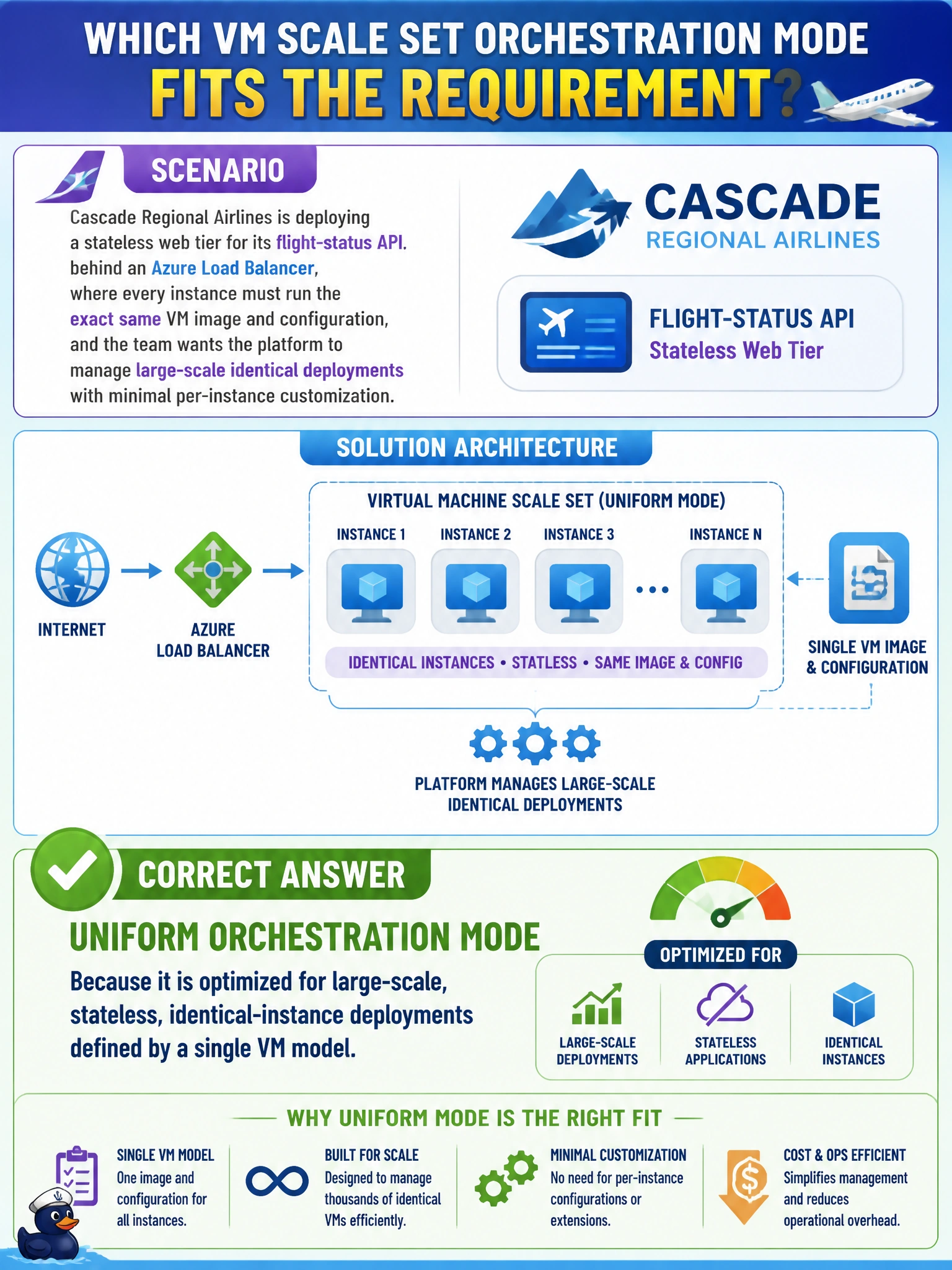
Cascade Regional Airlines is deploying a stateless web tier for its flight-status API behind an Azure Load Balancer, where every instance must run the exact same VM image and configuration, and the team wants the platform to manage large-scale identical deployments with minimal per-instance customization. Which Virtual Machine Scale Set orchestration mode fits this requirement?
Select an answer to reveal the explanation.
Short Explanation
When every instance is supposed to be a carbon copy of the next and you just need a lot of them, that's the textbook case for Uniform mode — it's built around one shared VM model applied identically at scale. That's a great fit for a stateless API tier sitting behind a load balancer.
Full Explanation
Uniform orchestration mode defines a single VM model referenced by every instance in the scale set, making it well suited to large-scale, stateless, horizontally scaled workloads where instances are interchangeable and identical, such as a flight-status API tier behind Azure Load Balancer. Flexible mode is not a requirement imposed by having a load balancer in front of the scale set; both Uniform and Flexible scale sets can sit behind Azure Load Balancer or Application Gateway, so that claim misattributes a load-balancer requirement to orchestration mode. There is no 'Manual orchestration mode' for scale sets — Manual is an upgrade policy setting, not an orchestration mode, and it does not disable autoscaling by itself. Availability zone support is a deployment configuration available to scale sets, not a third orchestration mode alongside Uniform and Flexible; scale sets choose between exactly those two orchestration modes. As an operational check, review the scale set's orchestrationMode property when provisioning to confirm it is set to Uniform, and verify the single VM model's image reference is what every instance actually boots from after a scale-out event.