
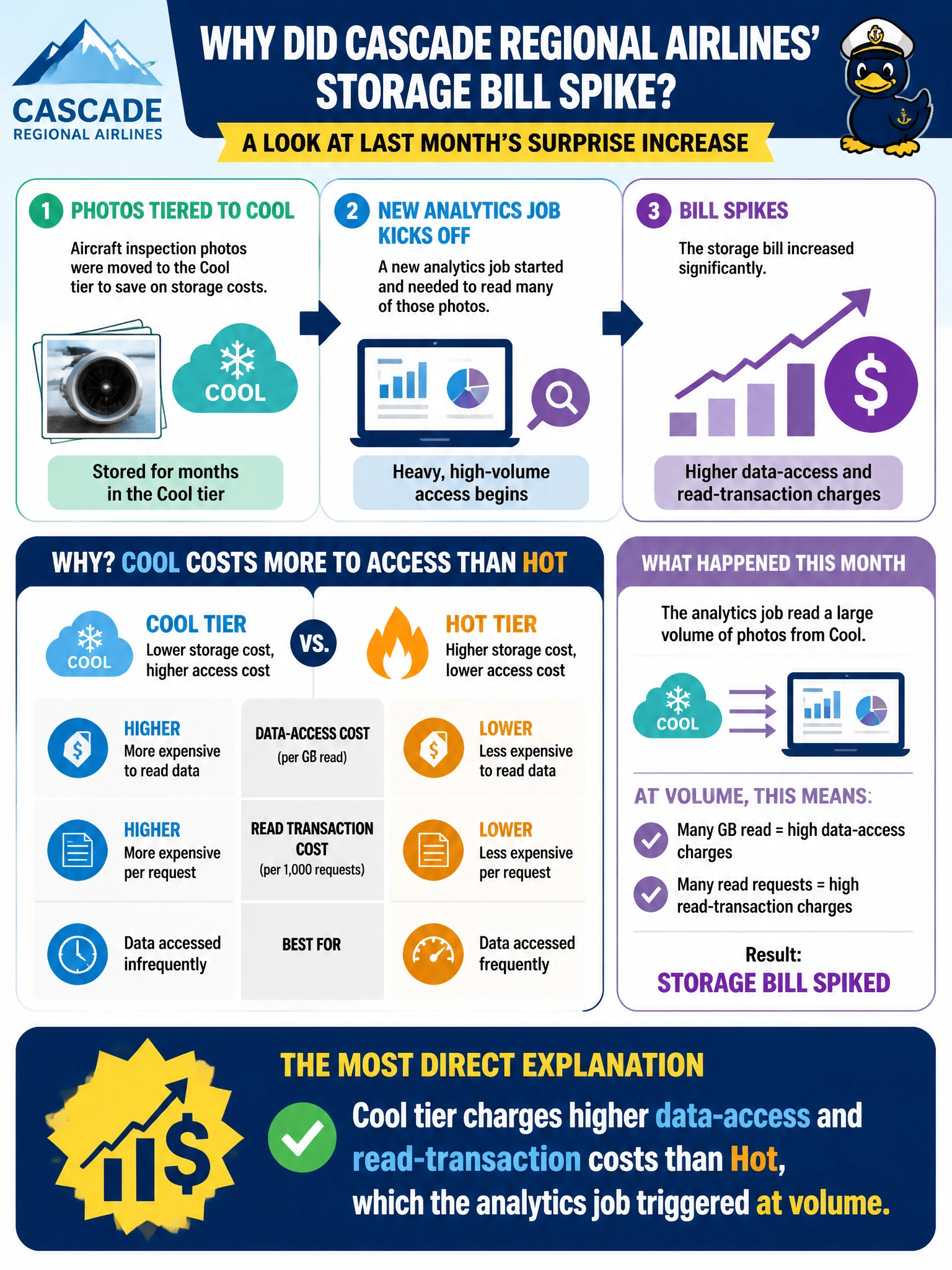
Cascade Regional Airlines' finance team asks why last month's storage bill spiked after a batch of aircraft inspection photos, tiered to Cool for months, was suddenly accessed heavily by a new analytics job? What most directly explains this cost increase?
Select an answer to reveal the explanation.
Short Explanation
Cool tier's whole pitch is a lower storage price in exchange for higher charges every time you actually touch the data, which is the opposite trade Hot makes. A brand-new analytics job hammering months of Cool-tier photos with reads is exactly the scenario where that access-cost trade-off bites hardest.
Full Explanation
Each access tier balances storage cost against access cost differently: Hot has the highest storage price but the lowest data-access and transaction costs, while Cool has a lower storage price specifically in exchange for meaningfully higher per-gigabyte data-retrieval and per-transaction charges, so a workload that suddenly reads Cool-tier data at volume — like a new analytics job scanning months of inspection photos — will see those access charges accumulate quickly even though the storage cost itself did not change. The claim that Cool storage costs more per gigabyte than Hot is backwards; Cool's entire value proposition is a cheaper storage rate for infrequently accessed data. Soft delete does not double storage charges automatically; it does add some incremental cost for retained deleted data during its retention window, but that is unrelated to a spike driven by a new heavy-read workload. Redundancy level is a setting an administrator changes explicitly (LRS, ZRS, GRS, and so on); it never auto-upgrades in response to traffic volume, and even if it did, redundancy affects replication cost, not read-transaction cost. A concrete check: review the storage account's cost breakdown in Cost Management by meter category to confirm the spike traces to 'Data Retrieval' and 'Read Operations' line items rather than a base storage or redundancy charge.