
A team is adding a feature that suggests a one-sentence reply to a customer-support agent while the agent is actively typing. The suggestion must appear in well under a second, and the source transcripts are short, routine exchanges rather than complex multi-step problems. When comparing options in the Foundry model catalog, which factor should most influence their choice of model?
Select an answer to reveal the explanation.
Short Explanation
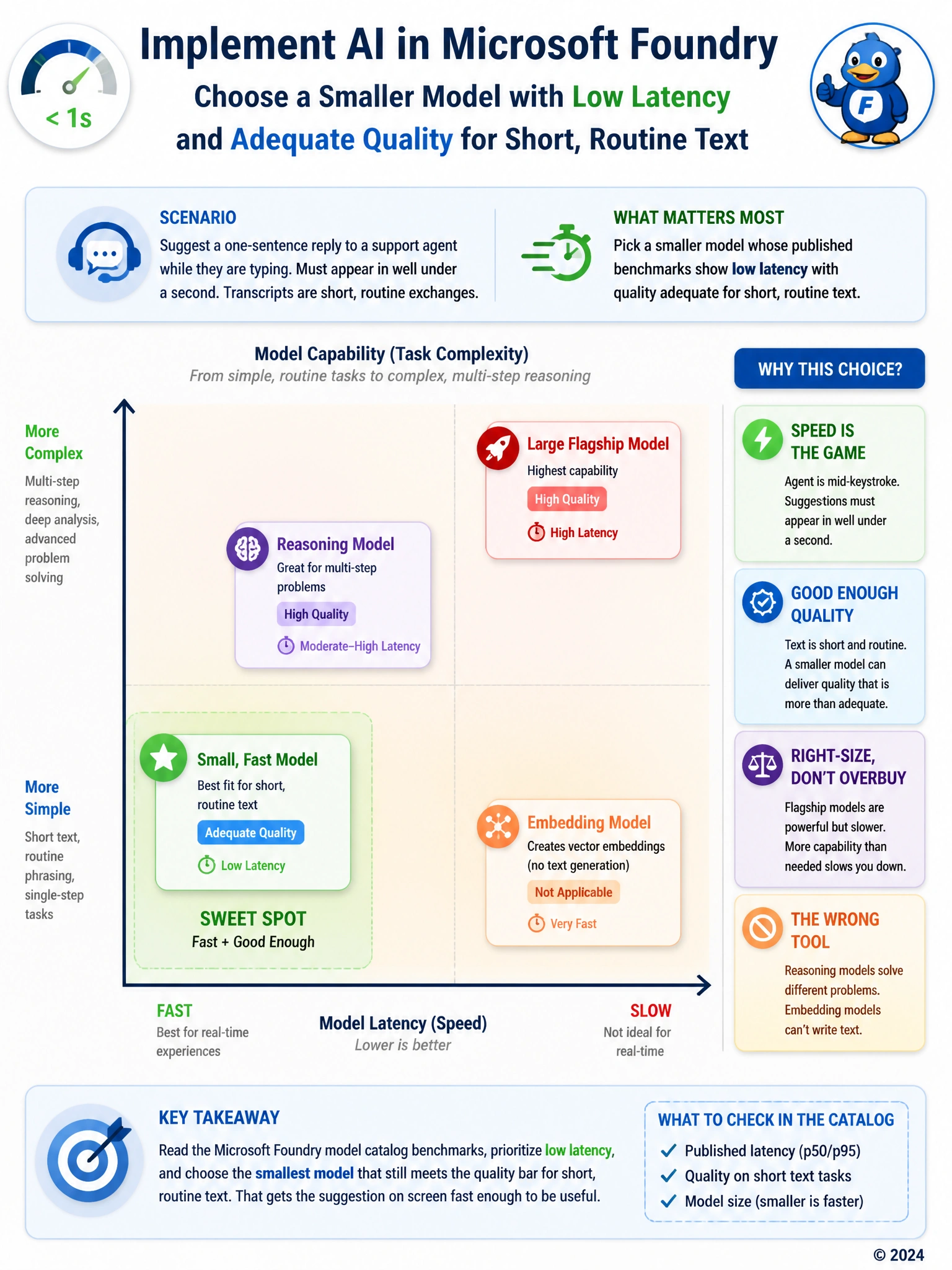
For a feature that has to whisper a suggestion into an agent's ear while they are mid-keystroke, speed is the whole game - the text itself is short and unremarkable, so there is no need to bring in the heaviest, most capable model available. The catalog publishes real latency numbers for a reason: picking a smaller model that scores well on speed and is still good enough for simple, routine phrasing gets the suggestion on screen fast enough to be useful. Reaching for the flagship model because it is the best one ignores that raw capability usually comes with slower responses, which defeats the point of a real-time feature. A model tuned for working through multi-step math problems is solving a completely different kind of task and its strengths do not transfer to dashing off a one-line reply. And a model that only produces vector embeddings cannot write text at all, so it is a non-starter regardless of speed. The right call here is reading the benchmarks for latency and picking the smallest model that clears the quality bar.
Full Explanation
The correct answer is A. The model catalog publishes latency and quality benchmarks alongside each model, and for a real-time typing-assist feature working on short, routine text, a smaller model that benchmarks fast with quality good enough for the task will meet the sub-second requirement without paying for capability the feature does not use. Option B is incorrect because the largest flagship model typically carries higher inference latency, and choosing it purely for maximum capability while ignoring the latency benchmark risks missing the sub-second target the feature depends on. Option C is incorrect because a model benchmarked for multi-step mathematical reasoning is optimized for a different kind of task; strength in reasoning chains says nothing about response speed on short routine text and is irrelevant to this feature's needs. Option D is incorrect because an embeddings-only model produces vector representations, not generated reply text, so it cannot perform the core function of suggesting a written reply at all. Matching the model choice to the catalog's latency and task-fit benchmarks, rather than defaulting to the most powerful available model, is what keeps a real-time suggestion feature responsive while still producing usable output.