
A consumer app team enables Azure AI Content Safety filtering on their Foundry-hosted chat model. During testing, the filter blocks many benign messages that merely mention violence in a news-discussion context, frustrating users. The team wants to reduce these false blocks for the violence category without disabling protection against genuinely harmful content. What should they do?
Select an answer to reveal the explanation.
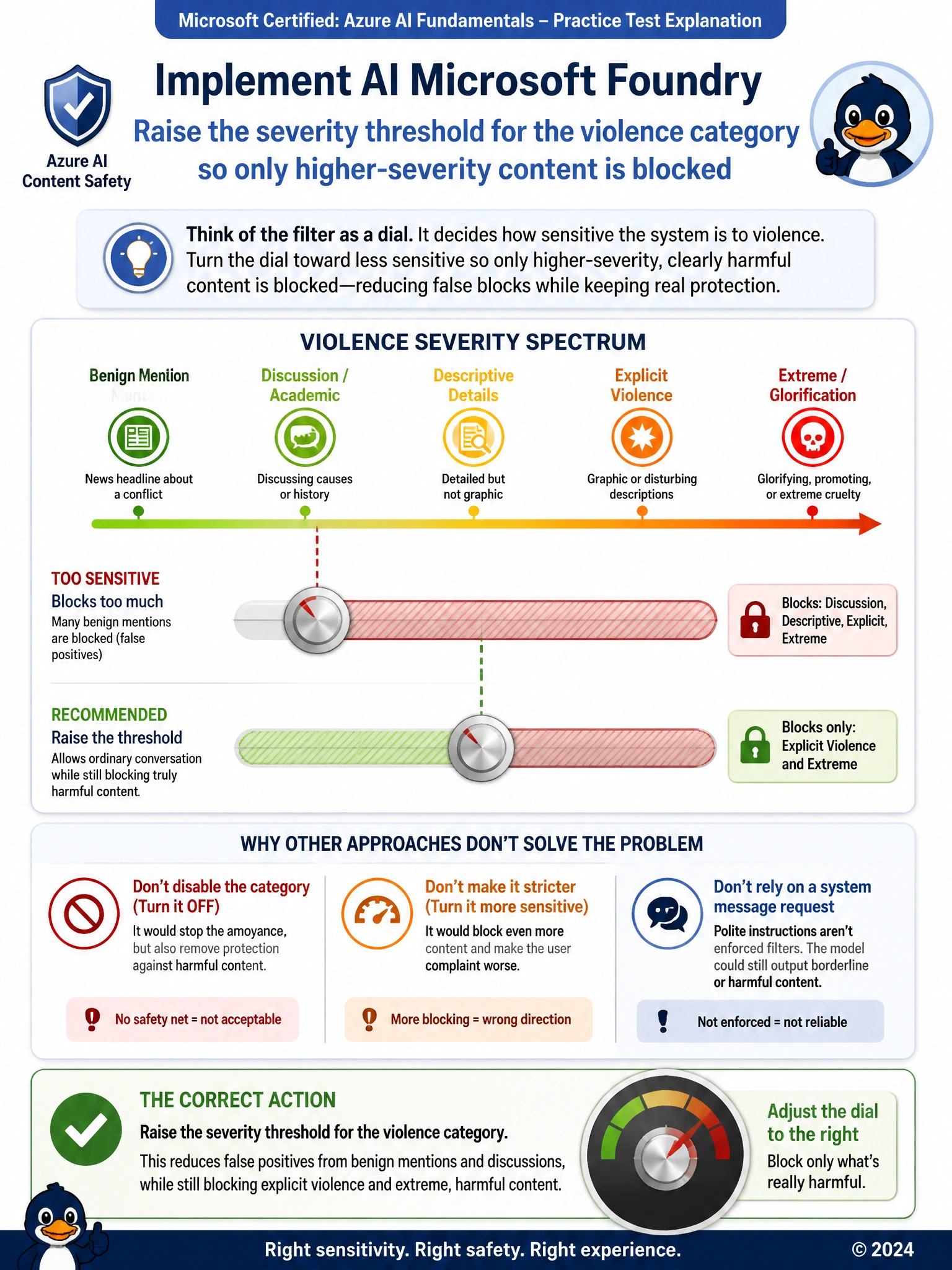
Short Explanation
Picture the filter as a dial that decides how sensitive it is to a topic - here, violence. Right now the dial is turned so sensitive that even a news headline mentioning a conflict trips it, which annoys real users who did nothing wrong. Turning the dial toward less sensitive - so it only reacts to the more severe, clearly harmful end of the scale - lets ordinary conversation through while still catching content that is actually dangerous. Turning the whole category off would fix the annoyance but also remove the safety net entirely, which is not what anyone wants. Turning the dial the other way, toward more sensitive, would only block more things and make the complaint worse. And swapping in a polite request in the system message does not replace an enforced filter - the model might still say something borderline, and there would be nothing independently checking it. The fix that actually matches the problem is adjusting how sensitive the existing filter is, not removing it or working around it with wording.
Full Explanation
The correct answer is C. Raising the severity threshold for the violence category means the filter only blocks content that scores at a higher severity level, letting lower-severity mentions such as a news reference to a conflict pass through while still catching genuinely graphic or harmful content at the top of the scale. This directly reduces false blocks without removing protection. Option A is incorrect because disabling the category entirely removes protection against actually harmful violent content along with the benign mentions, which overcorrects and reintroduces the risk the filter exists to manage. Option B is incorrect because lowering the threshold makes the filter stricter, blocking even more content and worsening the exact problem the team is trying to fix. Option D is incorrect because a system message is an instruction to the model, not an enforcement mechanism; it is not a substitute for the independently enforced content safety filter and does not reliably prevent the model from generating, or the filter from blocking, violent-sounding but harmless text. Tuning the severity threshold on the existing filter is the targeted fix: it keeps automated enforcement in place while recalibrating where the line between benign and harmful content sits for this specific category.