
A grocery chain is preparing to deploy a self-checkout camera system that flags unscanned items in the bagging area. Before the rollout, engineers run the model against thousands of hours of footage captured under fluorescent lighting, dim evening lighting, and glare from sunlight through storefront windows, and they configure the system to route any low-confidence detection to a cashier for manual review rather than automatically flagging the customer. Which Responsible AI principle does this testing and fallback design mainly reflect?
Select an answer to reveal the explanation.
Short Explanation
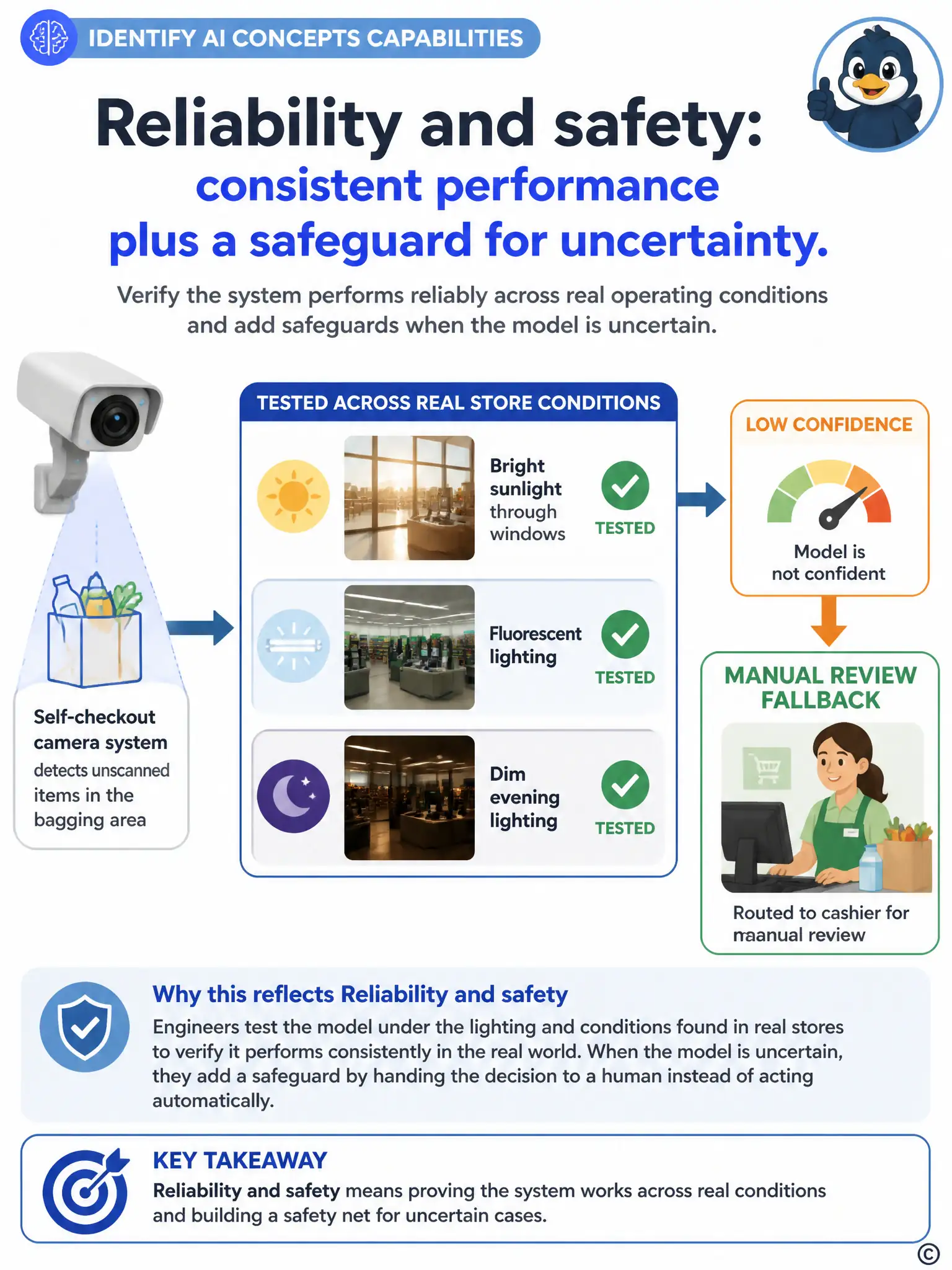
You’re testing whether the checkout model keeps working under fluorescent light, dim evening light, and glare, not just in a clean lab. You’re also making sure uncertain detections go to a cashier instead of automatically flagging a customer. That’s reliability and safety: consistent performance in real conditions plus a safeguard when the model isn’t sure.
Full Explanation
The correct principle is reliability and safety. Running the model against varied lighting conditions before launch, and routing uncertain detections to a human rather than acting on them automatically, is exactly what the reliability and safety principle asks for: verify the system behaves consistently across the real-world conditions it will face, and build in a safeguard for the cases where it cannot perform reliably. The privacy and security answer is incorrect because it concerns protecting the footage and detection logs from unauthorized access, which is not what the described testing and fallback are addressing. The fairness answer is incorrect because nothing in the scenario involves checking whether outcomes differ across demographic groups, which is what fairness testing would require. The inclusiveness answer is incorrect because inclusiveness is about accessibility for people with different abilities, and adding a human-review fallback for low-confidence detections is a safety safeguard, not an accessibility accommodation. The scenario is entirely about consistent, dependable performance and a controlled response when the model is unsure, which is the core of reliability and safety.