
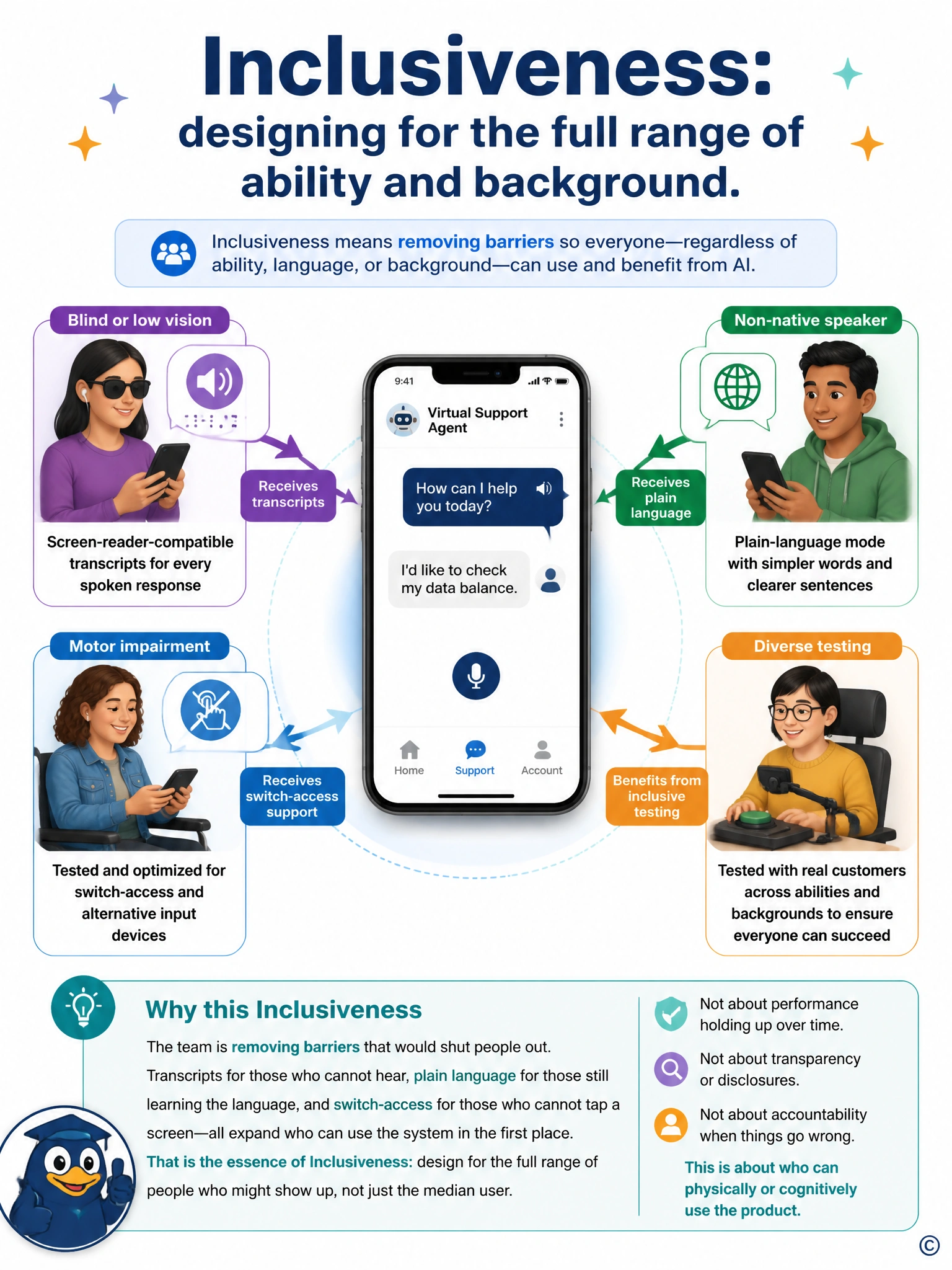
A telecom company is rolling out a virtual support agent embedded in its mobile app. Before launch, the team adds screen-reader-compatible transcripts for every spoken response, a plain-language mode for non-native speakers, and holds testing sessions with customers who have motor impairments and use switch-access devices. Which Responsible AI principle is this work primarily addressing?
Select an answer to reveal the explanation.
Short Explanation
Notice what the team is actually changing here: they are not tweaking accuracy or adding a disclaimer, they are removing barriers that would shut certain people out entirely. A transcript for someone who cannot hear, plain language for someone still learning the language, switch-access support for someone who cannot tap a screen, that is all about widening who can use the thing in the first place. That is the whole idea behind one of the responsible AI principles: build for the full range of people who might show up, not just the median user. The other choices describe real and important ideas, but they are about different problems. One is about the system holding up consistently once it is out in the world. Another is about being upfront regarding how the system reaches its answers and where it falls short. A third is about making sure real people are on the hook when something goes wrong. None of those touch on who can physically or cognitively use the product, which is the specific gap being closed in this scenario.
Full Explanation
The correct answer is A. The team is deliberately removing barriers that would otherwise exclude entire groups of users, screen-reader transcripts for people who are blind or low vision, a plain-language mode for non-native speakers, and switch-access testing for people with motor impairments, which is exactly what the inclusiveness principle covers: building AI that works for people with diverse abilities, backgrounds, and circumstances rather than only the average user. Option B is incorrect because reliability and safety is about the system behaving consistently and predictably under varied operating conditions, such as noisy audio or unusual phrasing, not about accessibility for different user groups. Option C is incorrect because transparency concerns disclosing how the system works and what it cannot do, not adapting the interface for different abilities. Option D is incorrect because accountability is about having identifiable people or teams answerable for the system's behavior and outcomes, which is a governance function separate from the accessibility features described here.