
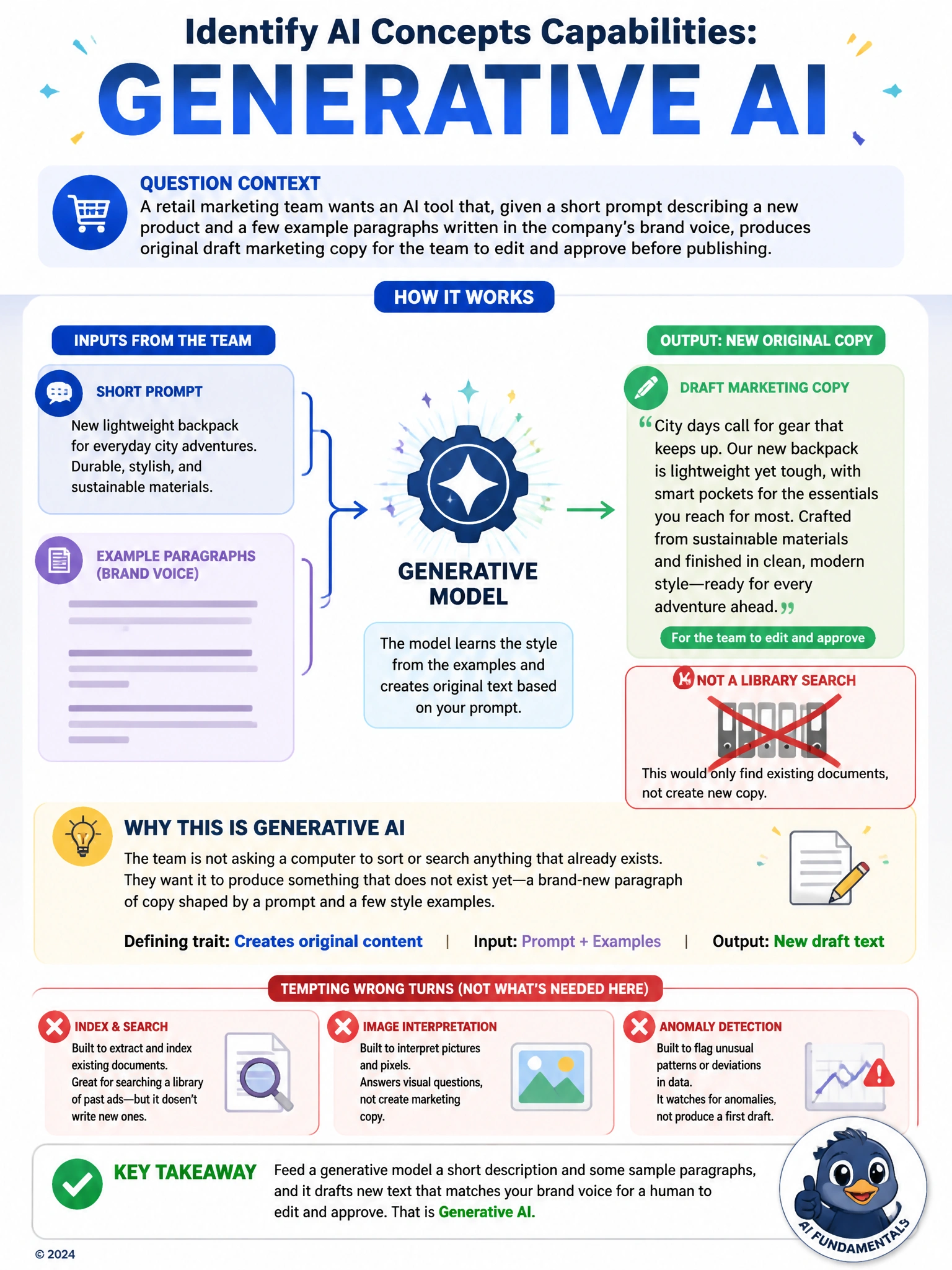
A retail marketing team wants an AI tool that, given a short prompt describing a new product and a few example paragraphs written in the company's brand voice, produces original draft marketing copy for the team to edit and approve before publishing. Which AI workload does this describe?
Select an answer to reveal the explanation.
Short Explanation
The marketing team is not asking a computer to sort or search anything that already exists, they want it to produce something that does not exist yet, a brand-new paragraph of copy shaped by a prompt and a few style examples. That is the defining trait of a system that creates original content rather than organizing or classifying existing content. Feed it a short description and some sample paragraphs, and it drafts new text mimicking that voice for a human to edit and approve. The tempting wrong turns: a system built to extract and index existing documents would help someone search a library of past ads, not write a new one. A system built to interpret pictures answers a completely different kind of question involving pixels rather than words. And a system built to flag unusual patterns is watching for deviations in data, not producing a first draft of anything.
Full Explanation
The correct answer is D. Producing new draft marketing copy from a short prompt and a handful of brand-voice examples is a generative AI task: the system creates original text that did not exist before, shaped by the style patterns it was shown, for a human to review and approve. Option A is incorrect because knowledge mining extracts and organizes information from an existing body of content, such as making an archive searchable, rather than generating new prose from a prompt. Option B is incorrect because computer vision interprets and analyzes image or video data, which is unrelated to a task involving text prompts and written brand voice. Option C is incorrect because anomaly detection identifies data that deviates from a learned normal pattern, a concept that does not apply to producing creative marketing text on request. The marketing team's requirement, turning a short description and stylistic examples into new draft copy, matches the defining capability of generative AI: producing original content rather than classifying, searching, or flagging existing data.