
A corporate legal team has forty years of scanned contracts stored as PDF images with no searchable index. They want an AI solution that extracts entities such as party names, dates, and clause types from the scanned documents and builds a searchable index so paralegals can quickly locate every contract mentioning a specific counterparty. Which AI workload category best describes this solution?
Select an answer to reveal the explanation.
Short Explanation
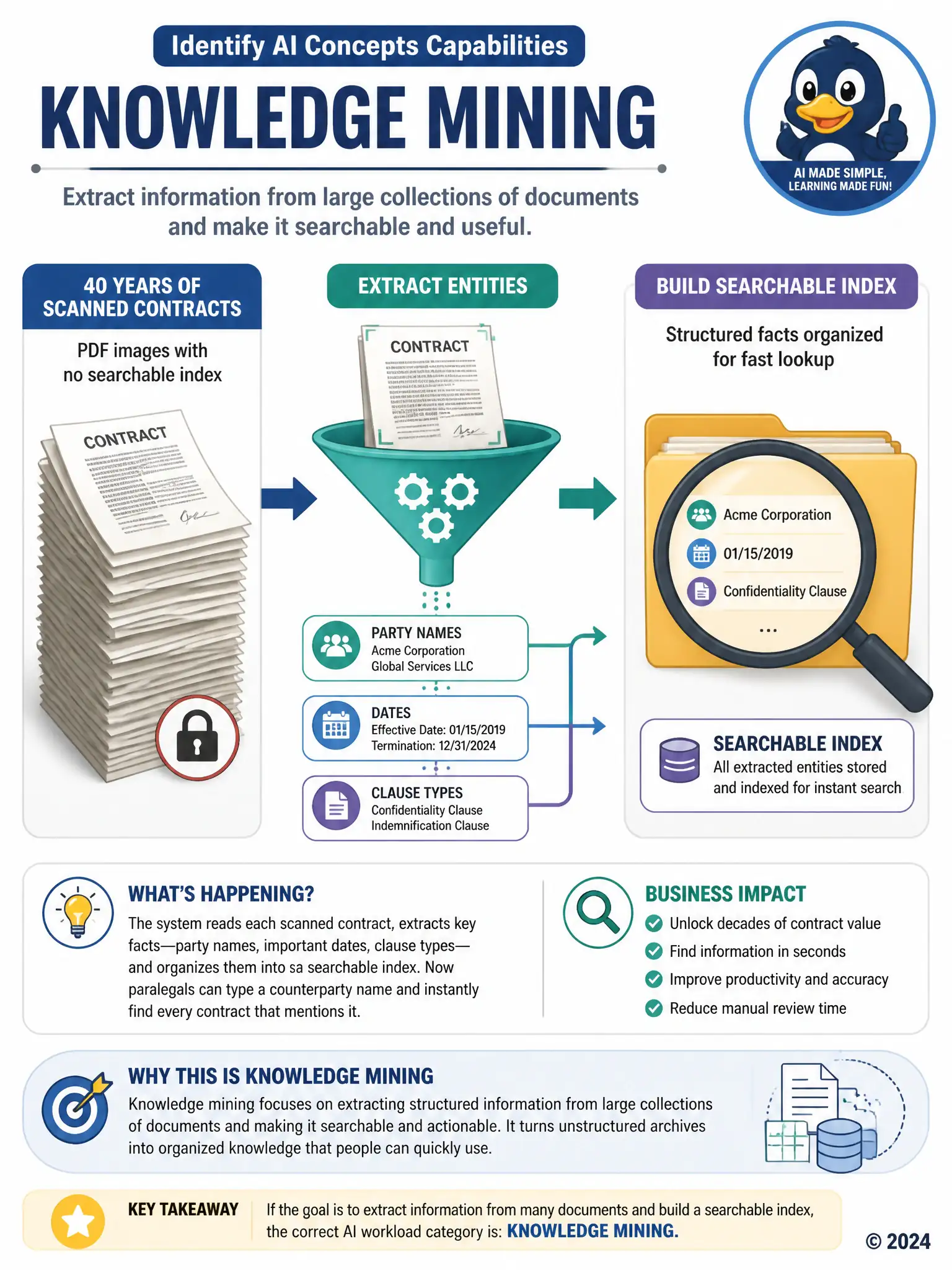
Forty years of scanned contracts are basically locked in a filing cabinet until you extract the facts. You need knowledge mining to pull out party names, dates, and clause types, then build a searchable index so paralegals can find every mention of a counterparty. It’s not about creating new text, spotting odd events, or learning from rewards.
Full Explanation
Knowledge mining is the best fit because extracting structured facts such as party names, dates, and clause types from scanned contract images and organizing them into a searchable index is the defining pattern of knowledge mining. This workload turns a large body of unstructured or semi-structured content into something people can search and query efficiently. Generative AI is incorrect because it produces new original content, such as drafting new contract language, rather than extracting and indexing information that already exists across an archive of documents. Anomaly detection is incorrect because it identifies data points or events that deviate from an established normal pattern, which does not describe building a searchable index of contract terms. Reinforcement learning is incorrect because it trains a model through trial and error using rewards and penalties, a training approach unrelated to extracting entities from scanned documents and indexing them for search. The legal team's goal, letting paralegals instantly locate every contract mentioning a given counterparty, depends on entity extraction and search indexing over an existing document archive, which is exactly the workload knowledge mining is built to deliver.