
A logistics company hosts live conference calls between English-speaking dispatchers and Spanish-speaking drivers and wants each spoken sentence translated into the other party's language and spoken back almost immediately during the live call, rather than produced afterward as a written transcript. Which AI capability addresses this requirement?
Select an answer to reveal the explanation.
Short Explanation
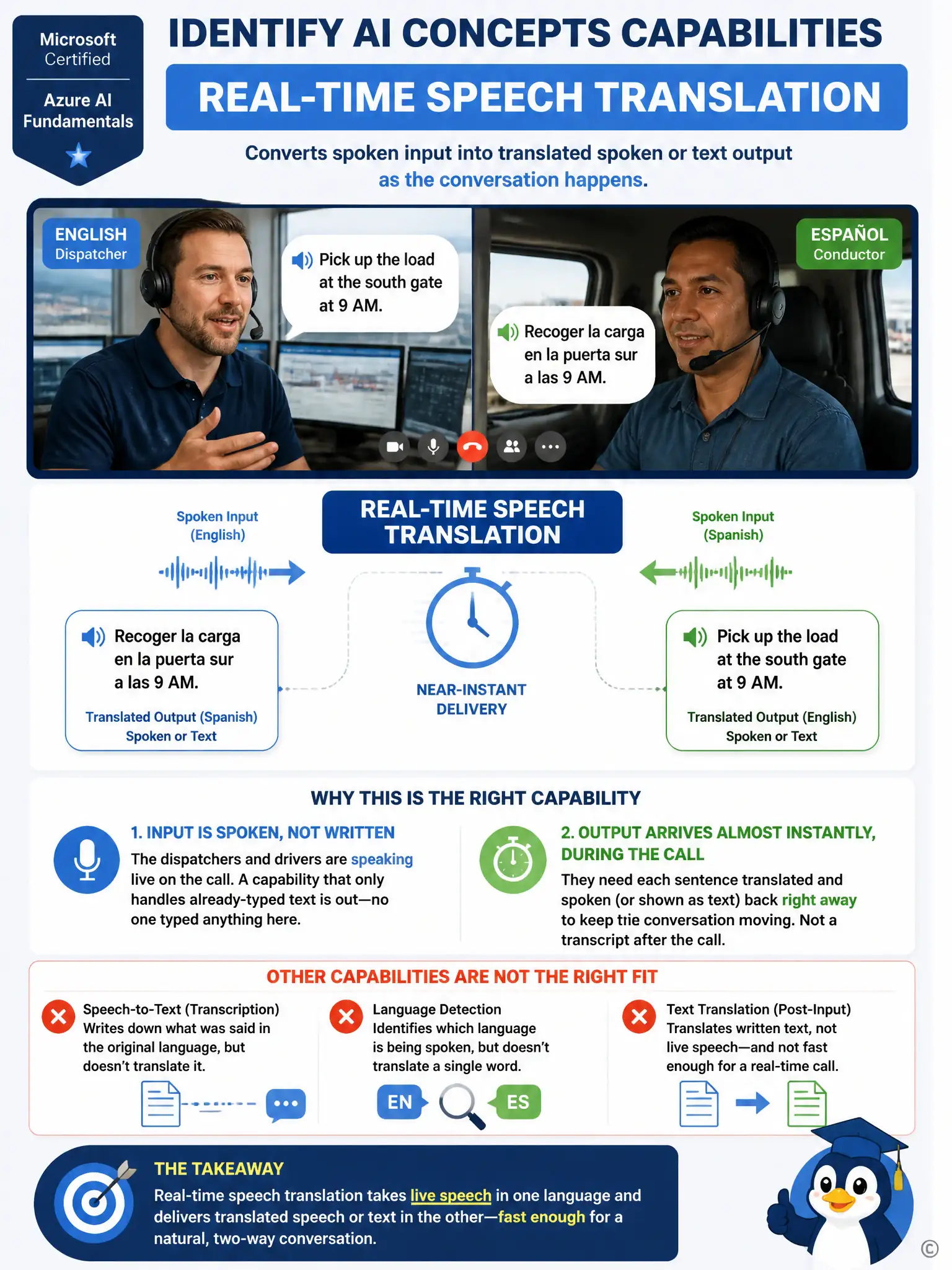
You need a capability that takes live speech in one language and returns translated speech or text fast enough to keep the call moving. Text-only translation, same-language transcription, and language detection don't meet the live spoken translation requirement.
Full Explanation
The correct capability is real-time speech translation, because it is designed to take spoken audio as input and produce translated output, spoken or written, within the live flow of a conversation, which matches the requirement for near-immediate translation during an active call. Text translation is incorrect because it operates on already-written text; it requires the spoken words to first be transcribed and would not, by itself, deliver a live spoken translation during the call. Speech-to-text transcription is incorrect because it only converts audio into a written transcript in the same language it was spoken; it produces no translation at all, so a Spanish-speaking driver's words would remain in Spanish text. Language detection is incorrect because it merely identifies which language is being used; it never converts or translates anything and would need to be paired with additional capabilities to be useful here. The specific combination of spoken input, translated output, and near-immediate delivery during a live call is exactly what real-time speech translation is built for.