
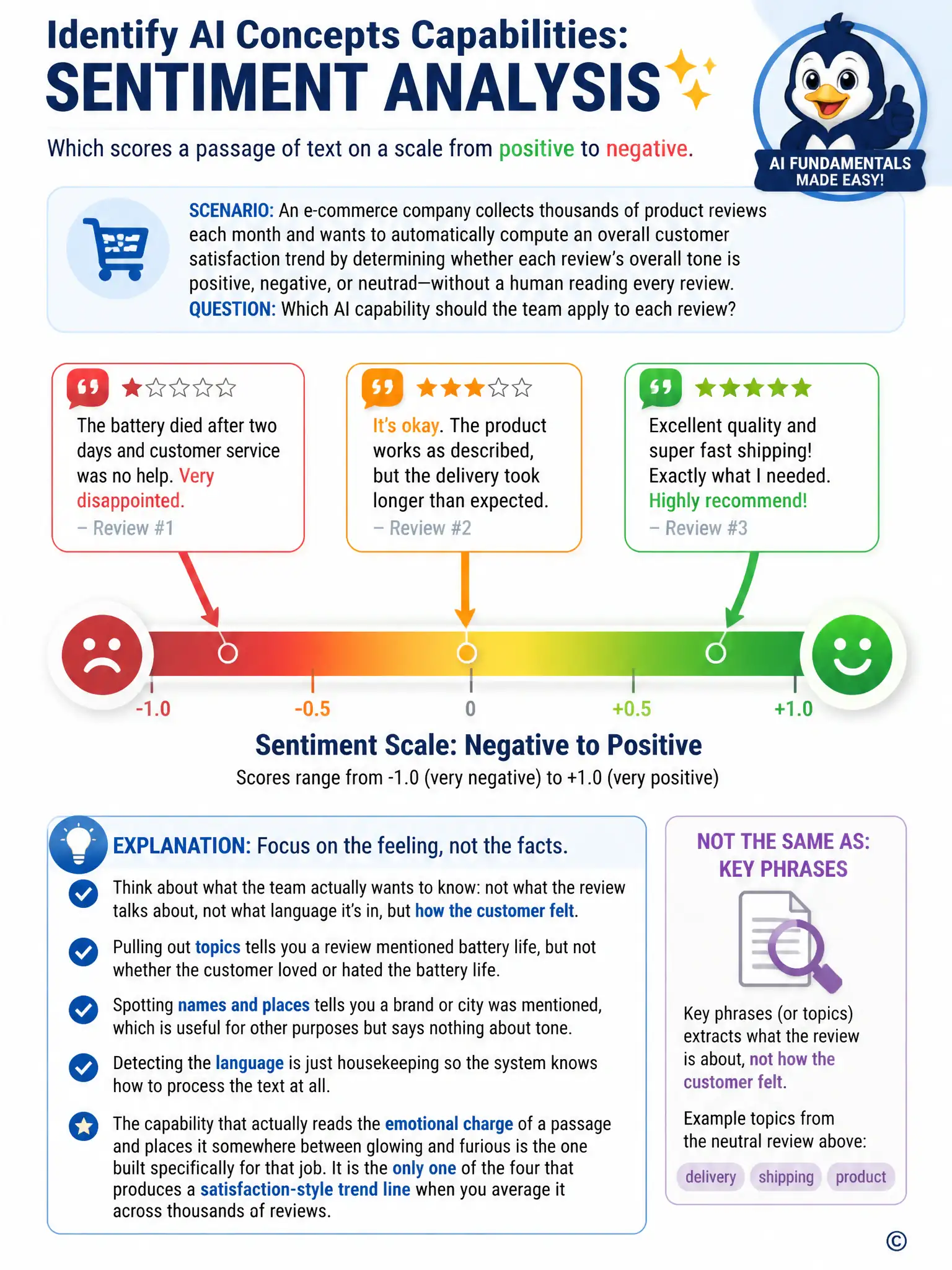
An e-commerce company collects thousands of product reviews each month and wants to automatically compute an overall customer satisfaction trend by determining whether each review's overall tone is positive, negative, or neutral, without a human reading every review individually. Which AI capability should the team apply to each review?
Select an answer to reveal the explanation.
Short Explanation
You're not asking what the review talks about; you're asking how the customer felt. Sentiment analysis scores each review using positive-to-negative polarity, so you can average thousands of scores into overall satisfaction trend.
Full Explanation
The correct capability is sentiment analysis, which scores text on positive-to-negative polarity scale. The team needs per-review polarity scores, positive, negative, or neutral, aggregated into satisfaction trends, and that is exactly what sentiment analysis produces: it reads the passage and returns where it falls on the opinion scale. Key phrase extraction is incorrect because it identifies main topics or talking points in reviews, such as 'battery life' or 'shipping delay', but it does not judge whether those topics were discussed favorably or unfavorably. Named entity recognition is incorrect because it labels concrete entities like brand names, people, or locations mentioned in text; it has no notion of tone and would not distinguish glowing reviews from scathing ones. Language detection is incorrect because it only identifies which natural language the review is written in, as preprocessing step that might run before analysis but tells the team nothing about customer satisfaction. Only sentiment analysis directly answers the question the team is asking: was this review positive or negative.