
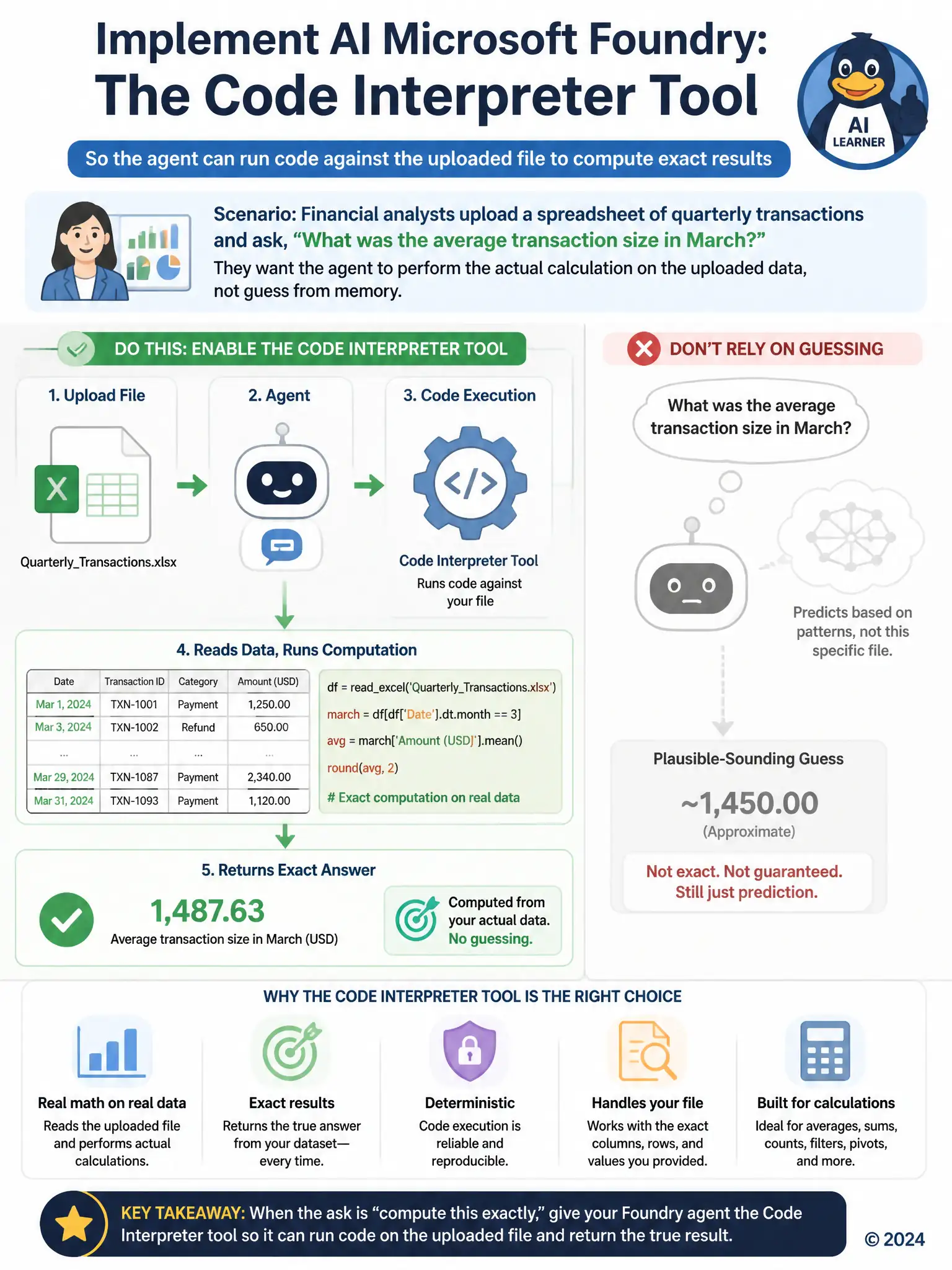
A financial analyst team wants their Foundry-hosted agent to let users upload a spreadsheet of quarterly transactions and ask questions such as 'what was the average transaction size in March,' with the agent performing the actual calculation on the uploaded data rather than guessing from memory. Which Foundry Agent Service capability should the team enable?
Select an answer to reveal the explanation.
Short Explanation
What the analysts want is real math on real numbers, not a plausible guess. Enable the code interpreter tool so the agent can run code against the uploaded spreadsheet, read the March rows, calculate the average, and hand back the exact figure. Instructions, fine-tuning, and retrieval might help context, but they don't guarantee actual computation.
Full Explanation
The capability to enable is the code interpreter tool. It lets a Foundry agent write and execute code against an uploaded file, so when a user asks for the average transaction size in March, the agent can actually run a calculation over the real numbers in the spreadsheet and return an exact result rather than an estimate produced purely from language generation. The custom system message instructing the agent to calculate carefully is incorrect because a system message can tell the agent to be careful, but the underlying model still generates its answer through language prediction rather than genuine computation, so exact figures like an average across many rows are not reliably guaranteed. The fine-tuning approach on sample spreadsheets so it learns typical transaction patterns is incorrect because fine-tuning trains the model on example patterns it has seen before, which helps with style or typical structure but does not let the model compute a precise statistic on a new spreadsheet's specific values months after training. The retrieval-augmented generation approach connected to the spreadsheet as a text data source is incorrect because retrieval-augmented generation is built to pull relevant passages of text for the model to reference, not to execute numeric operations, so it could surface rows from the file but would not reliably perform an accurate calculation across them.