
A market-research firm needs to summarize 50,000 archived customer-interview transcripts stored in blob storage. The summaries are needed by tomorrow morning for a report, but no one needs any individual summary right away, and the firm wants to minimize the per-request cost of calling its Foundry-hosted model. Which deployment approach should the firm use to process the transcripts?
Select an answer to reveal the explanation.
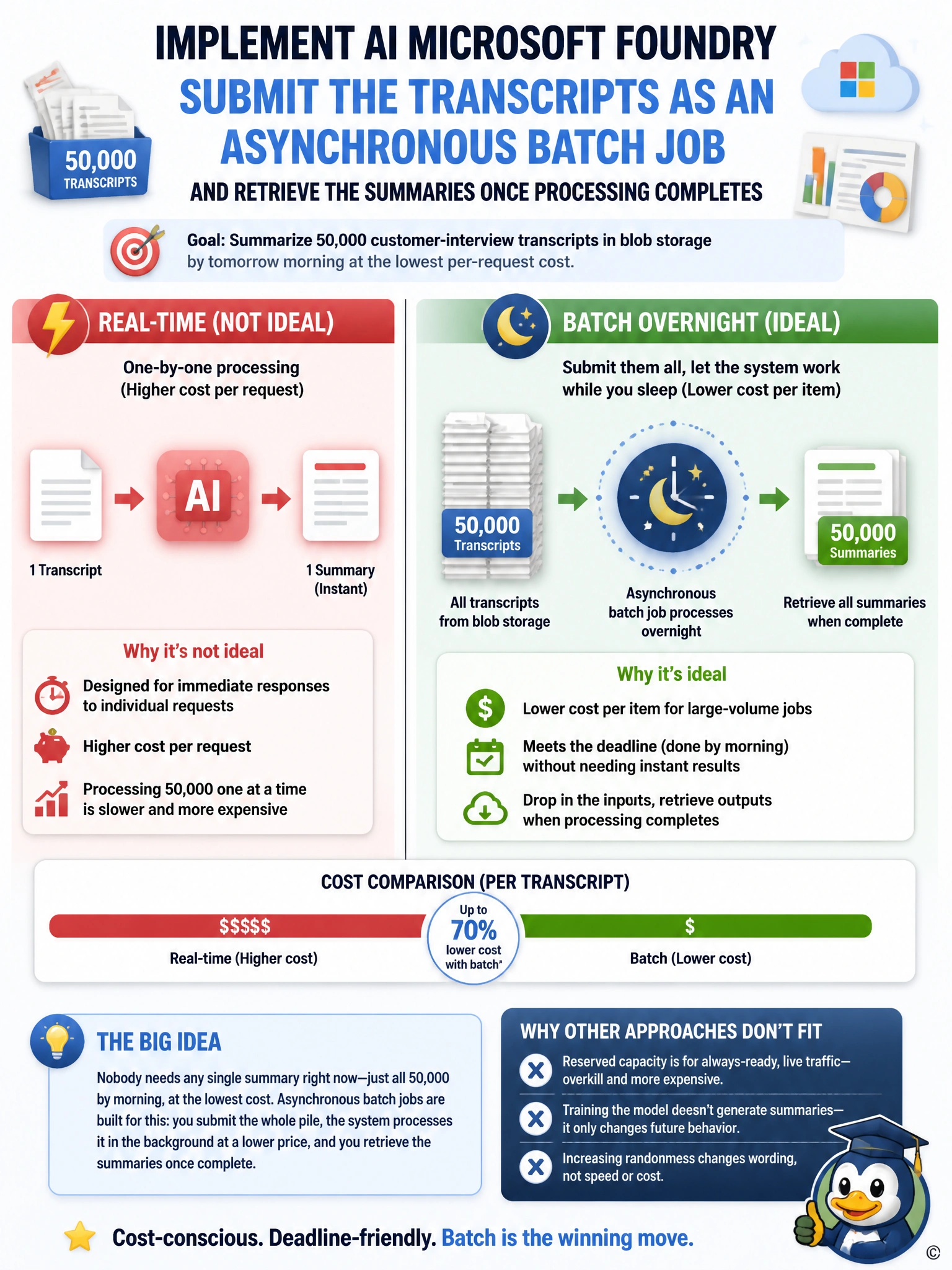
Short Explanation
Think about what actually matters here: nobody needs any single summary right now, they just need all 50,000 done by morning, and every dollar per request counts. That's the textbook case for an asynchronous batch job — you drop the whole pile of transcripts in, walk away, and let the system chew through them at a lower price because it's not promising instant answers. Paying for reserved, always-ready capacity meant for live, latency-sensitive traffic would be overkill and more expensive here, since nothing about this task needs instant responses. Training the model on the transcripts wouldn't get you summaries either — training teaches a model new habits for future requests, it doesn't hand back a write-up of what it just read. And cranking up randomness settings might make the wording more varied, but it does nothing for speed or your bill. The cost-conscious, deadline-friendly move is the batch path.
Full Explanation
The correct answer is B. Foundry's batch processing option lets you submit a large set of independent requests as an asynchronous job that runs when capacity allows, and it is priced at a discount specifically because none of the individual results are needed immediately, which matches a firm that only needs all 50,000 summaries by tomorrow morning and cares about minimizing per-request cost. Option A is incorrect because provisioned throughput is designed for steady, latency-sensitive real-time traffic, and its reserved-capacity pricing is meant to guarantee low-latency responses, not to discount one-off bulk jobs, so it would cost more than necessary for work with no immediate deadline. Option C is incorrect because fine-tuning changes how a model responds to future prompts by training on examples; it does not produce summaries of the training data itself, so the transcripts would still need to be summarized afterward through separate requests. Option D is incorrect because temperature controls the randomness and creativity of generated text, not the speed of generation or the cost per request, so adjusting it would have no effect on either the report deadline or the firm's cost goal.