
A developer is building a Foundry Agent Service agent for an e-commerce site. When a shopper asks whether a specific item is currently in stock, the agent must query the live inventory database and return the real quantity at that moment, not a memorized answer. Which capability should the developer configure the agent to use?
Select an answer to reveal the explanation.
Short Explanation
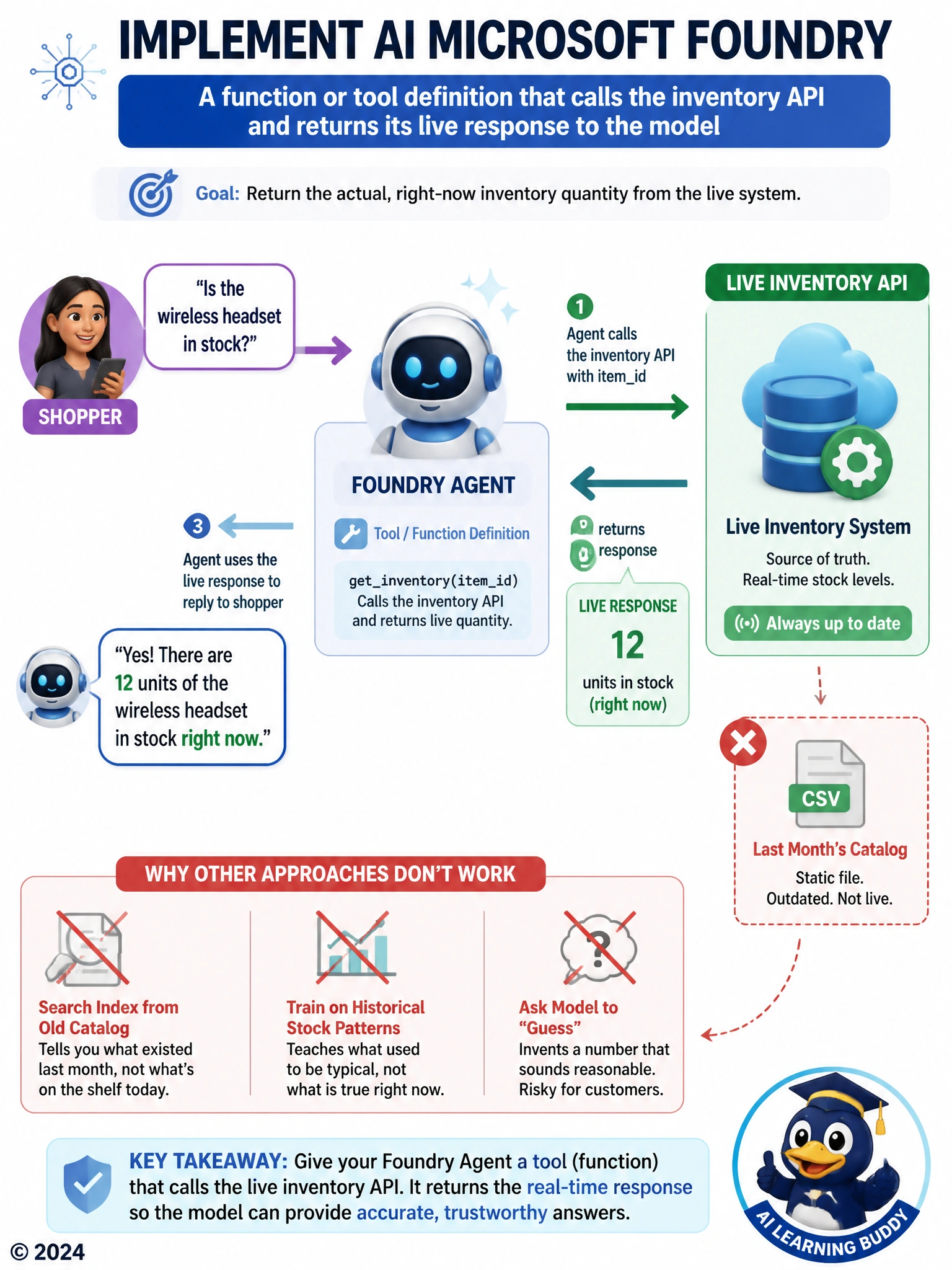
The shopper wants to know the actual, right-now count of an item, and no amount of training data or clever wording gets you that, because stock levels change by the minute. What actually works is giving the agent a way to reach out and call the real inventory system while the conversation is happening, so it hands back the true number instead of anything remembered or guessed. A search index built from an old catalog file only tells you what existed last month, not what is on the shelf today. Training the model on historical stock patterns just teaches it what used to be typical, which is not the same as what is true right now. And telling the model to make an educated guess is really just asking it to invent a number that sounds reasonable, which is risky when a customer might place an order based on it.
Full Explanation
The correct answer is C. Configuring the agent with a function or tool definition that calls the live inventory API lets the model request real-time data during the conversation and return the actual quantity on hand at that exact moment, which is exactly what the shopper is asking about. Option A is incorrect because a retrieval-augmented generation index built from last month's catalog PDF is a static snapshot; it can describe what a product is but cannot report a quantity that changes by the hour. Option B is incorrect because fine-tuning on historical stock-level examples teaches the model patterns from the past, not the current live count, so it would produce a plausible-sounding but potentially wrong number. Option D is incorrect because instructing the model to guess a reasonable stock level through a longer system message produces an invented answer with no connection to the actual database, which is worse than saying nothing, since a shopper acting on a guessed number could be misled into ordering something that is not actually available. Only a live function call reaches outside the model to the authoritative, moment-in-time source of truth.