
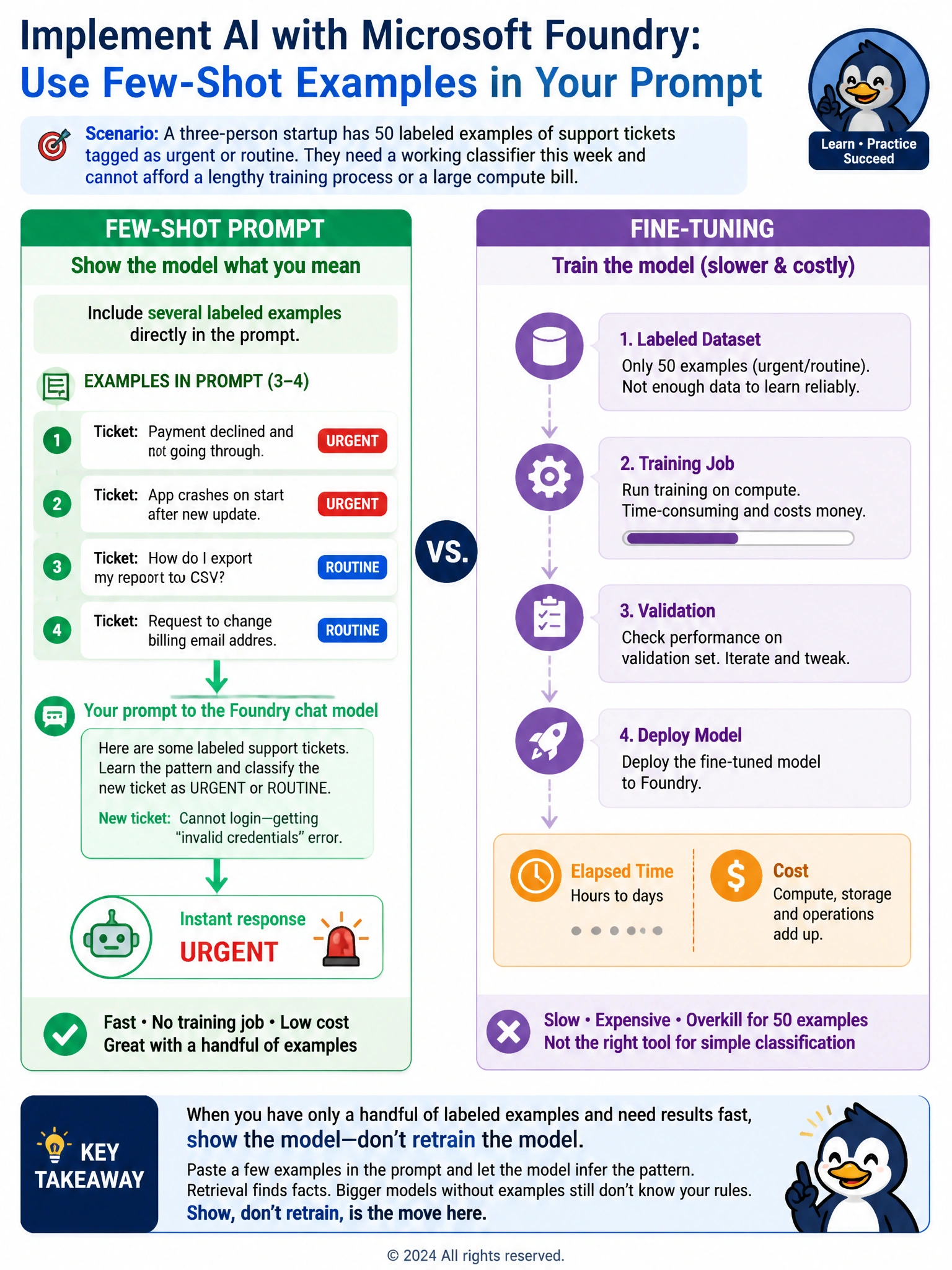
A three-person startup has 50 labeled examples of support tickets tagged as urgent or routine. The team needs a working classifier this week and cannot afford a lengthy training process or a large compute bill. They plan to build the feature using a Foundry-hosted chat model.
Select an answer to reveal the explanation.
Short Explanation
When you only have a handful of examples and no time or budget for a training run, the fastest path is just showing the model what you mean, right inside the prompt. Paste in a few tickets you've already labeled as urgent or routine, and the model picks up the pattern from those examples alone, no separate training job required. Training a model from scratch on 50 examples is like trying to teach a new hire a nuanced judgment call from a single afternoon of notes, it is not enough data to lock in reliable behavior, and it costs time and money to run. A retrieval setup solves a different problem entirely, that is for finding facts in a big pile of documents, not for teaching a yes or no distinction. And just switching to a bigger, fancier model without giving it any examples does nothing, the model still does not know what counts as urgent for this specific business. Show, don't retrain, is the move here.
Full Explanation
The correct answer is B. With only 50 examples and a tight timeline, few-shot prompting lets the team paste several labeled tickets directly into the prompt so the model infers the urgent-versus-routine pattern immediately, with no training job, no compute bill, and results available the same day. Option A is incorrect because fine-tuning needs a proper training and validation split, incurs training compute cost, and 50 examples is a thin dataset for reliable fine-tuning, all of which fights the team's time and budget constraints. Option C is incorrect because a vector index and retrieval are built for finding and grounding answers in a large document collection, not for teaching a model a two-class labeling decision from a handful of examples. Option D is incorrect because swapping to a larger model without giving it any examples or guidance does not tell it what 'urgent' means for this company's tickets; a bigger model with an unchanged, example-free prompt will not reliably learn the distinction. Few-shot prompting matches the constraint of small data, small budget, and fast turnaround better than any of the alternatives.