
A media monitoring service ingests thousands of news articles per day and needs to automatically pull out the specific companies, people, and locations mentioned in each article so analysts can search and filter by those entities later. Which natural language processing capability should the service use?
Select an answer to reveal the explanation.
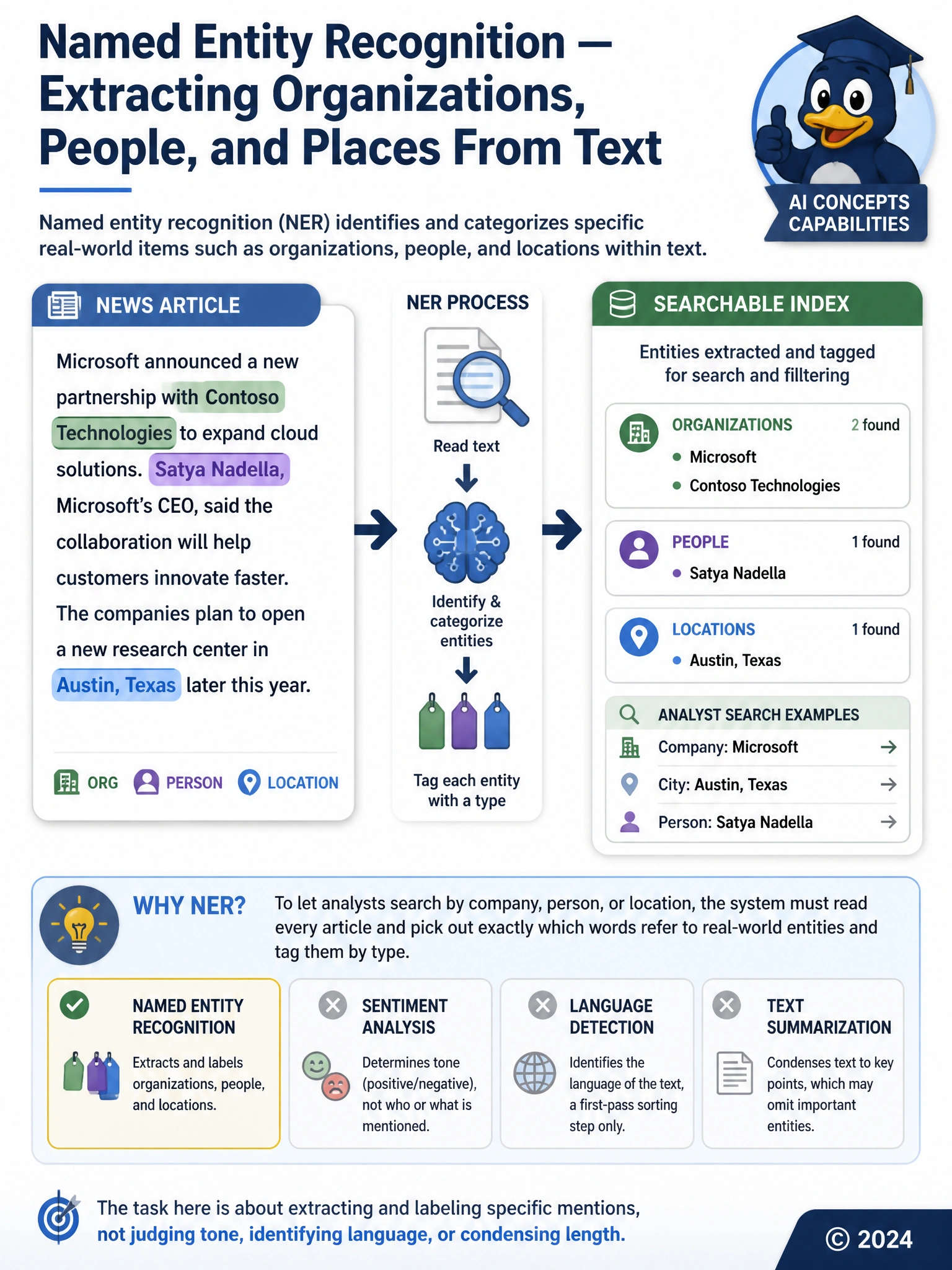
Short Explanation
Picture an analyst who wants to type in a company name and pull up every article that mentions it, or filter by a specific city. To make that possible, something has to read every article and pick out exactly which words refer to a company, a person, or a place, and tag each one accordingly. That's a very specific job, spotting and labeling real-world things by category inside a wall of text, and it's a different job from scoring whether an article sounds upbeat or negative, which tells you tone but nothing about who or what is mentioned. It's also different from figuring out what language the article was written in, which is just a first-pass sorting step before any real analysis happens. And it's different from shrinking an article down to a few key sentences, since a summary might easily leave out a smaller company or a passing mention of a location that an analyst still needs indexed. The task here is squarely about extracting and labeling specific mentions, not judging tone, identifying language, or condensing length.
Full Explanation
The correct answer is B. Named entity recognition is the natural language processing capability built specifically to scan text and identify and categorize real-world items such as organizations, people, and locations, which is exactly what the service needs in order to let analysts search and filter articles by those entities. Option A is incorrect because sentiment analysis produces a positive, negative, or neutral tone score for a passage of text; it says nothing about which specific companies, people, or places are mentioned, so it cannot power entity-based search and filtering. Option C is incorrect because language detection only identifies which natural language an article is written in, such as English or Spanish, which is unrelated to pulling out the entities mentioned inside the article's content. Option D is incorrect because text summarization condenses an article into a shorter version of its key points, but a summary does not reliably enumerate every organization, person, and location mentioned in a structured, searchable way, which is what the analysts specifically require. Because the task is extracting and categorizing specific real-world mentions from free text, named entity recognition is the fitting capability.