
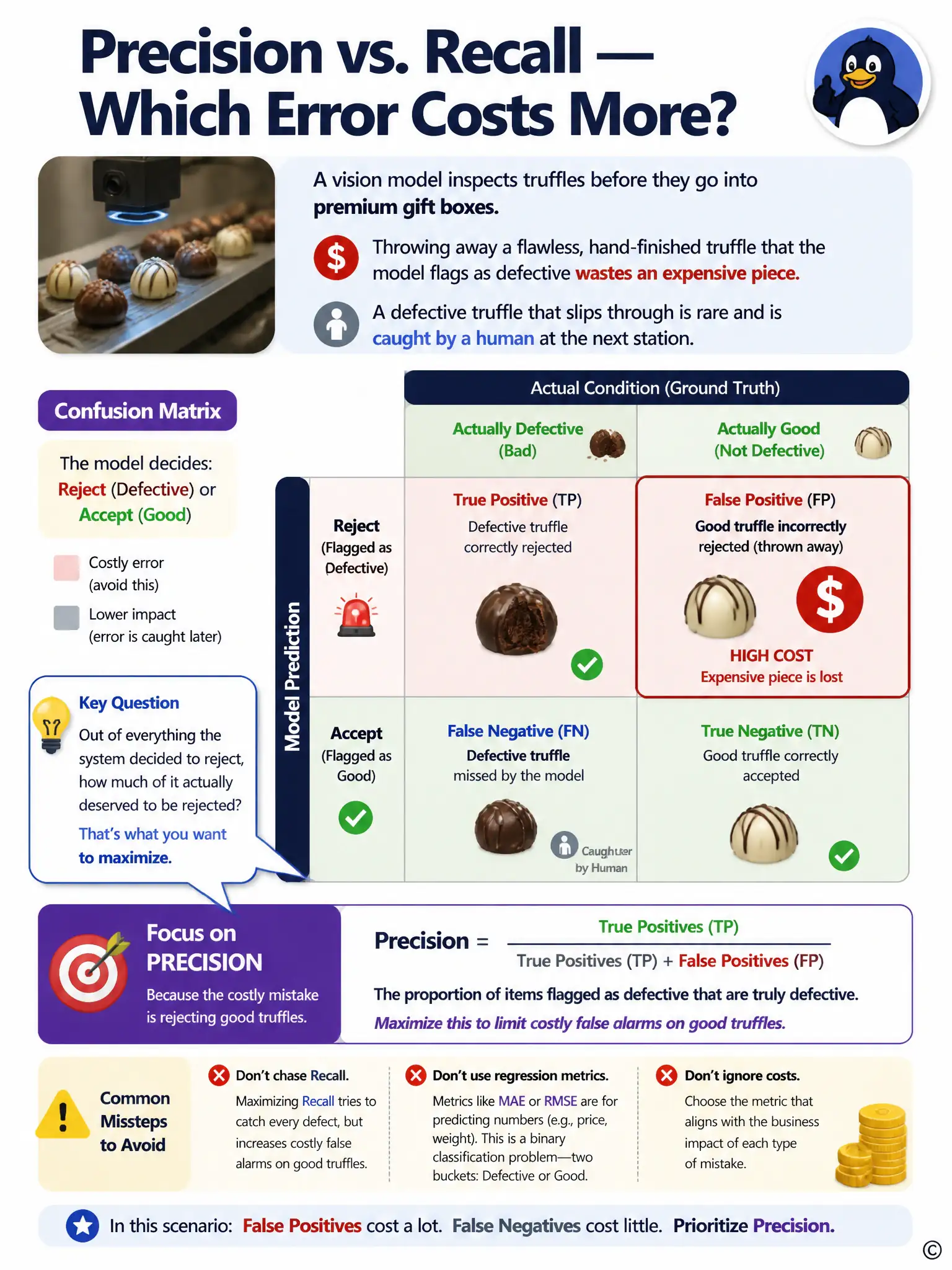
A specialty chocolatier uses a vision model to inspect truffles on its packaging line before they go into gift boxes sold at a premium price. Discarding a perfectly good truffle that the model mistakenly flags as defective wastes an expensive, hand-finished piece, while a genuinely defective truffle that slips through is rare and is usually caught by a human at the next station anyway. Which evaluation metric should the team prioritize when tuning the model's decision threshold?
Select an answer to reveal the explanation.
Short Explanation
Ask which mistake actually costs money. Here, tossing a flawless truffle is the expensive error, so you want to maximize precision—out of everything flagged defective, how much truly is defective. Chasing recall catches every defect but raises costly false alarms, and numeric regression metrics don't apply to this two-bucket classification problem.
Full Explanation
The correct answer is precision, because it measures, out of everything the model flagged as defective, how many were actually defective; maximizing precision directly reduces the number of good truffles wrongly discarded, which is exactly the costly mistake described in the scenario. The recall-focused choice is incorrect because prioritizing recall would push the model to catch every last defect at the expense of raising more false alarms, which in this scenario is the wrong tradeoff since false alarms are the expensive error and missed defects are cheaply caught downstream by a human. The mean squared error choice is incorrect because mean squared error applies to regression tasks that predict a continuous numeric value, such as a price or a temperature, not to a classification task that sorts truffles into defective or acceptable categories. The R-squared choice is incorrect for the same reason: R-squared describes how well a regression model's predicted values track actual observed values, which has no meaning for a model producing a defective versus acceptable classification. Because this is a classification problem with an asymmetric cost that favors avoiding false positives, precision is the metric that should guide threshold tuning.