
A consumer platform's Foundry-hosted assistant is being reviewed before launch. The moderation team wants the content filtering configuration to catch both attempts to manipulate the model into ignoring its instructions and content that promotes self-harm, while still tolerating the ordinary casual rude language the team expects from a general audience. (Select TWO.) Which two actions should the team take when configuring the deployment's content filters?
Select all correct answers, then click Submit.
Short Explanation
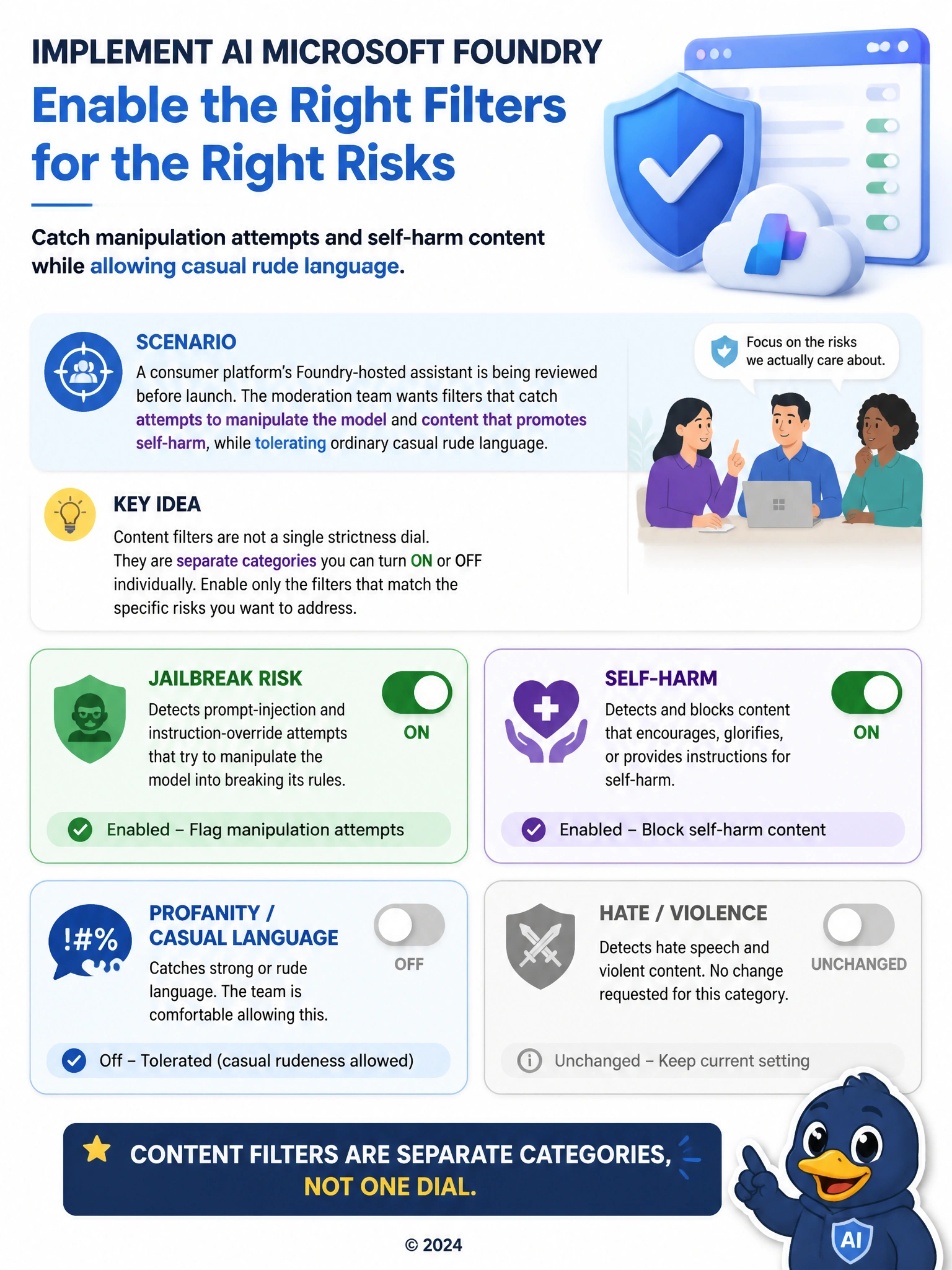
Notice that the moderation team actually named two separate risks they care about, someone trying to trick the assistant into breaking its own rules, and content that promotes hurting yourself, and neither of those is the same thing as garden-variety rude language, which the team has already said they're fine with. That distinction matters because content filtering isn't one dial you turn up or down, it's a set of separate categories you can switch on individually. So the right move is to turn on the category that watches for manipulation attempts, and separately turn on the category that watches for self-harm content, leaving casual rudeness alone since that's not what they're worried about. Cranking a strictness setting up to its max would sweep in exactly the ordinary rough language they want to allow, and turning everything off would leave both of the risks they actually care about completely unguarded. Matching each specific risk to its own specific filter is what actually gets them what they asked for.
Full Explanation
The correct answers are A and B. Enabling the jailbreak risk category specifically targets attempts to manipulate the model into bypassing its instructions, which is a distinct risk from offensive wording and needs its own filter to catch prompt-injection style attacks. Enabling the self-harm category flags and blocks content that encourages or promotes self-harm, directly addressing the second requirement the team named. Option C is incorrect because setting profanity filtering to its strictest level would block the casual rude language the team explicitly said it wants to tolerate, over-filtering ordinary conversation and frustrating a general audience rather than addressing jailbreak attempts or self-harm content. Option D is incorrect because disabling all filters removes protection against both risks the team is trying to catch, leaving the assistant exposed to instruction-override attacks and self-harm content alike, which is the opposite of what a pre-launch review is meant to prevent. Because jailbreak attempts and self-harm content are separate categories with separate filtering controls, the team needs to enable both specific categories rather than adjusting a single blanket setting.