
A logistics company is moving a Foundry-hosted chatbot from a low-traffic pilot into production, where it must serve a steady 50,000 requests per hour with predictable response times under a service-level agreement, and traffic does not fluctuate much from day to day. Which deployment approach best fits this requirement?
Select an answer to reveal the explanation.
Short Explanation
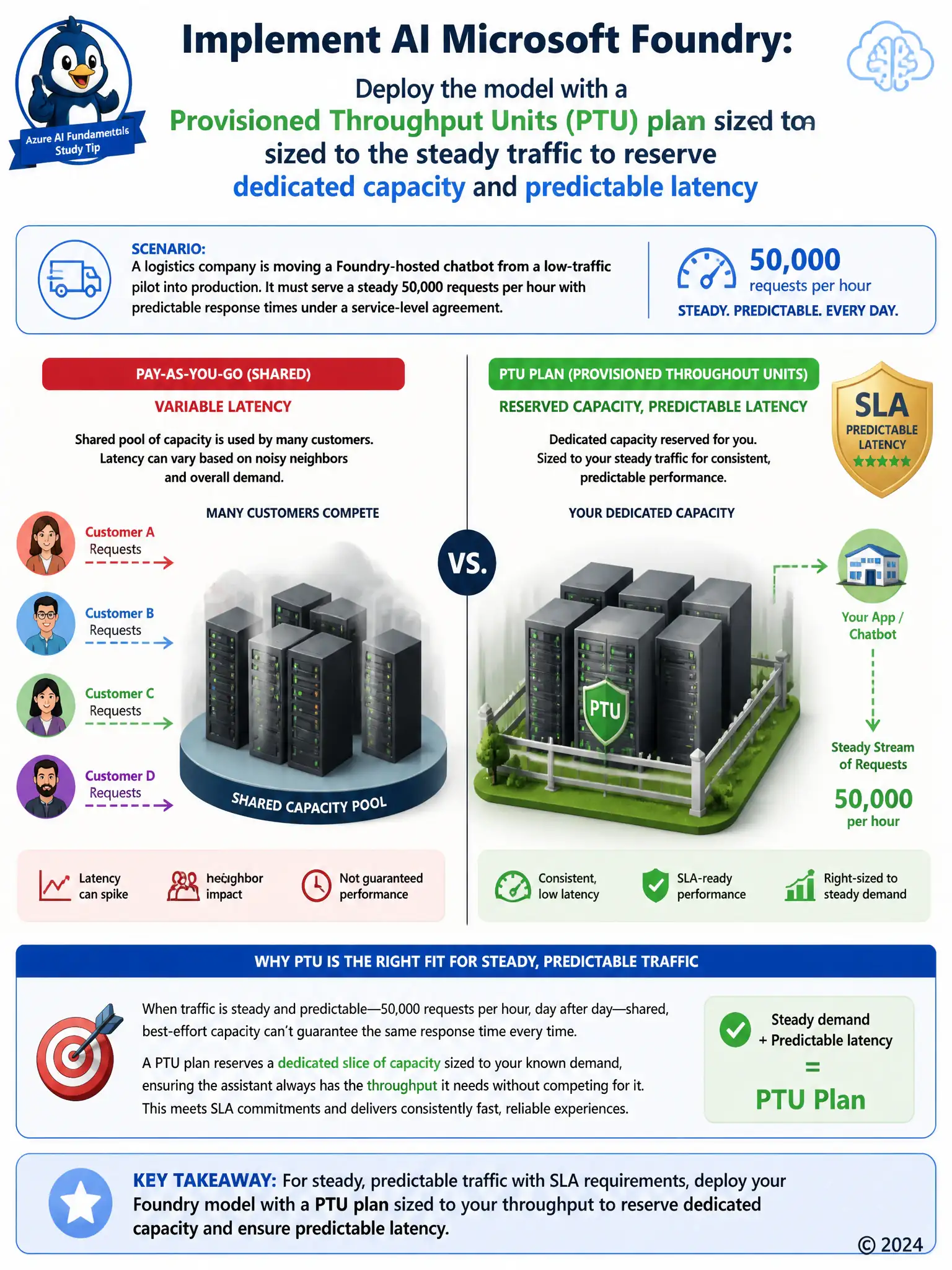
When your traffic is steady at 50,000 requests per hour, you want capacity that's reserved and sized to fit. The Provisioned Throughput Units plan sized to steady traffic reserves dedicated capacity and predictable latency, so your SLA doesn't depend on the shared pool. Cutting response length or using the weaker model just degrades the answer; it doesn't reserve capacity.
Full Explanation
The correct choice is deploying the model with the Provisioned Throughput Units (PTU) plan sized to steady traffic, because it reserves dedicated capacity sized to the company's known, steady request volume. That gives consistent latency and guaranteed headroom that the shared, best-effort tier cannot promise under the contractual SLA. The pay-as-you-go serverless API deployment used during the pilot is incorrect because it shares capacity across many customers on the same infrastructure; while convenient for the pilot with unpredictable, low volume, it does not guarantee the consistent response times the steady, high-volume SLA requires. Reducing the number of tokens allowed per response is incorrect because shrinking the response length might reduce processing time per call, but it does not change how the deployment is provisioned, and it degrades the assistant's answers to work around the capacity problem instead of solving it. Switching to the smaller, less capable model version is incorrect because it changes the quality and capability of responses rather than addressing the underlying need for reserved, predictable throughput, and traffic volume was never the model-capability problem. Since the traffic pattern here is steady and well understood in advance, reserving dedicated capacity through the provisioned deployment is the fit that matches both the volume and the latency guarantee.