
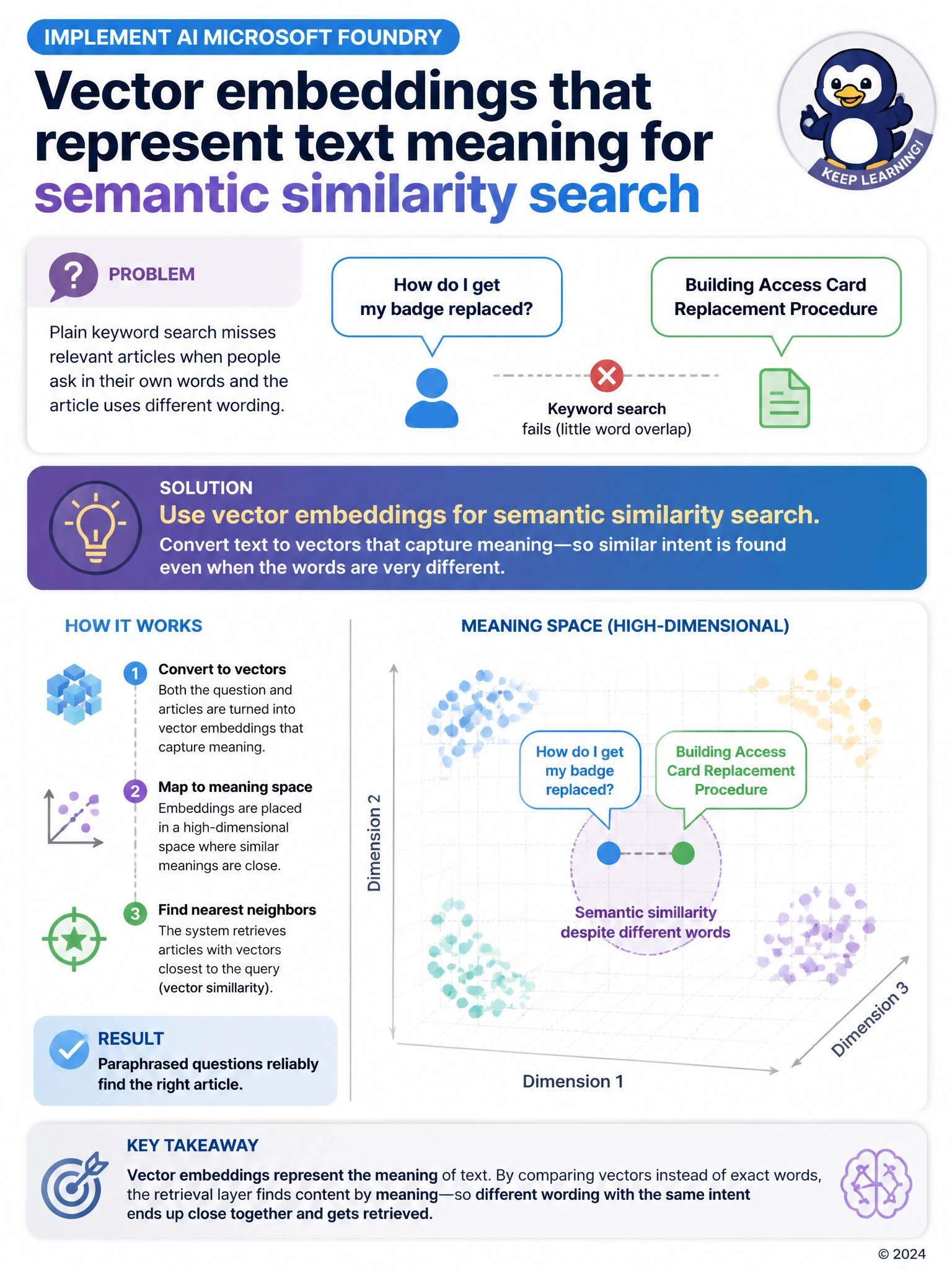
A small internal-tools team is building a wiki-search assistant so employees can ask questions in their own words, such as how do I get my badge replaced, and still find the relevant article even though its title reads Building Access Card Replacement Procedure. Plain keyword matching keeps missing these because the wording differs from the article text. Which capability should the retrieval layer use to find articles by meaning rather than exact wording?
Select an answer to reveal the explanation.
Short Explanation
The problem here isn't the assistant's writing style, it's that plain keyword search only finds an article if the words actually overlap, and people rarely phrase things the way a document title does. Someone asking about getting their badge replaced and an article titled about access card replacement mean the same thing, but share barely any words. What closes that gap is converting both the question and the article text into a representation of their meaning, so things that mean the same thing end up close together even when the wording is completely different, letting the search find the right article anyway. Making responses longer, making the wording more consistent, or filtering out inappropriate queries, none of those touch the actual problem, which is that the search step is matching text literally instead of matching by meaning. Once retrieval compares meaning instead of exact words, paraphrased questions start finding the right article reliably.
Full Explanation
The correct answer is D. Vector embeddings convert text into numerical representations of meaning, so a query like how do I get my badge replaced can be matched against an article titled Building Access Card Replacement Procedure based on semantic similarity rather than requiring shared keywords, which is exactly the gap this team is running into. Option A is incorrect because raising the maximum output token limit only allows longer generated responses, it does nothing to help the retrieval step find articles whose wording differs from the user's query. Option B is incorrect because temperature affects how varied the wording of a generated response is, it has no role in matching a search query to relevant documents by meaning. Option C is incorrect because content safety filtering blocks inappropriate or unsafe queries and responses, which is unrelated to the problem of paraphrased queries failing to match article titles. Since the core issue is that meaning-equivalent phrases are not being recognized as related by exact-text matching, the fix is a retrieval method built to compare meaning rather than literal wording, which is what embedding-based semantic search provides.