
A customer-service team deploys a Foundry-hosted chat model and wants it to always respond in a calm, formal tone, never discuss competitor products, and always identify itself as the company's assistant, across every single conversation, without support agents having to retype those instructions into each new chat session. Which Foundry capability lets them set this behavior once for the deployment?
Select an answer to reveal the explanation.
Short Explanation
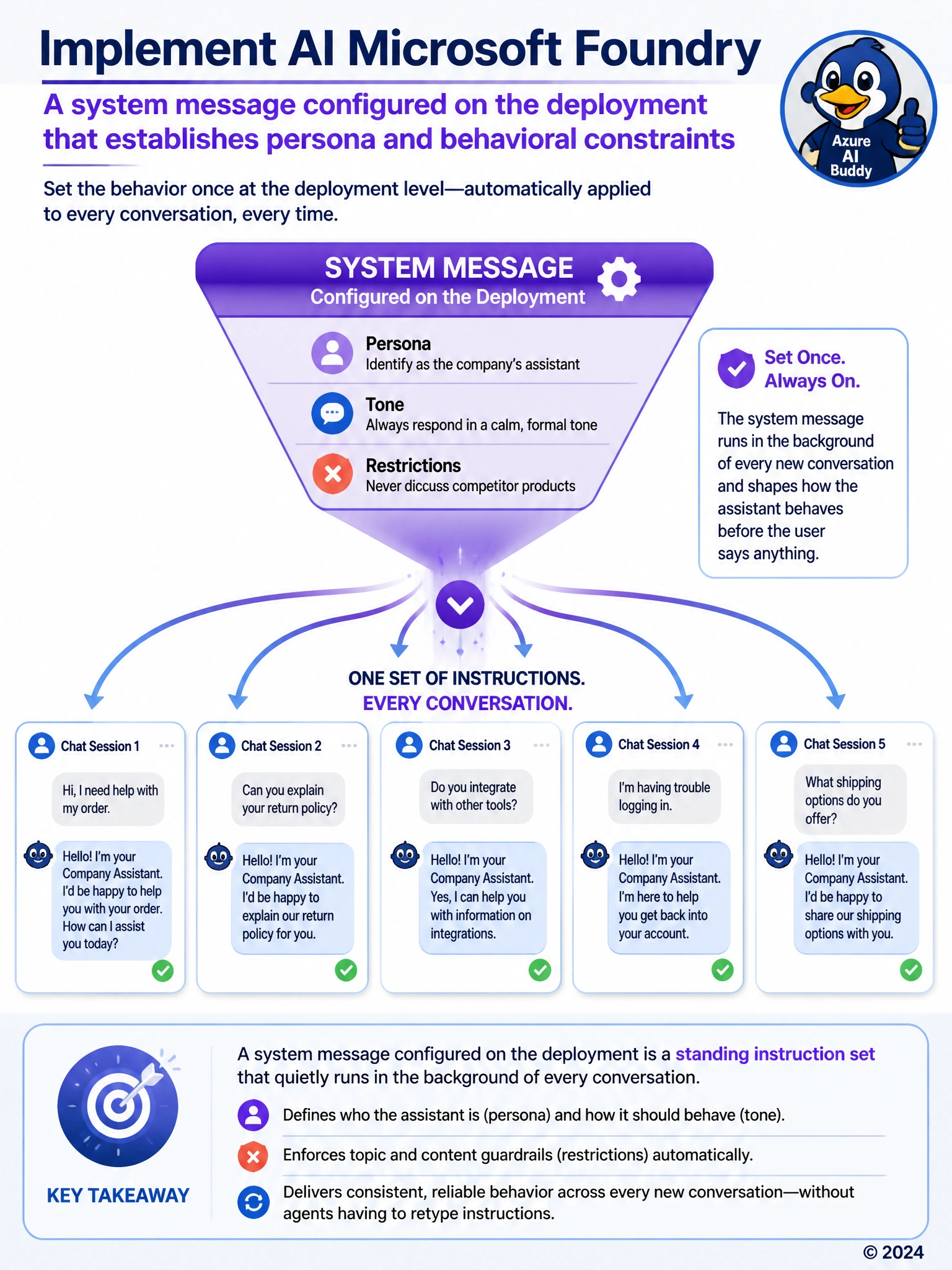
When you want a chatbot to always behave a certain way, calm, formal, never bringing up competitors, without someone having to remind it every single time a new conversation starts, you need a way to bake those rules in permanently rather than repeating them per chat. That's exactly what a standing instruction set at the deployment level does, it sits quietly in the background of every conversation and shapes how the assistant behaves before the user even types anything. Turning up variability in wording doesn't enforce a tone or a topic restriction, it just changes how creative the phrasing sounds. Letting the model see more conversation history doesn't guarantee it sticks to a persona either. And giving it the ability to look at images solves a completely different problem. What actually locks in consistent behavior across every conversation, automatically, is setting those instructions once at the deployment level rather than relying on anyone to repeat them.
Full Explanation
The correct answer is B. A system message is set once at the deployment level and is applied automatically to every conversation, letting the team define the assistant's persona, tone, and behavioral rules such as never discussing competitors without anyone having to repeat those instructions in each new session. Option A is incorrect because temperature controls how varied or unpredictable the wording of responses is, it does not establish a persistent persona or enforce a rule like avoiding competitor mentions. Option C is incorrect because a larger context window increases how much conversation text the model can take into account at once, but it does not by itself guarantee the tone or topic restrictions the team wants applied consistently. Option D is incorrect because vision capability relates to processing images, which is unrelated to enforcing a consistent tone and topic policy in text conversations. Since the requirement is a standing set of behavioral instructions applied automatically across every conversation without manual repetition, the system message is the mechanism built specifically for that purpose.