
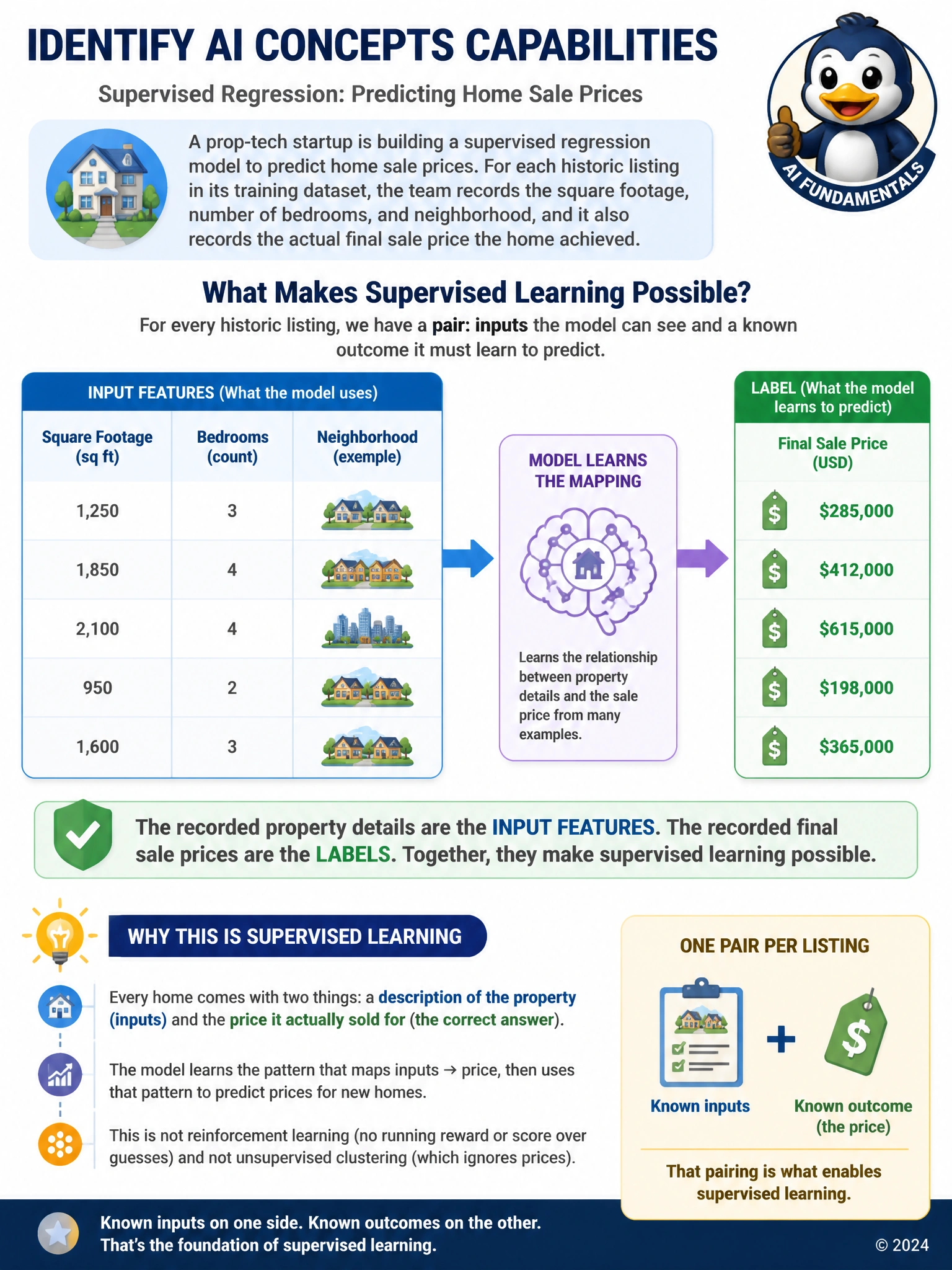
A prop-tech startup is building a supervised regression model to predict home sale prices. For each historic listing in its training dataset, the team records the square footage, number of bedrooms, and neighborhood, and it also records the actual final sale price the home achieved. (Select TWO.) Which two elements of this dataset make supervised learning possible?
Select all correct answers, then click Submit.
Short Explanation
Every home in this dataset comes with two things bundled together: a description of the property, like its square footage and bedroom count, and the price it actually sold for. That price tag is the answer key the model is trying to learn to predict, while the property details are what it is given to make that prediction from. Neither of those matches a setup where the model earns points that pile up over repeated guesses, since nothing here is scoring predictions against nearby comparable sales as a running reward. And neither matches grouping homes into clusters based on how similar they look, because clustering never looks at the sale price at all. What actually makes this supervised learning possible is exactly that pairing: known inputs on one side and a known, correct outcome on the other, for every single historic listing.
Full Explanation
The correct answers are B and C. Supervised learning requires two things paired together in the training data: input features that describe each example, and a known correct output, called a label, that the model is trained to predict from those features. Here the square footage, bedroom count, and neighborhood are the input features, and the recorded final sale price is the label the model learns to map those features onto. Option D is incorrect because this dataset contains no reward signal at all; the model is trained by comparing its prediction directly against a known recorded price, not by accumulating a score over repeated actions the way a reinforcement learning agent would. Option A is incorrect because cluster assignments belong to unsupervised learning, where groups are formed purely from similarity between examples with no reference to an outcome like price; this dataset instead pairs every example with its actual sale price, which is precisely what clustering does not require.