
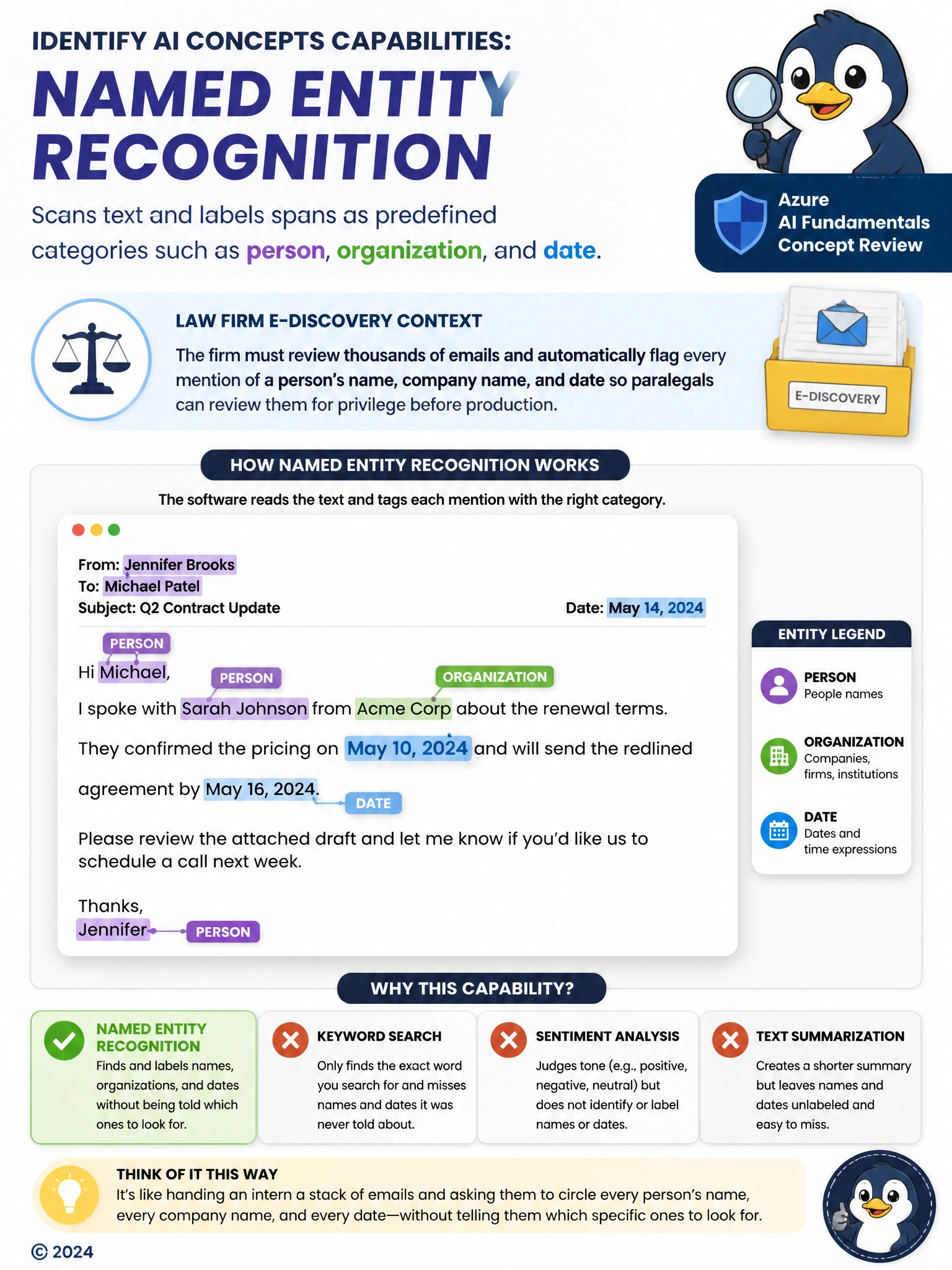
A law firm's e-discovery team must review thousands of emails collected for a case and automatically flag every mention of a person's name, company name, and date so paralegals can review them for privilege before production. The firm wants software that scans the plain text of each email and picks out these specific categories of words, rather than just searching for a single keyword typed by a user. Which AI capability should the firm use?
Select an answer to reveal the explanation.
Short Explanation
Picture handing an intern a stack of emails and asking them to circle every person's name, every company name, and every date, without telling them in advance which specific names to look for. That is a very different job from searching for one word you already know is in there, since a plain keyword search cannot find names it was never told about. It is also not about judging whether an email sounds upset or friendly, and it is not about shrinking a long email down into a two-sentence recap either, since both of those leave the actual names and dates unlabeled and easy to miss. What the review team needs is software that reads the text and tags each mention with the right category as it goes, person, company, or date, so paralegals can scan straight to the flagged spans instead of rereading every message end to end.
Full Explanation
The correct answer is B. The firm needs software that reads unstructured email text and automatically labels specific spans as belonging to predefined categories, such as person names, organization names, and dates, so paralegals can jump straight to those mentions instead of reading every line. That capability is named entity recognition, a natural language processing task built for exactly this kind of structured extraction from free text. Option A is incorrect because keyword search only returns documents containing an exact term a user types in advance; it cannot discover every person, company, and date across thousands of emails without the reviewer already knowing what to search for. Option C is incorrect because sentiment analysis scores the emotional tone of text as positive, negative, or neutral, which has nothing to do with identifying names or dates. Option D is incorrect because text summarization condenses a document's overall meaning into a shorter passage, which would blur or drop the very entity details the review team needs to preserve and flag individually.