
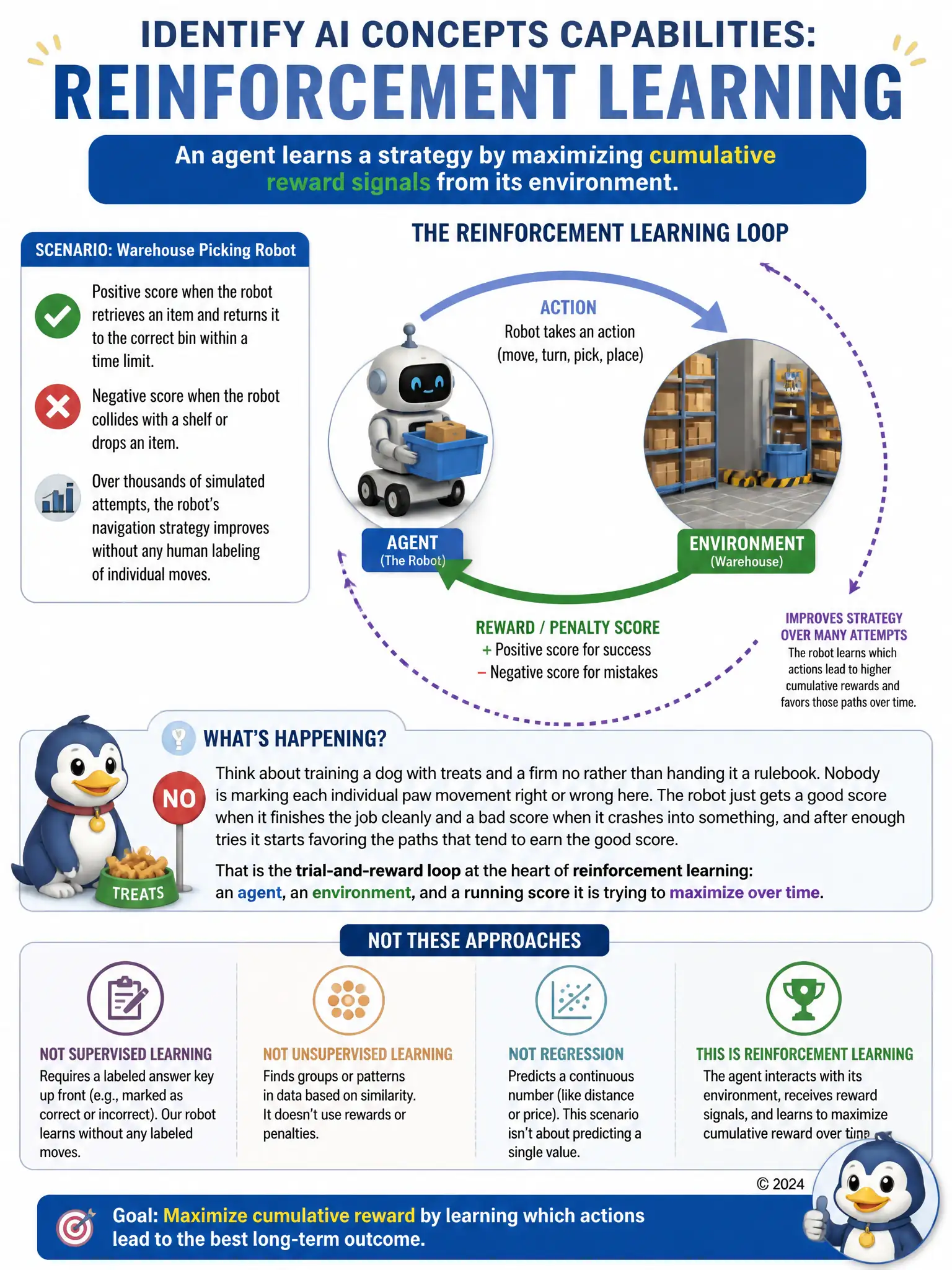
A robotics engineering team is training a warehouse picking robot in a simulated environment. The robot receives a positive score each time it retrieves an item and returns it to the correct bin within a time limit, and a negative score whenever it collides with a shelf or drops an item. Over thousands of simulated attempts, the robot's navigation strategy improves without any human labeling individual moves as right or wrong. Which type of machine learning approach is being used?
Select an answer to reveal the explanation.
Short Explanation
Think about training a dog with treats and a firm no rather than handing it a rulebook. You're using reinforcement learning because the robot gets positive and negative scores for outcomes and learns by maximizing cumulative reward over many attempts. It isn't supervised learning, clustering, or regression because there's no labeled answer key, no similarity grouping, and no single continuous prediction.
Full Explanation
The correct approach is reinforcement learning, where an agent learns a strategy by maximizing cumulative reward signals from its environment. The robot is not being told which specific action is correct or incorrect at each step; instead, it experiences positive and negative scores that accumulate over an entire simulated attempt, and it adjusts its strategy over many episodes to maximize that cumulative reward. This trial-and-reward pattern, where an agent interacts with an environment and gradually improves its behavior from feedback signals rather than labeled examples, defines reinforcement learning. The supervised learning approach is incorrect because supervised learning requires a training dataset where a human has already labeled each example with the correct output; here, no one is labeling individual robot movements as right or wrong. The unsupervised clustering approach is incorrect because unsupervised clustering groups data points by similarity in the absence of any feedback signal, while this robot's behavior is explicitly shaped by reward and penalty scores tied to outcomes. The regression approach is incorrect because regression is a supervised technique for predicting a continuous numeric value from labeled input-output pairs, not a description of an agent improving a multi-step strategy through accumulated reward over time.