
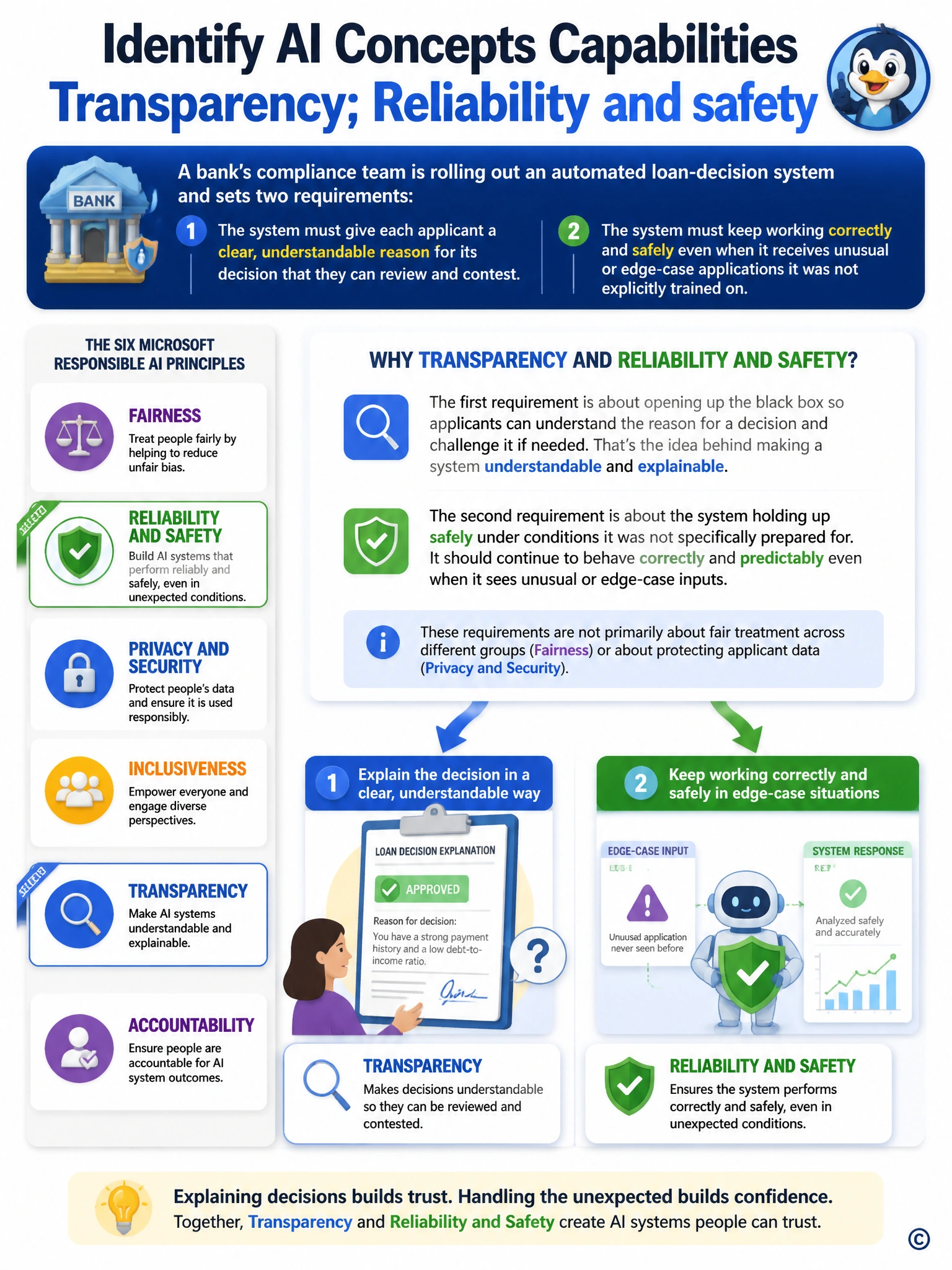
A bank's compliance team is rolling out an automated loan-decision system and sets two requirements: first, the system must be able to give each applicant a clear, understandable reason for its decision that they can review and contest; second, the system must keep working correctly and safely even when it receives unusual or edge-case applications it was not explicitly trained on. Which two Microsoft responsible AI principles do these requirements most directly reflect? (Select TWO.)
Select all correct answers, then click Submit.
Short Explanation
This scenario is really describing two separate promises the bank is making. The first promise - give applicants a reason they can actually understand and push back on - is about opening up the black box so decisions are not a mystery, which is the idea behind making a system understandable and explainable. The second promise - keep behaving correctly even when an application looks nothing like what the system was trained on - is about the system holding up safely under conditions it was not specifically prepared for, rather than breaking or behaving unpredictably. Neither promise is really about comparing outcomes across different groups of people, which is a related but separate concern about equitable treatment. And neither is about keeping applicant data locked down and protected from misuse, which is its own separate concern about safeguarding information. Because the two requirements are specifically about explaining decisions and holding up reliably in unfamiliar situations, they point to two particular principles rather than the ones focused on equity or data protection.
Full Explanation
The correct answers are C and D. Transparency is the principle that AI systems should be understandable, including providing explanations for decisions that affect people, which directly matches the requirement that applicants receive a clear, contestable reason for each decision. Reliability and safety is the principle that AI systems should perform consistently and safely across the range of conditions they may encounter, including situations not explicitly covered in training, which matches the requirement that the system keep functioning correctly on unusual or edge-case applications. Option B is incorrect because fairness concerns whether the system treats individuals and groups equitably and avoids reinforcing discrimination, which is a distinct concern from explaining decisions or handling edge cases robustly; the scenario does not mention comparing outcomes across demographic groups. Option A is incorrect because privacy and security concerns protecting applicants' personal data from unauthorized access or misuse, which is unrelated to either explaining a decision or handling unfamiliar inputs safely. Because the two stated requirements map specifically to explainability and to robust, safe operation under uncertainty rather than to equitable treatment or data protection, transparency and reliability and safety are the principles being described.