
A subscription news outlet has 15,000 archived articles all written in a very distinctive, consistent editorial voice. They want a Foundry-hosted model to draft new articles that reliably match this voice without needing the voice guidelines repeated in every prompt.
Select an answer to reveal the explanation.
Short Explanation
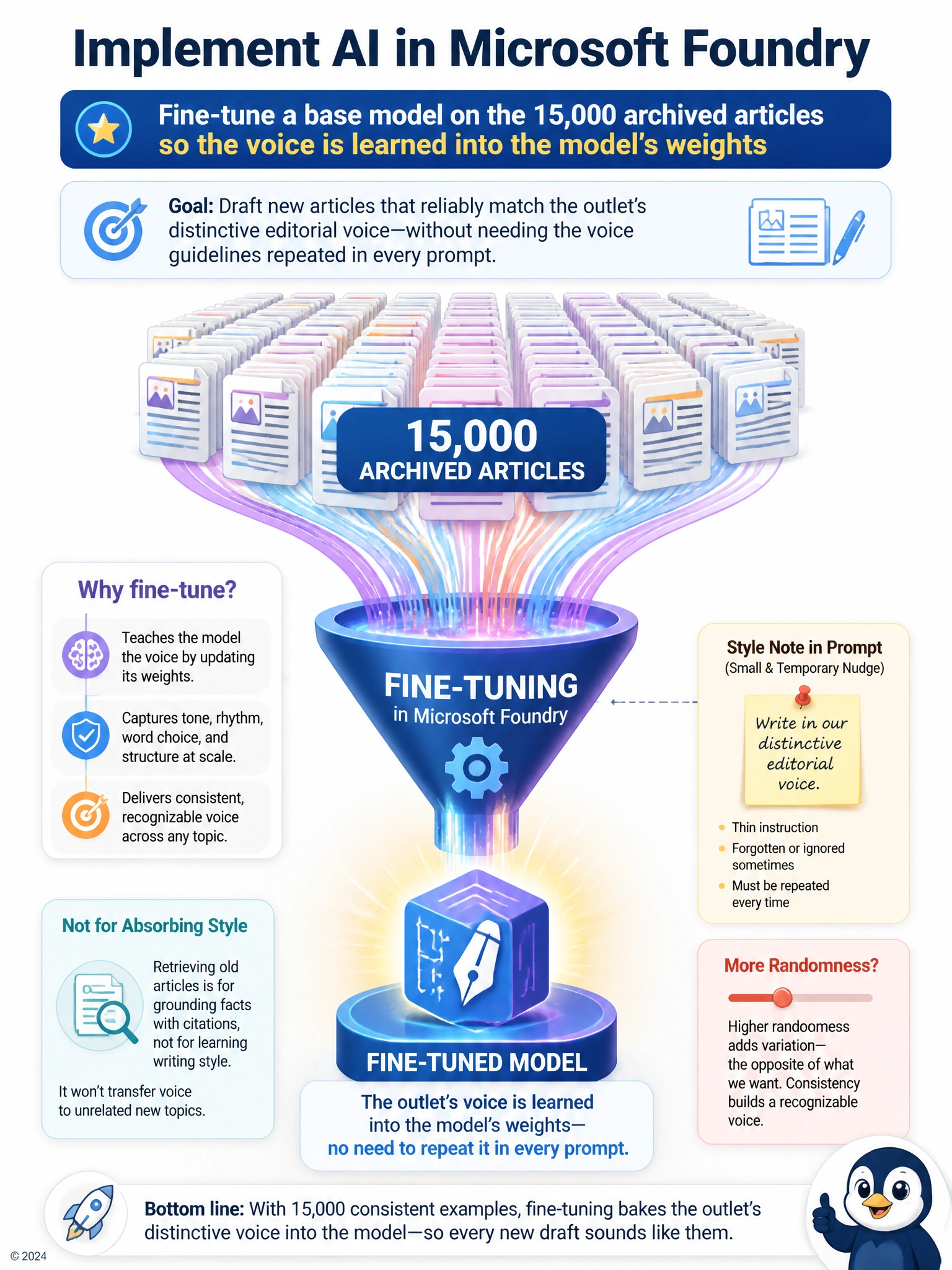
With fifteen thousand examples of the exact same distinctive voice sitting in the archive, that's more than enough raw material to actually teach a model the style itself, baking it into how the model writes rather than hoping a few sentences of instruction stick every single time. A quick style note in the system message is fine for a rough nudge, but it's thin compared to what fifteen thousand consistent examples could actually train into the model, and it has to be repeated and hoped for each time. Pulling in random old articles as citations is really meant for grounding facts an assistant can point back to, not for absorbing a writing style, so it wouldn't transfer voice to unrelated new topics. And cranking up randomness in the output does the opposite of what's wanted here, since the goal is a consistent, recognizable voice, not more variation.
Full Explanation
The correct answer is D. With 15,000 consistent examples of a distinctive editorial voice available, fine-tuning a base model on that archive lets the voice pattern get learned directly into the model's weights, so new drafts reliably reflect the style without repeating instructions in every prompt, which is exactly the scale of example set fine-tuning is suited for. Option A is incorrect because a short system message can nudge tone somewhat, but three sentences cannot capture the nuance of a voice built from 15,000 examples, and the outlet explicitly wants reliability without repeating guidance each time. Option B is incorrect because retrieval-augmented generation is meant to ground factual answers in specific source documents for citation, not to teach a model a general writing style; pulling in random articles as citations would not make new, unrelated drafts sound consistently on-voice. Option C is incorrect because raising temperature increases randomness and variety in output, which works against the goal of consistent, reliable voice matching rather than supporting it.